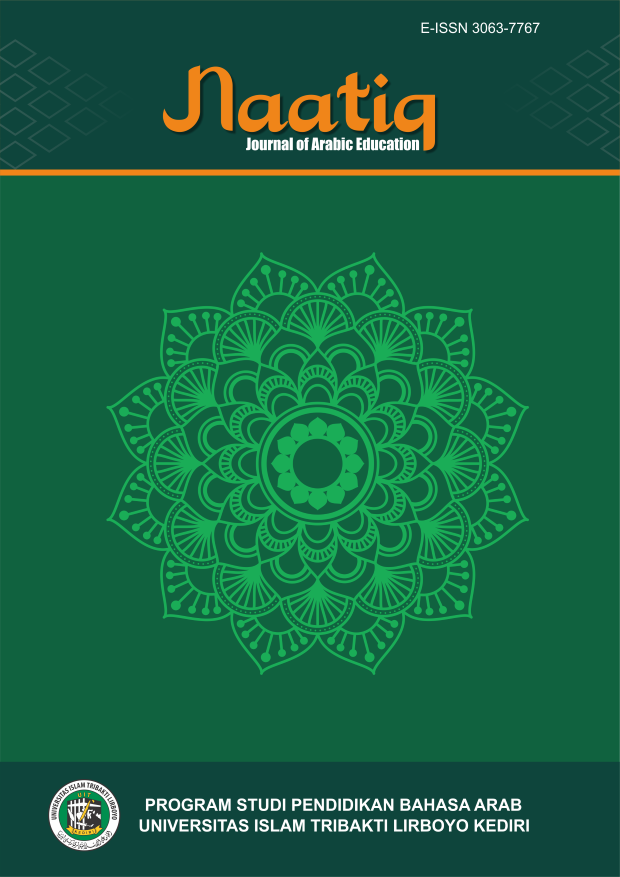
The Interventional Role of Arabic Teachers in Senior Secondary Schools’ Arabic Drama Instructional Classes in Ilorin, Nigeria
DOI:
https://doi.org/10.33367/naatiq.v2i2.7791Keywords:
Arabic Drama Pedagogy, Teacher Intervention Strategies, Cognitive Engagement, Language Learning, Arabic InstructionAbstract
Arabic drama is a distinct literary genre crucial in enhancing students’ linguistic proficiency, cultural understanding, and interpretative skills. However, in many Nigerian secondary schools, particularly in Ilorin, Arabic drama remains underutilised due to the limited pedagogical capacity of Arabic teachers and insufficient instructional integration. This paper investigates the interventional role of Arabic teachers in facilitating the teaching and learning of Arabic drama in senior secondary schools. This research explores how Arabic teachers function beyond traditional instruction by identifying student needs, adapting instructional strategies, and promoting cultural and performance-based learning within Arabic drama classes. The paper adopts a conceptual-descriptive approach, relying on an extensive review of academic literature, curriculum documents, drama texts and expert reflections. The findings reveal that qualified Arabic teachers significantly enhance students’ engagement and performance in Arabic drama by acting as facilitators, directors, counsellors and cultural interpreters. Teachers who integrate performance techniques, differentiated instruction and contextualised drama content contribute to improved language fluency, creative expression and cultural literacy among learners. The paper concludes that integrating qualified Arabic teachers into drama instruction is essential for enriching Arabic language education. It contributes a conceptual framework for rethinking Arabic drama pedagogy. It highlights the need for curriculum reform, teacher training and institutional support to optimise the interventional capacity of Arabic educators in Nigerian secondary schools.
 Abstract
Views:
106,
Abstract
Views:
106,  PDF downloads: 74
Published
Issue
Section
License
Copyright (c) 2025 Tunde Ahmed Alfabani

This work is licensed under a Creative Commons Attribution-ShareAlike 4.0 International License.