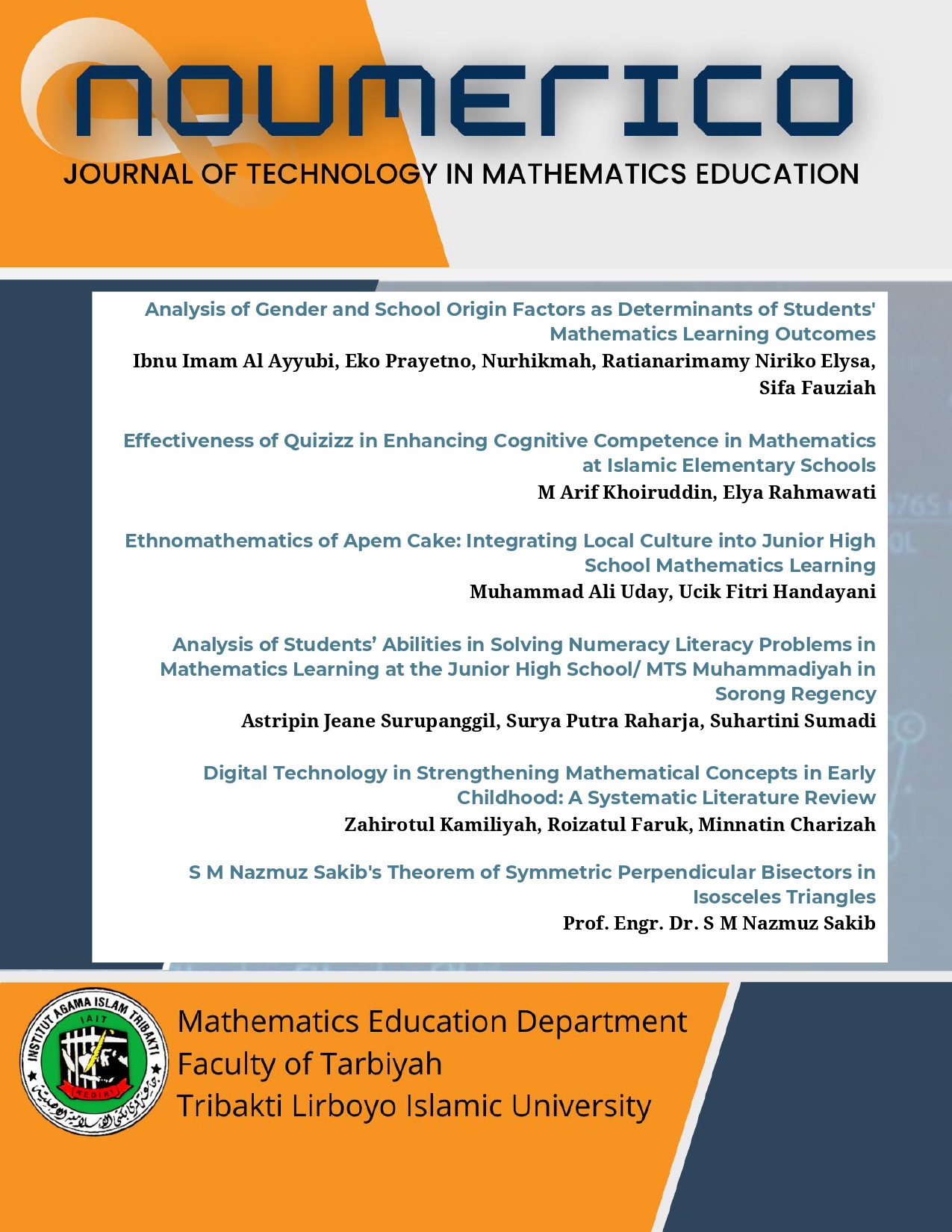
Analysis of Gender and School Origin Factors as Determinants of Students' Mathematics Learning Outcomes
DOI:
https://doi.org/10.33367/jtme.v3i2.6701Keywords:
Learning Outcomes, Mathematics, Statistical Tests, Elementary EducationAbstract
This study aims to investigate the impact of gender and school origin on mathematics learning outcomes. Specifically, the study will analyze whether there are significant differences in mathematical ability between male and female students, and evaluate whether learning outcomes differ between students from public and private schools. The research was conducted at three different schools: MI Muslimin Bojongranca, MI Muslimin Cipongkor 1, and SDN Pasir Banteng in West Bandung Regency, specifically in grade V. A quantitative approach with an Ex Post Facto method was applied, and the data were analyzed using descriptive and inferential statistics. The results indicate that school origin significantly affects students’ mathematics learning outcomes, with students from MI Muslimin Cipongkor 1 achieving higher average scores compared to those from MI Muslimin Bojongranca. Meanwhile, no significant differences were found between male and female students. The analysis was continued using non-parametric tests. This study recommends that schools enhance the quality of teaching and learning facilities to improve students’ outcomes, and future research may explore other factors influencing mathematics achievement.
References
Abbas, A. B., & Rizki, N. A. (2023). Mediasi regulasi diri atas pengaruh lingkungan belajar terhadap hasil belajar matematika Siswa SMP. Primatika: Jurnal Pendidikan Matematika, 12(1), 51–60. https://doi.org/https://doi.org/10.30872/primatika.v12i1.2108
Al Ayyubi, I. I., Bukhori, H. A., Komara, C., Yulianti, E., & Mahriah, E. (2024). Pengaruh Model Cooperative Learning terhadap Hasil Belajar Matematika dalam Keberagaman Peserta Didik. Journal of Nusantara Education, 3(2), 30–38. https://doi.org/https://doi.org/10.57176/jn.v3i2.94
Al Ayyubi, I. I., Hayati, A. F., Azizah, E. N., Herdiansyah, R., & Mirayanti, U. (2024). Pendidikan Humanis Paulo Freire Dalam Pembelajaran Matematika MI. Wulang: Jurnal Pendidikan Guru Madrasah Ibtidaiyah, 1(1), 1–15. http://ojs.staisdharma.ac.id/index.php/wjp/article/view/178
Al Ayyubi, I. I., Nudin, E., & Bernard, M. (2018). Pengaruh pembelajaran berbasis masalah terhadap kemampuan pemecahan masalah matematis siswa SMA. JPMI (Jurnal Pembelajaran Matematika Inovatif), 1(3), 355–360. https://doi.org/https://doi.org/10.22460/jpmi.v1i3.p355-360
Al Ayyubi, I. I., Prayetno, E., Annastasya, T., & Rahmawati, S. (2025). The Influence of Islamic Religious Education (PAI) on Students’ Mathematical and Logical Thinking Skills in Junior High School. IJEMR: International Journal of Education Management and Religion, 2(1), 1–14. https://doi.org/https://doi.org/10.71305/ijemr.v2i1.168
Al Ayyubi, I. I., Rohaendi, N., Herdiansyah, R., & Puspita, T. (2024). Implementasi Model Problem Based Learning pada Pembelajaran Matematika. Tadrusuun: Jurnal Pendidikan Dasar, 3(1), 206–216. https://doi.org/https://doi.org/10.62274/tadrusuun.v3i1.121
Al Ayyubi, I. I., Rohmatulloh, R., Suryana, I., & Wijaya, T. T. (2024). Improving Students’ Creative Thinking Skills Assisted by GeoGebra Software. Noumerico: Journal of Technology in Mathematics Education, 2(1), 23–34. https://doi.org/https://doi.org/10.33367/jtme.v2i1.4244
Alam, A. (2020). What is the’Philosophy of Chemistry Education’? Viewing Philosophy behind Educational Ideas in Chemistry from John Dewey’s Lens: The Curriculum and the Entitlement to Knowledge. PalArch’s Journal of Archaeology of Egypt/Egyptology, 17(9), 6857–6889. https://archives.palarch.nl/index.php/jae/article/download/5303/5219
Budiharso, T., & Tarman, B. (2020). Improving quality education through better working conditions of academic institutes. Journal of Ethnic and Cultural Studies, 7(1), 99–115. https://www.jstor.org/stable/48710249
Christidamayani, A. P., & Kristanto, Y. D. (2020). The Effects of Problem Posing Learning Model on Students’ Learning Achievement and Motivation. Indonesian Journal on Learning and Advanced Education (IJOLAE), 2(2), 100–108. https://doi.org/10.23917/ijolae.v2i2.9981
Dahri, N. A., Yahaya, N., Al-Rahmi, W. M., Aldraiweesh, A., Alturki, U., Almutairy, S., Shutaleva, A., & Soomro, R. B. (2024). Extended TAM based acceptance of AI-Powered ChatGPT for supporting metacognitive self-regulated learning in education: A mixed-methods study. Heliyon, 10(8), e29317. https://doi.org/https://doi.org/10.1016/j.heliyon.2024.e29317
Dewi, S. P., Maimunah, M., & Roza, Y. (2021). Analisis kemampuan komunikasi matematis siswa pada materi lingkaran ditinjau dari perbedaan gender. Jurnal Kependidikan: Jurnal Hasil Penelitian Dan Kajian Kepustakaan Di Bidang Pendidikan, Pengajaran Dan Pembelajaran, 7(3), 699–707. https://doi.org/https://doi.org/10.33394/jk.v7i3.3687
Liljedahl, P., & Cai, J. (2021). Empirical research on problem solving and problem posing: a look at the state of the art. ZDM - Mathematics Education, 53(4), 723–735. https://doi.org/10.1007/s11858-021-01291-w
Mandasari, N., & Rosalina, E. (2021). Analisis Kesulitan Siswa dalam Menyelesaikan Soal Operasi Bilangan Bulat di Sekolah Dasar. Jurnal Basicedu, 5(3), 1139–1148. https://doi.org/10.31004/basicedu.v5i3.831
Manurung, A. S., Halim, A., & Rosyid, A. (2020). Pengaruh Kemampuan Berpikir Kreatif untuk meningkatkan Hasil Belajar Matematika di Sekolah Dasar. Jurnal Basicedu, 4(4), 1274–1290. https://doi.org/https://doi.org/10.31004/basicedu.v4i4.544
Marlina, R., & Auliya, D. (2021). Minat Belajar Siswa dan Hasil Belajar Matematika Ditinjau dari Jenis Kelamin. Jurnal Ilmiah Pendidikan Matematika, 6(2), 179–193.
Maulidya, N. S., & Nugraheni, E. A. (2021). Analisis Hasil Belajar Matematika Peserta Didik Ditinjau dari Self Confidence. Jurnal Cendekia : Jurnal Pendidikan Matematika, 5(3), 2584–2593. https://doi.org/10.31004/cendekia.v5i3.903
Mutaqin, M. Z., Lestari, D. A., Solihin, S., Al-Ayyubi, I. I., & Rahmawati, S. (2024). Factors in Religious Culture to Increase Tolerant Attitude of Gen-Z Among Urban Muslims. Akademika: Jurnal Pemikiran Islam, 29(1), 73–86. https://doi.org/https://doi.org/10.32332/akademika.v29i1.9145
Nurhikmah, N. (2024). Character Education Islam From the Views of Imam Al-Ghazali. Jurnal Al Burhan, 4(1), 53–66. https://doi.org/10.58988/jab.v4i1.300
Rachman, A., Yochanan, E., Samanlangi, A. I., & Purnomo, H. (2024). Metode Penelitian Kuantitatif, Kualitatif, dan R&D. Saba Jaya Publisher.
Rahim, A., Nursalam, Suhartatik, Nurhikmah, & Akhiruddin. (2024). Konsep Ideologi Sastra Lisan Doangang Makassar dalam. Jurnal Onoma: Pendidikan, Bahasa, Dan Sastra, 10(3), 3274–3282.
Ridho’i, M. (2022). Analisis Faktor-Faktor yang Mempengaruhi Hasil Belajar Matematika Siswa MTs Miftahul Ulum Pandanwangi. JURNAL E-DuMath, 8(2), 118–128. https://doi.org/10.52657/je.v8i2.1809
Rosdiana, Muhammad Yaumi, Nurhikmah, & Suharti. (2022). Analysis of the Values of Character Education in the Thematic Textbook VII “Events in Life” For Class v Students. AULADUNA: Jurnal Pendidikan Dasar Islam, 9(2), 199–216. https://doi.org/https://doi.org/10.24252/auladuna.v9i2a7.20
Rosmaiyadi, Buyung, & Hartianingsih, S. (2023). Analysis Of Mathematical Critical Thinking Skills In Terms Of Gender In Class VIII Material of Cube. Jurnal Pendidikan Matematika Indonesia, 8(1), 11–24.
Sabat, A. O., Mardiyana, & Pramudya, I. (2021). Gender Difference: Students’ Mathematical Literacy in Problem Solving. Proceedings of the International Conference of Mathematics and Mathematics Education (I-CMME 2021), 597, 25–30. https://doi.org/10.2991/assehr.k.211122.004
Subekti, M. R., Kurniati, A., & Firda, T. (2021). Analisis Minat Belajar Matematika Siswa Kelas IV SDN 25 Gurung Peningkah Kayan Hilir Tahun 2020/2021. J-PiMat : Jurnal Pendidikan Matematika, 3(2), 417–426. https://doi.org/10.31932/j-pimat.v3i2.1376
Subhaktiyasa, P. G. (2024). Menentukan Populasi dan Sampel: Pendekatan Metodologi Penelitian Kuantitatif dan Kualitatif. Jurnal Ilmiah Profesi Pendidikan, 9(4), 2721–2731. https://doi.org/10.29303/jipp.v9i4.2657
Sulistya, A., & Susanto, R. (2023). Analysis of students’ learning difficulties in mathematics on the concept of mixed devotion materials. Education and Social Sciences Review, 4(1), 10–16.
Syavira, V. F., & Novtiar, C. (2021). Analisis Kesalahan Pemecahan Masalah Matematis Siswa dalam Menyelesaikan Soal Operasi Hitung Campuran Bilangan Cacah dan Pecahan. JPMI (Jurnal Pendidikan Matematika Indonesia), 4(6), 1671–1678. https://doi.org/10.22460/jpmi.v4i6.1671-1678
Tamphu, S., Suyitno, I., Susanto, G., Budiana, N., & Salim, M. R. (2024). Building bridges to the future of learning : Exploring artificial intelligence research using R- Studio assisted bibliometrics. Cogent Education, 11(1). https://doi.org/10.1080/2331186X.2024.2417623
Tijsma, G., Hilverda, F., Scheffelaar, A., Alders, S., Schoonmade, L., Blignaut, N., & Zweekhorst, M. (2020). Becoming productive 21st century citizens: A systematic review uncovering design principles for integrating community service learning into higher education courses. Educational Research, 62(4), 390–413. https://doi.org/10.1080/00131881.2020.1836987
Wilkie, K. J., & Roche, A. (2023). Primary teachers’ preferred fraction models and manipulatives for solving fraction tasks and for teaching. Journal of Mathematics Teacher Education, 26(6), 703–733. https://doi.org/10.1007/s10857-022-09542-7
 Abstract
Views:
144,
Abstract
Views:
144,  PDF downloads: 81
Published
Issue
Section
License
Copyright (c) 2025 Ibnu Imam Al Ayyubi, Eko Prayetno, Nurhikmah, Ratianarimamy Niriko Elysa, Sifa Fauziah

This work is licensed under a Creative Commons Attribution-ShareAlike 4.0 International License.