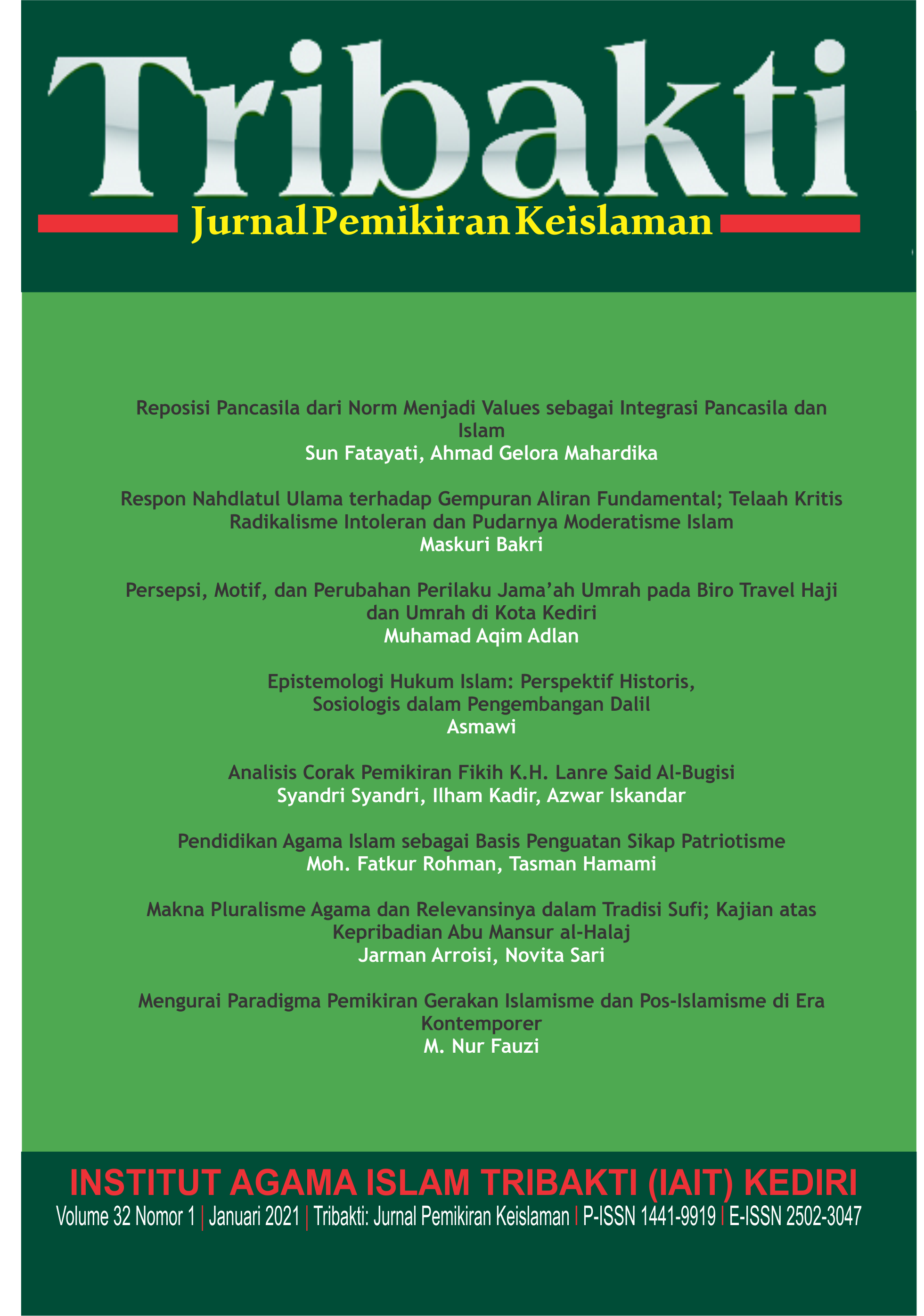
Reposisi Pancasila dari Norm Menjadi Values sebagai Integrasi Pancasila dan Islam
DOI:
https://doi.org/10.33367/tribakti.v32i1.1404Keywords:
Integration, Islam, Norm, Pancasila, ValuesAbstract
Pancasila and Islam are two ideologies that are often seen as different. This can be seen from the history of the Indonesian state administration where it is recorded that Pancasila was used as a tool for the Government to dissolve organizations and parties with Islamic nuances, namely Masyumi and HTI. The contradiction was caused by the Government placing Pancasila as part of legal norms, not values. Even though the consequence of placing Pancasila as a legal norm should be that there should also be an agency authorized to conduct trials. However, unlike other legal norms, there is no single institution that has the authority to test Pancasila. In addition, according to experts, Pancasila is a building of values which is the way of life of the Indonesian people. The research method in this article is normative juridical. The result states that Pancasila should be positioned as a value, not as a legal norm.
References
Asmaroini, Ambiro Puji. “Menjaga Eksistensi Pancasila Dan Penerapannya Bagi Masyarakat Di Era Globalisasi.†JPK: Jurnal Pancasila Dan Kewarganegaraan 2, no. 1 (2017): 1–14.
Awan, Muzaffar. “Indonesia ’ s Democracy and Tolerant Islam.†Defence Journal 17, no. 5 (2010): 23–27. https://search.proquest.com/docview/1474345645/fulltext/63592A4774714C74PQ/4?accountid=46437.
Azizah, Nurul. “Ideologi Gerakan Kahar Mudzakkar Di Sulawesi Selatan 1952-1965.†Pemikiran Keislaman 15, no. 2 (2019): 95–104.
Brata, Ida Bagus, and Ida Bagus Nyoman Wartha. “Lahirnya Pancasila Sebagai Pemersatu Bangsa Indonesia.†Jurnal Santiaji Pendidikan 7, no. 1 (2017): 120–32.
Fassi, Marisa. “Legal Ambiguity As A Site Of Power And Resistance: Sex Work And The Police In Córdoba-Argentina.†Zhurnal Issledovanii Sotsialnoi Politiki = The Journal of Social Policy Studies 12, no. 2 (2014): 275–86.
Fauzi, Agus. “Agama, Pancasila Dan Konflik Sosial Di Indonesia.†E-Journal Lentera Hukum 4, no. 2 (2017): 122. https://doi.org/10.19184/ejlh.v4i2.5295.
Hardinanto, Aris. “Untuk Menyelidiki Usaha-Usaha Persiapan Kemerdekaan Diterjemahkan Sebagai Badan Penyelidik Usaha Persiapan Kemerdekaan.†Veritas 3, no. 1 (1945): 43–64.
Hartono, Yudi. “Model Pembelajaran Nilai-Nilai Karakter Bangsa Di Indonesia Dari Masa Ke Masa.†Agastya: Jurnal Sejarah Dan Pembelajarannya 7, no. 01 (2017): 34–48. https://doi.org/10.25273/ajsp.v7i01.1059.
Irsyadillah Irsyadillah, and Alhashmi Aboubaker Lasyoud. “Does Accounting Education Develop Ethical Maturity? Evidence from Indonesia.†Journal of Accounting and Management Information Systems 17, no. 3 (2018): 462–83. https://doi.org/10.24818/jamis.2018.03007.
Mahardika, Ahmad Gelora. “Menggali Nilai-Nilai Kebangsaan Dalam Pancasila Sebagai Groundnorm Negara Kesatuan Republik Indonesia.†Ahkam 6, no. 2 (2018): 267–92.
Malau, Parningotan, and Alvi Syahrin. “An Obligation of Corporate Criminal Liability in the Case of Non-Implementation of Occupational Health and Safety (OHS).†Journal of Advanced Research in Law and Economics 11, no. 1 (2020): 121–35. https://doi.org/10.14505/jarle.v11.1(47).16.
Maroni, Sopian Sitepu, and Nenny Dwi Ariani. “Humanistic Law Enforcement as the Application of the Value of Justice, Expediency and Legal Certainty Based on Pancasila.†Journal of Legal, Ethical and Regulatory Issues 22, no. 4 (2019): 1–6.
Novita Eleanora, Fransiska. “Pancasila Sebagai Norma Dasar Dalam Sistem Hukum Indonesia.†ADIL: Jurnal Hukum 3, no. 1 (2019): 141. https://doi.org/10.33476/ajl.v3i1.838.
Posha, Beti Yanuri. “Perkembangan Islam Di Indonesia Pasca Kemerdekaan.†Historia 3, no. 2 (2015): 75–82.
Pratiwi, Sapti Eka. “Pembubaran Partai Politik Di Indonesia Pada Masa Demokrasi Terpimpin.†Avatara 4, no. 3 (2016): 1059–70.
Rohman, M Saifullah. “Kandungan Nilai-Nilai Syariat Islam Dalam Pancasila.†Jurnal Studi Agama Millah 13, no. 1 (2013): 205–15. http://www.nu.or.id/a,public-m,dinamic-s,detail-ids,4-id,40159-lang,id-c,kolom-t,Pancasi.
Rusli, Ris’an. “The State Concept: The Political Thinking of Mohammad Natsir.†International Journal of Islamic Thought 13, no. 1 (2018): 105–18. https://doi.org/10.24035/ijit.06.2018.010.
Susanto. “Pancasila Sebagai Identitas Dan Nilai Luhur Bangsa: Analisis Tentang Peran Pancasila Sebagai Modal Sosial Berbangsa Dan Bernegara.†Jurnal Ilmiah Ilmu Pemerintahan 2, no. 1 (2017): 44–52. https://doi.org/10.14710/jiip.v2i1.1634.
Suwirta, Andi. “Pers Dan Kritik Sosial Pada Masa Orde Baru: Studi Kasus Pers Mingguan Mahasiswa Indonesia Di Bandung, 1966-1974.†Mimbar Pendidikan 3, no. 2 (2018): 113–36. https://doi.org/10.17509/mimbardik.v3i2.13949.
Syarif, Mujar Ibnu. “Spirit Piagam Jakarta Dalam Undang-Undang Dasar 1945.†Jurnal Cita Hukum 4, no. 1 (2016): 15–32. https://doi.org/10.15408/jch.v4i1.3568.
Utama, Wildan Sena. “Ulasan Buku Pancasila : Sebuah Monumen Atau Leitstar Dinamis ?†Negara Paripurna: Historisitas, Rasionalitas Dan Aktualitas Pancasila 11, no. 1 (2014).
Yustikaningrum, Rima Yuwana. “Indonesia and LGBT: Is It Time to Appreciate Local Value ?†Challenges of the Knowledge Society. Public Law, n.d., 712–16.
 Abstract
Views:
636,
Abstract
Views:
636,  PDF downloads: 437
Published
Issue
Section
License

This work is licensed under a Creative Commons Attribution-NonCommercial-ShareAlike 4.0 International License.