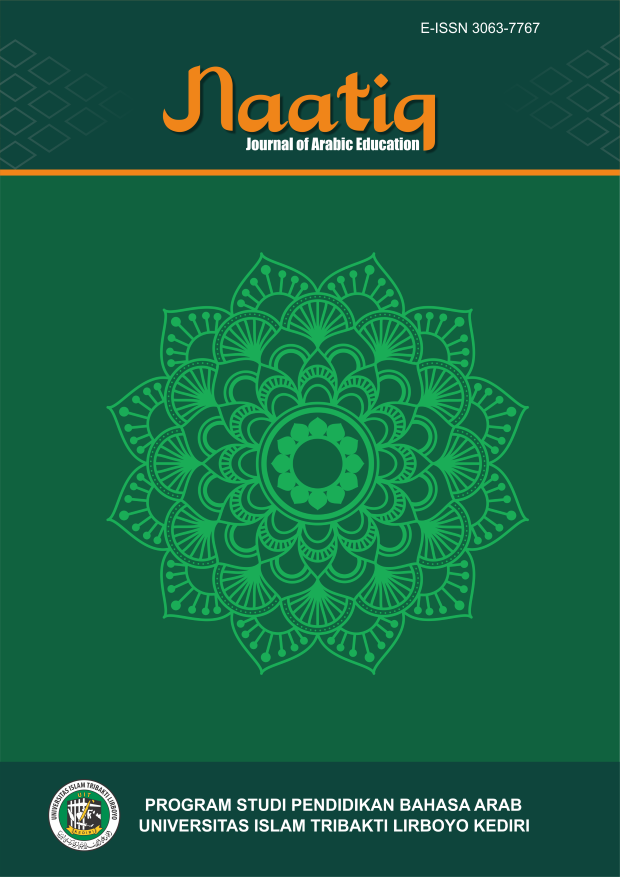
The Influence of Peer Teaching Method on Speaking Skills of Eight Grade Student at Abdullah Bin Mas'ud Boarding School, Kisaran
DOI:
https://doi.org/10.33367/naatiq.v2i1.7038Keywords:
Arabic language; Speaking Skills; Peer Teaching;Abstract
Arabic is a foreign language that holds an important position in Islamic education in Indonesia, particularly within the environment of Islamic boarding schools (pesantren). Although it has become part of the official curriculum, the teaching of speaking skills (kalam) often encounters obstacles, both in terms of teaching methods and students' active engagement. In this context, the present study proposes the Peer Teaching method as an alternative approach aligned with Vygotsky’s social constructivism theory, particularly the concept of the Zone of Proximal Development (ZPD), which emphasizes learning through peer interaction. This research was conducted in the second-grade Mutawassith class at the Abdullah Bin Mas’ud Islamic Boarding School in Kisaran. The aim of this study is to analyze the change in students' speaking ability before and after the treatment and to assess the effectiveness of the peer teaching method in the pesantren learning context. A quantitative approach was employed using a one-group pre-experimental design (One Group Pretest-Posttest). The results showed that the total pretest score was 1,646 with an average of 65.84, while the posttest score increased to 2,151 with an average of 86.04. Statistical testing revealed that the calculated t-value was greater than the critical t-value (2.797 < 8.283 > 2.064), indicating a significant influence of the peer teaching method on improving students' speaking ability. Therefore, the null hypothesis (Ho) is rejected, and the alternative hypothesis (Ha) is accepted. This study provides practical contributions to the development of speaking (kalam) instructional methods in pesantren and other Islamic educational institutions. The use of peer teaching not only improves learning outcomes quantitatively but also fosters active participation, self-confidence, and collaboration among students. With a strong theoretical foundation and significant empirical findings, this method can serve as an innovative alternative to overcome stagnation in spoken Arabic instruction, particularly in pesantren environments characterized by collective and interactive learning cultures.
References
Abu Ahmadi dan Joko Tri Prasety. (2015). Strategi belajar mengajar. Rineka Cipta.
Dr. Priyono MM. (2008). Metode Penelitian Kuantitatif. Zifatama Publishing.
Febianti, Y. N. (2014). Peer Teaching (Tutor Sebaya) Sebagai Metode Pembelajaran Untuk Melatih Siswa Mengajar. Edunomic, 2 (2), 81–87.
Fuadah, N. (2022). Ta ‘ limDiniyah : Jurnal Pendidikan Agama Islam ( Journal of Islamic Education Studies ) IMPLEMENTATION OF PEER TEACHING LEARNING METHODS IN HONORING ARABIC SPEAKING SKILLS IN ISLAMIC EDUCATION. 2(2), 203–214.
Hady, Y. (2019). Pembelajaran Mahārat al-Kalām Menurut Rusdy Ahmad Thu’aimah dan Mahmud Kamil al-Nâqah. al Mahāra: Jurnal Pendidikan Bahasa Arab, 5(1), 63–84. https://doi.org/10.14421/almahara.2019.051-04
Hayati, I. (2017). Pengaruh Model Pembelajaran Peer Teaching Terhadap Peningkatan Aspek Afektif Mahasiswa Mata Kuliah Akuntansi Keuangan Prodi Perbankan Syariah Universitas Muhammadiyah Sumatera Utara. Jurnal Masharif As-Syariah, 2(2).
Kuswoyo. (2017). Konsep Dasar Pembelajaran Maharah Al-Kalam. An-Nuha, 4(1), 49–56.
Mufidah, N., & Attaqi, K. F. (2022). Peran Pemahaman Maharah Kalam Pada Pembelajaran Bahasa Arab Di Madrasah Aliyah Keagamaan (Mak). Proceeding International Conference on Islamic Education, 7, 700–708.
Mukhlis, A. (2016). Pembelajaran Tutor Sebaya: Solusi Praktis Dalam Rangka Menyongsong Pembelajaran Sastra Yang Menyenangkan Bagi Siswa SMP. JP-BSI (Jurnal Pendidikan Bahasa dan Sastra Indonesia), 1(2), 68. https://doi.org/10.26737/jp-bsi.v1i2.93
mulyadi. (2008). Diagnosis Kesulitan Belajar dan Bimbingan terhadap Kesulitan Belajar Khusus. nuha litera.
Nurdiyan, I. (2018). Model pembelajaran peer teaching dalam pembelajaran pendidikan jasmani. Biormatika: Jurnal ilmiah fakultas keguruan dan ilmu pendidikan, 4(1), 1–8. www.ejournal.unsub.ac.id/index.php/FKIP/article/download/191/170
Nurul Ramadhani Makarao. (2009). Metode mengajar dalam bidang kesehatan. Alfabeta.
Sam, Z. (2016). Metode Pembelajaran Bahasa Arab. Nukhbatul ’Ulum, 2(1), 206–220. https://doi.org/10.36701/nukhbah.v2i1.16
Sugiyono. (2017). Metode Penelitian Kuantitatif, Kualitatif, dan R&D. Alfabeta.
Zaini, H. (2008). Strategi Pembelajaran Aktif. Pustaka Insan Madani.
الحميد, م. م. ا. ع. (1994). التحفة السنية. الدار النموذ جية.
راضي، ح. (2006). طروق التدريس اللغة العربية. مكتبة الخبتي.
عدس،ع. ا. (1998). البحث العلمي أدواته ومفهوم وأساليبه. دار اسامة للنشر والتوزيع.
 Abstract
Views:
58,
Abstract
Views:
58,  PDF downloads: 27
Published
Issue
Section
License
Copyright (c) 2025 Umeir Ibnul Fath, Hudzaifah

This work is licensed under a Creative Commons Attribution-ShareAlike 4.0 International License.