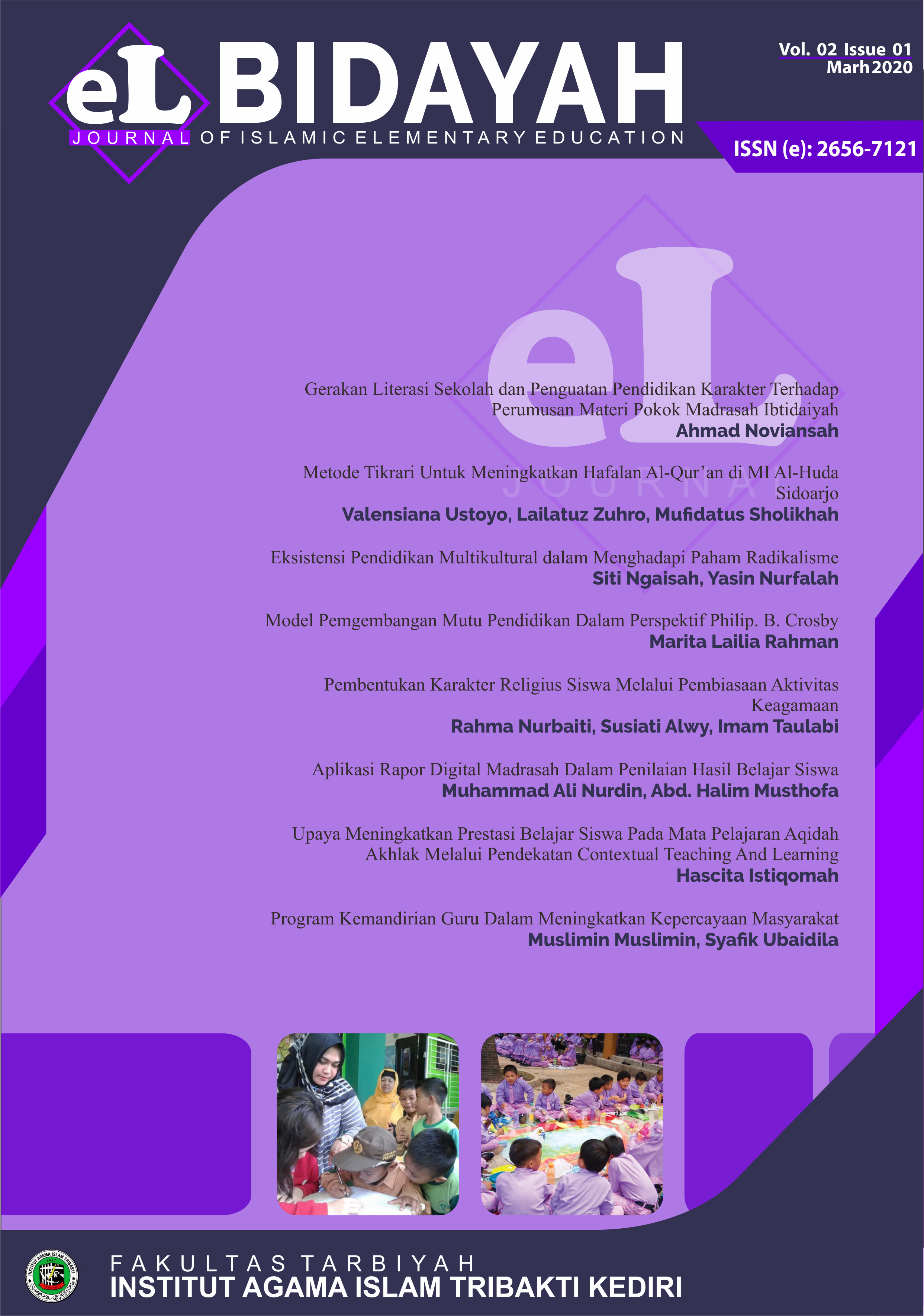
Gerakan Literasi Sekolah dan Penguatan Pendidikan Karakter Terhadap Perumusan Materi Pokok Madrasah Ibtidaiyah
DOI:
https://doi.org/10.33367/jiee.v2i1.1009Keywords:
School Literacy Wisdom, Character Education, Affirmation Character of EducationAbstract
National government policy to make regulations School literacy movement is an effort of the Ministry of Education and Culture in achieving one of its programs, which is to fulfill the nation's children from the age of development to read so that the potential of human resources increases and broadens public involvement in developing and cultivating literacy in Indonesia, the school litersation movement is also a comprehensive and ongoing effort to make schools the first learning organization to be based on, lack of interest in reading or ability literacy has an impact on people's lives. Conceptually, literacy is adopted and promoted by the Ministry of Education and Culture (Kemendikbud), so that character education also arises to develop the character of the nation's children, character education is all that concerns good behavior, character, heart, soul, behavior, personality, nature, temperament, character, character, and nature.
References
Dalyono, Bambang. Implemtasi Penguatan Pendidikan Karakter Di Sekolah. Bangun Rakaprima 03/02/Okto. n.d.
Fath, Zainal Al. Kebijakan Gerakan Literasi Sekolah (Konsep Dan Implementasi). Pendidikan Madrasah Ibtidaiyah 1 No 2. n.d.
Firdaos, Yeti Rijal. Penguatan Pendidikan Karakter Berbasis Masyarakat Pada Sekolah Menengah Pertama Negeri (SMPN) Di Kabupaten Tulang Bawang Provinsi Lampung. Al-Tadzkiyyah 8 No II. 2017.
Maisaro, Atik. Manajemen Program Penguatan Pendidikan Karakter Di Sekolah Dasar, 01. n.d.
Nindya Faradina. Pengaruh Program Gerakan Literasi Sekolah Terhadap Minat Baca Siswa Di SD Islam Terpadu Muhammadiyah An-Najah Jatinom Klaten. Hanata Widya 6, no. 8. 2017.
Oktaviani, Ika. Menggagas Kajian Kearifan Budaya Lokal Di Sekolah Dasar Melalui Gerakan Literasi Sekolah. Prosiding Seminar Nasioanal, 2017.
Rahmayani, Putri. Penguatan Pendidikan Karakter Bagi Siswa Sekolah Dasar Melalui Kearifan Local. Jpsd 3 No 2 n.d.
Rohman, Syaifur. Membangun Budaya Membaca Pada Anak Melalui Program Gerakam Literasi Sekolah 2017.
 Abstract
Views:
452,
Abstract
Views:
452,  PDF downloads: 609
Published
Issue
Section
License
License and Copyright Agreement
In submitting the manuscript to the journal, the authors certify that:
- They are authorized by their co-authors to enter into these arrangements.
- The work described has not been formally published before, except in the form of an abstract or as part of a published lecture, review, thesis, or overlay journal.
- That it is not under consideration for publication elsewhere,
- That its publication has been approved by all the author(s) and by the responsible authorities – tacitly or explicitly – of the institutes where the work has been carried out.
- They secure the right to reproduce any material that has already been published or copyrighted elsewhere.
- They agree to the following license and copyright agreement.
Copyright
Authors who publish with El Bidayah:Journal of Islamic Elementary Education agree to the following terms:
- Authors retain copyright and grant the journal the right of first publication with the work simultaneously licensed under a Creative Commons Attribution License (CC BY-SA 4.0) that allows others to share the work with an acknowledgement of the work's authorship and initial publication in this journal.
- Authors are able to enter into separate, additional contractual arrangements for the non-exclusive distribution of the journal's published version of the work (e.g., post it to an institutional repository or publish it in a book), with an acknowledgment of its initial publication in this journal.
- Authors are permitted and encouraged to post their work online (e.g., in institutional repositories or on their website) before and during the submission process, as it can lead to productive exchanges, as well as earlier and greater citation of published work.
Licensing for Data Publication
El Bidayah: Journal of Islamic Elementary Education uses a variety of waivers and licenses, that are specifically designed for and appropriate for the treatment of data:
- Open Data Commons Attribution License, http://www.opendatacommons.org/licenses/by/1.0/ (default)
- Creative Commons CC-Zero Waiver, http://creativecommons.org/publicdomain/zero/1.0/
- Open Data Commons Public Domain Dedication and Licence, http://www.opendatacommons.org/licenses/pddl/1-0/
Other data publishing licenses may be allowed as exceptions (subject to approval by the editor on a case-by-case basis) and should be justified with a written statement from the author, which will be published with the article.
Open Data and Software Publishing and Sharing
The journal strives to maximize the replicability of the research published in it. Authors are thus required to share all data, code, or protocols underlying the research reported in their articles. Exceptions are permitted but have to be justified in a written public statement accompanying the article.
Datasets and software should be deposited and permanently archived in appropriate, trusted, general, or domain-specific repositories (please consult http://service.re3data.org and/or software repositories such as GitHub, GitLab, Bioinformatics.org, or equivalent). The associated persistent identifiers (e.g. DOI, or others) of the dataset(s) must be included in the data or software resources section of the article. Reference(s) to datasets and software should also be included in the reference list of the article with DOIs (where available). Where no domain-specific data repository exists, authors should deposit their datasets in a general repository such as ZENODO, Dryad, Dataverse, or others.
Small data may also be published as data files or packages supplementary to a research article, however, the authors should prefer in all cases a deposition in data repositories.

This work is licensed under a Creative Commons Attribution-ShareAlike 4.0 International License.