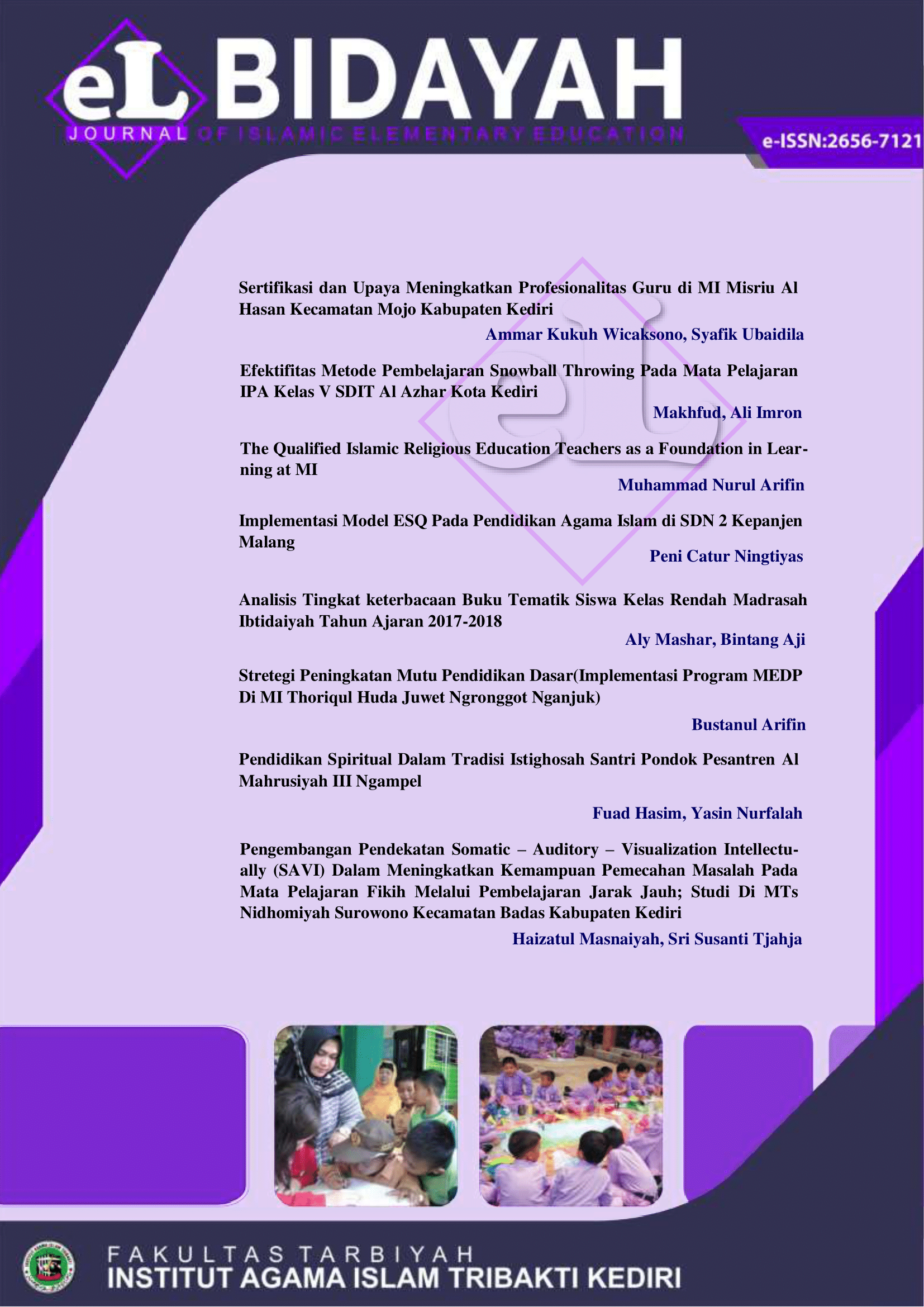
Implementasi Model ESQ Pada Pendidikan Agama Islam di SDN 2 Kepanjen Malang
DOI:
https://doi.org/10.33367/jiee.v2i2.1161Keywords:
Implementation, Emotional Spiritual Quotient, Islamic EducationAbstract
The nature of postmodernism thinking teaches to review educational concepts that have been considered standard. One of them is whether enough people are only emphasized to have intellectual intelligence alone? Departing from the questions above, this research was conducted using a library study approach. Literature study is a data collection technique by conducting a study of books, literature, notes, and reports that have to do with problems that are solved. From the results of this study, there are many different kinds of intelligence that are considered more important for life. Humans can be considered more chairy if they have some kind of intelligence, which consists of IQ (Intelligence Quotient), EQ (Emotional Quotient), SQ (Spiritual Quotient) and intelligence that Emotional spiritual quostient (ESQ) plays a crucial role in educational institutions that have Islamic base is able to develop Islamic education in Indonesia. The concept can be developed as follows: the concept of freedom of heart, the pillars of faith, the pillars of Islam, and monotheism.
[Alam berfikir postmodernisme mengajarkan untuk meninjau ulang konsep-konsep pendidikan yang selama ini dianggap baku. Salah satunya adalah apakah cukup manusia hanya ditekankan untuk memiliki kecerdasan intelektual semata? Berangkat dari pertanyaan di atas, penelitian ini dilakukan dengan menggunakan pendekatan studi kepustakaan atau Library Research. Studi kepustakaan adalah teknik pengum-pulan data dengan mengadakan studi penelaahan terhadap buku-buku, literatur-literatur, catatan-catatan, dan laporan-laporan yang ada hubungannya dengan ma-salah yang dipecahkan. Dari hasil kajian ini, banyak ditemukan ragam kecerdasan yang justru lebih dianggap penting bagi kehidupan. Manusia bisa dianggap lebih kursial jika memiliki beberapa macam kecerdasan, yang diantaranya terdiri IQ (Intelegence Quotient), EQ (Emosional Quotient), SQ (Spiritual Quotient) dan kecerdasan yang Emotional spiritual quostient (ESQ) berperan krusial pada lembaga-lembaga pendidikan yang ber-basis Islam mampu mengembangkan pen-didikan Islam di Indonsia. Konsep yang bisa dikembangkan sebagai berikut: konsep kebebasan hati, rukun iman, rukun Islam, dan ketauhidan]
References
Agustian, Ary Ginanjar. Rahasia Sukses Membangkitkan ESQ POWER Sebuah Inner Journy Melalui Al-Ihsan. Jakarta: ARGA, 2006.
———. Rahasia Sukses Membangun Kecerdasan Emosi dan Spiritual’ ESQ, Emotional, Spiritual Quottient. The ESQ Way 165, 1 Ihsan 6 Rukun Iman dan 5 Rukun Islam. Jakarta: ARGA, 2007.
Chambali, Soleh. Intan Berlian Laki Perempuan. Surabaya: Salim Nabhan dan Ahmad, 1951.
Eksan, Moch. Kiai Kelana Biografi Kiai Muchith Muzadi. Yogyakarta: LKiS, 2000.
Kementerian Pendidikan dan Kebudayaan. “Badan Pengembangan dan Pembinaan Bahasa. Pedoman Umum Ejaan Bahasa Indonesia (PUEBI).†Jakarta, 2016.
Ma’arif, dan A. Syafi’I. Pendidikan Islam di Indonesia antara Cita dan Fakta. Yogyakarta: Tiara Wacana, 1991.
Quthb, Muhammad. Sistem Pendidikan Islam terj. Salman Harun. Bandung: Al Maarif, 1993.
Soebahar, Abd Halim. Matrik Pendidikan Islam. Jakarta: Kalam Mulia, 2003.
Sulton, M., dan Moh. Khusnuridlo. Manajemen Pondok Pesantren Dalam Perspektif Global. Yogyakarta: Laks Bang PRESSindo, 2000.
Zamroni. Paradigma Pendidikan Masa Depan. Yogyakarta: Bigraf Publishing, 2001.
 Abstract
Views:
229,
Abstract
Views:
229,  PDF downloads: 475
Published
Issue
Section
License
License and Copyright Agreement
In submitting the manuscript to the journal, the authors certify that:
- They are authorized by their co-authors to enter into these arrangements.
- The work described has not been formally published before, except in the form of an abstract or as part of a published lecture, review, thesis, or overlay journal.
- That it is not under consideration for publication elsewhere,
- That its publication has been approved by all the author(s) and by the responsible authorities – tacitly or explicitly – of the institutes where the work has been carried out.
- They secure the right to reproduce any material that has already been published or copyrighted elsewhere.
- They agree to the following license and copyright agreement.
Copyright
Authors who publish with El Bidayah:Journal of Islamic Elementary Education agree to the following terms:
- Authors retain copyright and grant the journal the right of first publication with the work simultaneously licensed under a Creative Commons Attribution License (CC BY-SA 4.0) that allows others to share the work with an acknowledgement of the work's authorship and initial publication in this journal.
- Authors are able to enter into separate, additional contractual arrangements for the non-exclusive distribution of the journal's published version of the work (e.g., post it to an institutional repository or publish it in a book), with an acknowledgment of its initial publication in this journal.
- Authors are permitted and encouraged to post their work online (e.g., in institutional repositories or on their website) before and during the submission process, as it can lead to productive exchanges, as well as earlier and greater citation of published work.
Licensing for Data Publication
El Bidayah: Journal of Islamic Elementary Education uses a variety of waivers and licenses, that are specifically designed for and appropriate for the treatment of data:
- Open Data Commons Attribution License, http://www.opendatacommons.org/licenses/by/1.0/ (default)
- Creative Commons CC-Zero Waiver, http://creativecommons.org/publicdomain/zero/1.0/
- Open Data Commons Public Domain Dedication and Licence, http://www.opendatacommons.org/licenses/pddl/1-0/
Other data publishing licenses may be allowed as exceptions (subject to approval by the editor on a case-by-case basis) and should be justified with a written statement from the author, which will be published with the article.
Open Data and Software Publishing and Sharing
The journal strives to maximize the replicability of the research published in it. Authors are thus required to share all data, code, or protocols underlying the research reported in their articles. Exceptions are permitted but have to be justified in a written public statement accompanying the article.
Datasets and software should be deposited and permanently archived in appropriate, trusted, general, or domain-specific repositories (please consult http://service.re3data.org and/or software repositories such as GitHub, GitLab, Bioinformatics.org, or equivalent). The associated persistent identifiers (e.g. DOI, or others) of the dataset(s) must be included in the data or software resources section of the article. Reference(s) to datasets and software should also be included in the reference list of the article with DOIs (where available). Where no domain-specific data repository exists, authors should deposit their datasets in a general repository such as ZENODO, Dryad, Dataverse, or others.
Small data may also be published as data files or packages supplementary to a research article, however, the authors should prefer in all cases a deposition in data repositories.

This work is licensed under a Creative Commons Attribution-ShareAlike 4.0 International License.