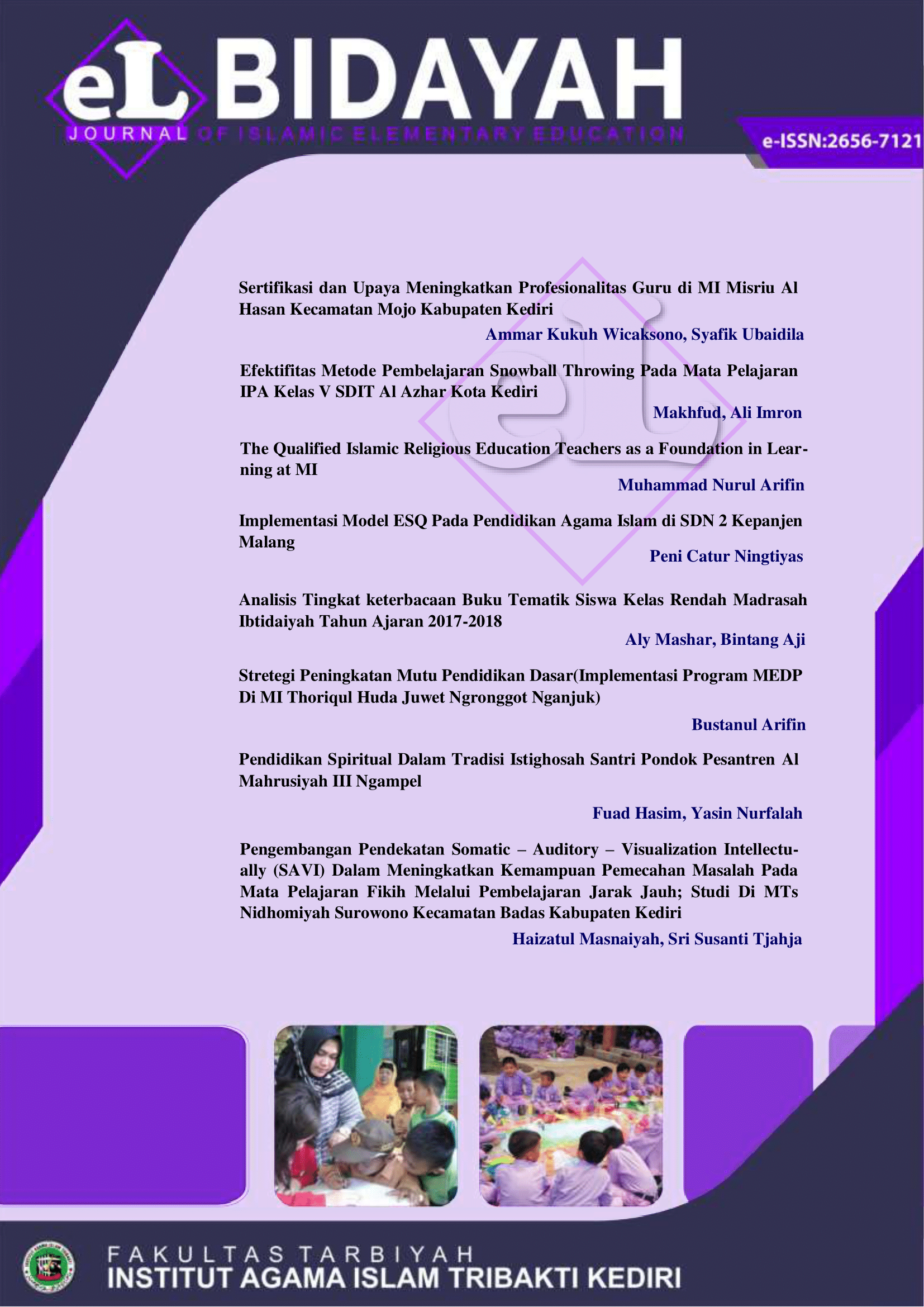
Pengembangan Pendekatan Somatic Auditory Visualization Intellectually (SAVI) Dalam Meningkatkan Kemampuan Pemecahan Masalah Pada Mata Pelajaran Fikih Melalui Pembelajaran Jarak Jauh; Studi Di MTs Nidhomiyah Surowono Kecamatan Badas Kabupaten Kediri
DOI:
https://doi.org/10.33367/jiee.v2i2.1350Keywords:
Development of SAVI Approach, Problem Solving Skills, iqh SubjectsAbstract
The outbreak of the coronavirus disease (COVID-19) in Indonesia has prompted the Ministry of Education and Culture and the Ministry of Religion to urge schools to organize distance learning. Because of this appeal, schools and madrasas organize distance learning activities, including MTs Nidhomiyah Surowono, Badas District. However, the distance learning of fiqh subjects is only providing assignments through the WA group and there is no feedback from the teacher. This phenomenon causes the problem-solving skills of the students to become low. So research and development (R & D) were done on the fiqh subjects to describe 1) the steps for developing the somatic-auditory-visualization-intellectually (SAVI) approach through distance learning, and 2) the effectiveness of developing somatic-auditory-visualization-intellectually approach (SAVI) to increase the problem-solving skills on the fiqh subjects through distance learning. This research used the research and development (R & D) approach Borg and Gall model that combined with the ADDIE model. The testing model used an experimental pretest-posttest control group design. The result of the pretest and posttest were analyzed by the test of normality, homogeneity, N-gain scores, and independent-sample t-test with IBM SPSS Statistics version 21. The results showed that the SAVI approach was quite effective in improving students' problem-solving skills. This can be seen based on the results of the pre-test and post-test in the experimental class compared to the control class. From the experimental class, it was obtained that the pre-test results had an average of 52, but after receiving the SAVI approach, the post-test score was 67. Far different from the control class whose initial class average score was 49 to 56. This is also supported by the mean results of the N-gain score for the experimental class was 33.5513 or 33.6 which was included in the moderate or moderately effective criteria.
References
COVID-19, Gugus Tugas Percepatan Penanganan. “Beranda | Gugus Tugas Percepatan Penanganan COVID-19.†covid19.go.id. Diakses 26 Juni 2020. https://covid19.go.id/.
Depdiknas. Undang-undang RI Nomor 20 Tahun 2003 Tentang Sistem Pendidikan Nasional, 2003.
Dirjen KSKK Madrasah Kemenag RI. Keputusan Menteri Agama Nomor 183 Tahun 2019 Tentang Kurikulum PAI dan Bahasa Arab Pada Madrasah. Kementrian Agama RI, 2019.
Farida, Ullin Nuril, dan Badrus. “Hubungan Tingkat Kecerdasan Spiritual Dan Kecerdasan Sosial Terhadap Self Efficacy Pada Siswa Kelas XI Di MAN 4 Madiun.†Jurnal Intelektual: Jurnal Pendidikan Dan Studi Keislaman 9, no. 01 (30 April 2019): 25–34. https://doi.org/10.33367/ji.v9i01.964.
Fuad, A. Jauhar, dan Hamam. Teori dan Praktik Penelitian Tindakan Kelas (PTK). Tulungagung: STAIN Tulungagung Pers, 2012.
Huda, Miftahul. Model-model Pengajaran dan Pembelajaran: Isu-isu Metodis dan Paradigmatis. Yogyakarta: Pustaka Pelajar, 2014.
Limbong, Sepriani Trimurtini. “Virus Corona - Penyebab, Gejala dan Pencegahan - Klikdokter.com.†Diakses 26 Juni 2020. https://www.klikdokter.com/penyakit/coronavirus.
Meier, Dave. The Accelerated Leraning Handbook: Panduan Kreatif Dan Efektif Merancang Program Pendidikan Dan Pelatihan (terj. Rahmani Astuti). Bandung: Kaifa, 2004.
Muhaimin. Paradigma Pendidikan Islam. Bandung: PT. Remaja Rosdakarya, 2004.
Munir. Pembelajaran Jarak Jauh berbasis Teknologi Informasi dan Komunikasi (TIK). Bandung: CV. Alfabeta, 2009.
Pakpahan, Roida, dan Yuni Fitriani. “Analisa Pemanfaatan Teknologi Informasi Dalam Pembelajaran Jarak Jauh Di Tengah Pandemi Virus Corona Covid-19.†Journal of Information System, Applied, Management, Accounting and Research 4, no. 2 (19 Mei 2020): 30–36.
Pangondian, Roman Andrianto, Paulus Insap Santosa, dan Eko Nugroho. “Faktor - Faktor Yang Mempengaruhi Kesuksesan Pembelajaran Daring Dalam Revolusi Industri 4.0.†Seminar Nasional Teknologi Komputer & Sains (SAINTEKS) 1, no. 1 (21 Februari 2019). https://www.prosiding.seminar-id.com/index.php/sainteks/article/view/122.
Sugiyono. Metode Penelitian Pendidikan (Pendekatan Kuantitatif, Kualitatif, dan R&D). 19 ed. Bandung: Alfabeta, 2014.
Taufiqurrahman, H.R. “Model Penelitian Pengembangan Borg and Gall (1983).†taufiq.net (blog). Diakses 30 Juni 2020. https://www.taufiq.net/2019/09/model-penelitian-pengembangan-borg-and.htm
Thersia, Vita, Muhammad Arifuddin, dan Misbah. “Meningkatkan Kemampuan Pemecahan Masalah Melalui Pendekatan Somatis Auditori Visual Intelektual (SAVI) dengan Model Pengajaran Langsung.†Berkala Ilmiah Pendidikan Fisika 7 (Desember 2018): 19–27. http://dx.doi.org/10.20527/bipf.v7i1.5638.
Widad, Aufal. “Tesis Pembelajaran Kooperatif Model SAVI (Somatis, Auditory, Visual, Intelektual) Dalam Mata Pelajaran PAI Di SMAN Balung dan SMAN Ambulu.†UIN MALIKI, 2015.
 Abstract
Views:
181,
Abstract
Views:
181,  PDF downloads: 167
Published
Issue
Section
License
License and Copyright Agreement
In submitting the manuscript to the journal, the authors certify that:
- They are authorized by their co-authors to enter into these arrangements.
- The work described has not been formally published before, except in the form of an abstract or as part of a published lecture, review, thesis, or overlay journal.
- That it is not under consideration for publication elsewhere,
- That its publication has been approved by all the author(s) and by the responsible authorities – tacitly or explicitly – of the institutes where the work has been carried out.
- They secure the right to reproduce any material that has already been published or copyrighted elsewhere.
- They agree to the following license and copyright agreement.
Copyright
Authors who publish with El Bidayah:Journal of Islamic Elementary Education agree to the following terms:
- Authors retain copyright and grant the journal the right of first publication with the work simultaneously licensed under a Creative Commons Attribution License (CC BY-SA 4.0) that allows others to share the work with an acknowledgement of the work's authorship and initial publication in this journal.
- Authors are able to enter into separate, additional contractual arrangements for the non-exclusive distribution of the journal's published version of the work (e.g., post it to an institutional repository or publish it in a book), with an acknowledgment of its initial publication in this journal.
- Authors are permitted and encouraged to post their work online (e.g., in institutional repositories or on their website) before and during the submission process, as it can lead to productive exchanges, as well as earlier and greater citation of published work.
Licensing for Data Publication
El Bidayah: Journal of Islamic Elementary Education uses a variety of waivers and licenses, that are specifically designed for and appropriate for the treatment of data:
- Open Data Commons Attribution License, http://www.opendatacommons.org/licenses/by/1.0/ (default)
- Creative Commons CC-Zero Waiver, http://creativecommons.org/publicdomain/zero/1.0/
- Open Data Commons Public Domain Dedication and Licence, http://www.opendatacommons.org/licenses/pddl/1-0/
Other data publishing licenses may be allowed as exceptions (subject to approval by the editor on a case-by-case basis) and should be justified with a written statement from the author, which will be published with the article.
Open Data and Software Publishing and Sharing
The journal strives to maximize the replicability of the research published in it. Authors are thus required to share all data, code, or protocols underlying the research reported in their articles. Exceptions are permitted but have to be justified in a written public statement accompanying the article.
Datasets and software should be deposited and permanently archived in appropriate, trusted, general, or domain-specific repositories (please consult http://service.re3data.org and/or software repositories such as GitHub, GitLab, Bioinformatics.org, or equivalent). The associated persistent identifiers (e.g. DOI, or others) of the dataset(s) must be included in the data or software resources section of the article. Reference(s) to datasets and software should also be included in the reference list of the article with DOIs (where available). Where no domain-specific data repository exists, authors should deposit their datasets in a general repository such as ZENODO, Dryad, Dataverse, or others.
Small data may also be published as data files or packages supplementary to a research article, however, the authors should prefer in all cases a deposition in data repositories.

This work is licensed under a Creative Commons Attribution-ShareAlike 4.0 International License.