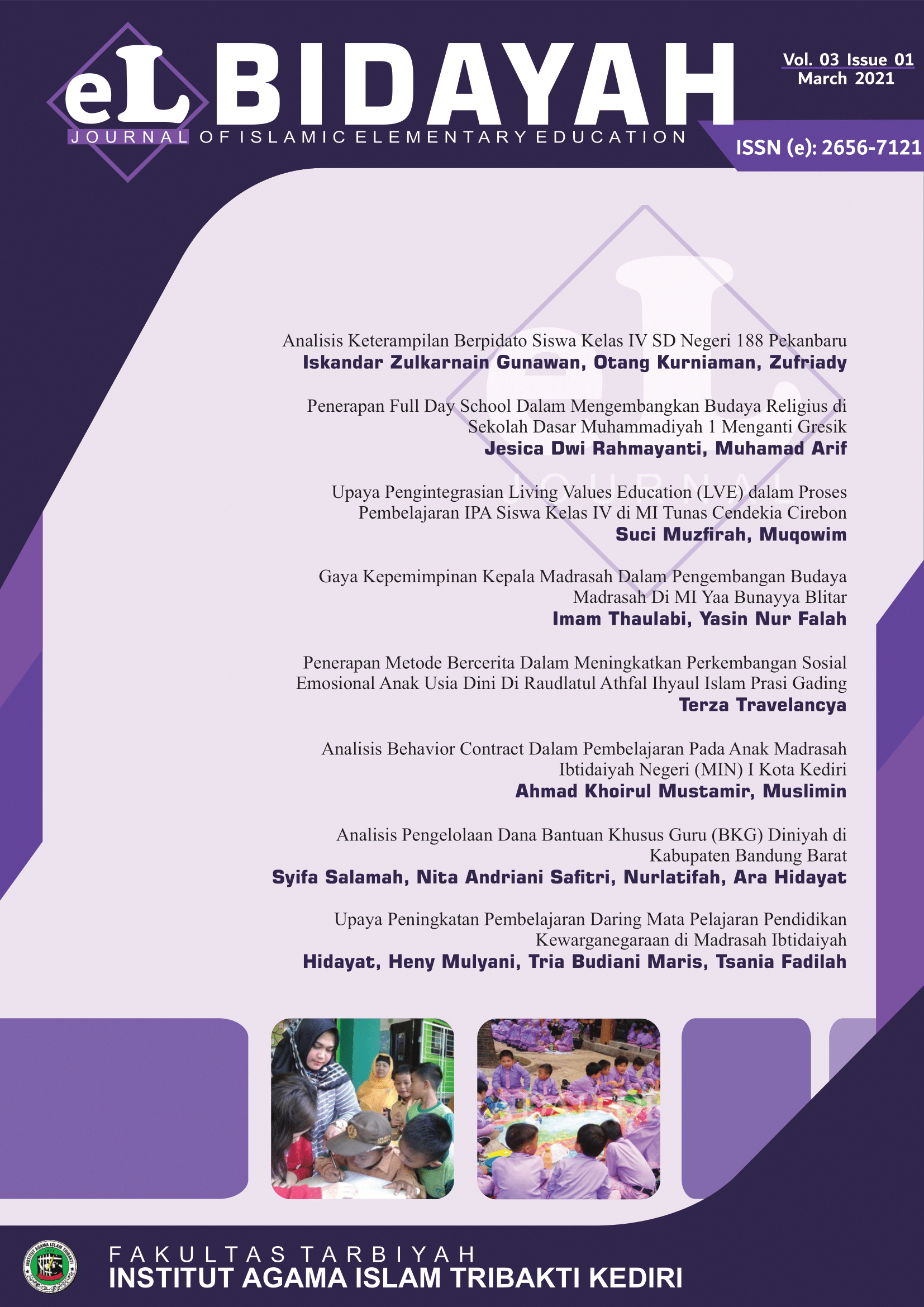
Gaya Kepemimpinan Kepala Madrasah Dalam Pengembangan Budaya Madrasah Di MI Yaa Bunayya Blitar
DOI:
https://doi.org/10.33367/jiee.v3i1.1508Keywords:
Leadership Style, Madrasa Principal, MadrasaCultureAbstract
This research specifically looks at the leadership style of the principal at Islamic Elementary Education Yaa Bunayya Dandong Srengat Blitar in developing the culture of the madrasa. The research method, of this study uses a descriptive qualitative approach. The location of this research is Islamic Elementary Education Yaa Bunayya Dandong Srengat Blitar. The data analysis used single case analysis while checking the validity of the data by triangulation, peer discussion, and attendance extension. The end of this study found 1) The leadership style of the head of the madrasa in the development of madrasa culture at Islamic Elementary Education Yaa Bunayya Dandong Srengat Blitar tends to be democratic by looking at the leadership style of the headmaster which is related to the behavior of the entire madrasa family and the community, building effective communication with subordinates and understanding their subordinates. by accepting the differences in the activities carried out. 2) Obstacles or obstacles to the leadership style of the head of Islamic Elementary Education Yaa Bunayya Dandong Srengat in developing madrasah culture in the form of obstacles caused by the lack of awareness of all madrasa members to implement madrasah regulations voluntarily.
References
Arikunto, Suharsimi. Prosedur Penelitian Suatu Pendekatan Praktik. Jakarta: Rineka Cipta, 2006.
Cowling, Alan G., and Philip James. The Essence of Personnel Management and Industrial Relations. New Jersey: Prentice Hall, 1994.
Danim, Sudarman. Kepemimpinan Pendidikan: Kepemimpinan Jenius (IQ + EQ), Etika, Perilaku Motivasional Dan Mitos. Bandung: Alfabeta, 2010.
Hersey, Paul, and Kenneth H. Blanchard. Manajemen Perilaku Organisasi: Pendayagunaan Sumber Daya Manusia. Terjemahan Oleh Agus Dharma. Jakarta: Erlangga, 2001.
Madhi, Jamal. Menjadi Pemimpin yang Efektif dan Berpengaruh Tinjauan Manajemen Kepemimpinan Islam. Terjemahan oleh Anang Syafruddin dan Ahmad Fauzan. Bandung: PT. Syaamil Cipta Media, 2004.
Marno, Triyo Supriyatno. Manajemen Dan Kepemimpinan Pendidikan Islam. Jakarta: Rineka Cipta, 2008.
Neprializa. ‘Manajemen Budaya Sekolah’. Jurnal Manajer Pendidikan 9 No.3 (2015): 419–29. https://ejournal.unib.ac.id/index.php/manajerpendidikan/article/download/1139/947
Paul Hersey, Kenneth H. Blanchard. Manajemen Perilaku Organisasi, Pendayagunaan Sumber Daya Manusia Penerjemah Agus Dharma. Jakarta: Erlangga, 2001.
Usman, Husaini. Manajemen Teori, Praktik Dan Riset Pendidikan. Jakarta: Bumi Aksara, 2009.
 Abstract
Views:
139,
Abstract
Views:
139,  PDF downloads: 144
Published
Issue
Section
License
License and Copyright Agreement
In submitting the manuscript to the journal, the authors certify that:
- They are authorized by their co-authors to enter into these arrangements.
- The work described has not been formally published before, except in the form of an abstract or as part of a published lecture, review, thesis, or overlay journal.
- That it is not under consideration for publication elsewhere,
- That its publication has been approved by all the author(s) and by the responsible authorities – tacitly or explicitly – of the institutes where the work has been carried out.
- They secure the right to reproduce any material that has already been published or copyrighted elsewhere.
- They agree to the following license and copyright agreement.
Copyright
Authors who publish with El Bidayah:Journal of Islamic Elementary Education agree to the following terms:
- Authors retain copyright and grant the journal the right of first publication with the work simultaneously licensed under a Creative Commons Attribution License (CC BY-SA 4.0) that allows others to share the work with an acknowledgement of the work's authorship and initial publication in this journal.
- Authors are able to enter into separate, additional contractual arrangements for the non-exclusive distribution of the journal's published version of the work (e.g., post it to an institutional repository or publish it in a book), with an acknowledgment of its initial publication in this journal.
- Authors are permitted and encouraged to post their work online (e.g., in institutional repositories or on their website) before and during the submission process, as it can lead to productive exchanges, as well as earlier and greater citation of published work.
Licensing for Data Publication
El Bidayah: Journal of Islamic Elementary Education uses a variety of waivers and licenses, that are specifically designed for and appropriate for the treatment of data:
- Open Data Commons Attribution License, http://www.opendatacommons.org/licenses/by/1.0/ (default)
- Creative Commons CC-Zero Waiver, http://creativecommons.org/publicdomain/zero/1.0/
- Open Data Commons Public Domain Dedication and Licence, http://www.opendatacommons.org/licenses/pddl/1-0/
Other data publishing licenses may be allowed as exceptions (subject to approval by the editor on a case-by-case basis) and should be justified with a written statement from the author, which will be published with the article.
Open Data and Software Publishing and Sharing
The journal strives to maximize the replicability of the research published in it. Authors are thus required to share all data, code, or protocols underlying the research reported in their articles. Exceptions are permitted but have to be justified in a written public statement accompanying the article.
Datasets and software should be deposited and permanently archived in appropriate, trusted, general, or domain-specific repositories (please consult http://service.re3data.org and/or software repositories such as GitHub, GitLab, Bioinformatics.org, or equivalent). The associated persistent identifiers (e.g. DOI, or others) of the dataset(s) must be included in the data or software resources section of the article. Reference(s) to datasets and software should also be included in the reference list of the article with DOIs (where available). Where no domain-specific data repository exists, authors should deposit their datasets in a general repository such as ZENODO, Dryad, Dataverse, or others.
Small data may also be published as data files or packages supplementary to a research article, however, the authors should prefer in all cases a deposition in data repositories.

This work is licensed under a Creative Commons Attribution-ShareAlike 4.0 International License.