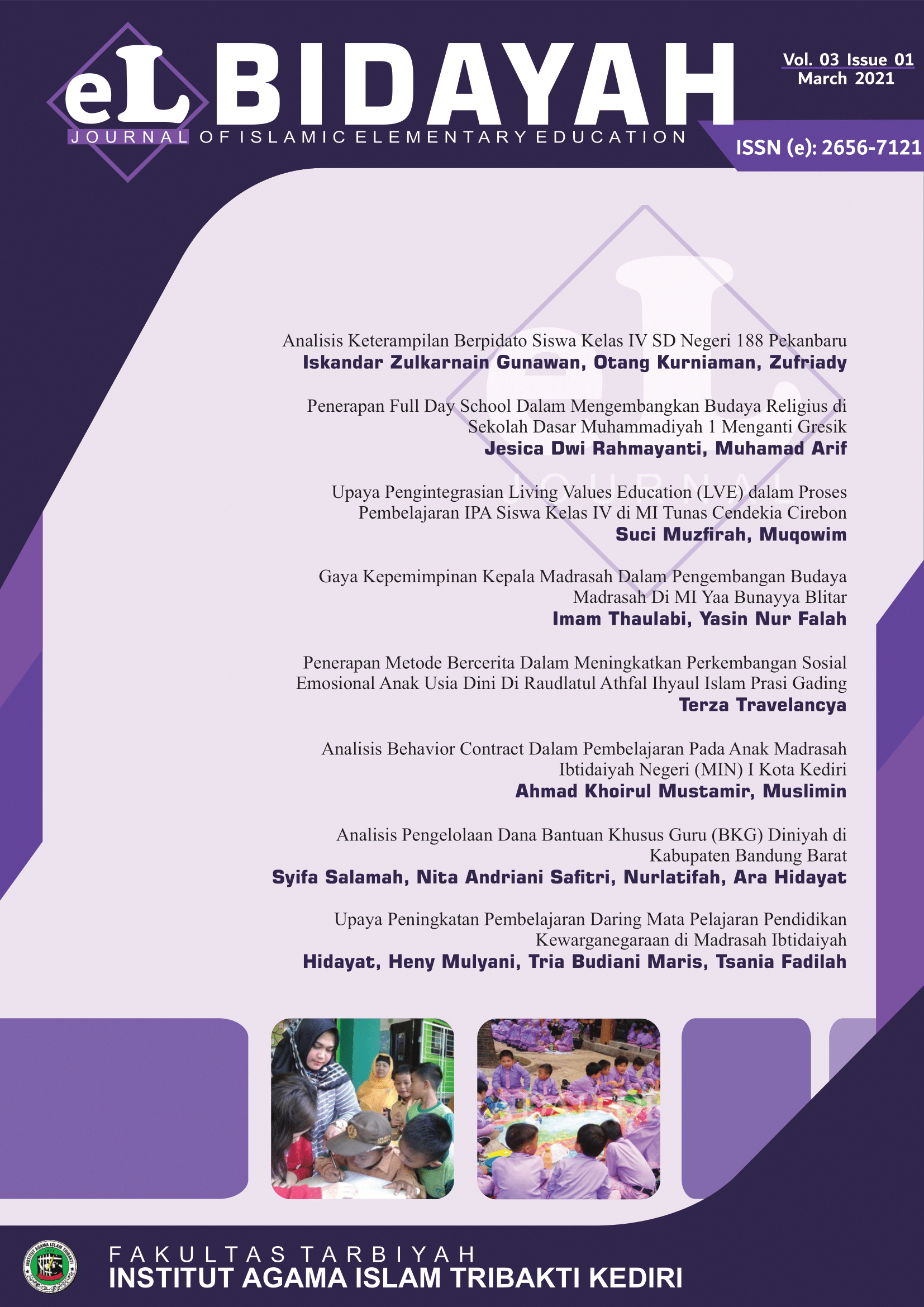
Penerapan Metode Bercerita Dalam Meningkatkan Perkembangan Sosial Emosional Anak Usia Dini Di Raudlatul Athfal Ihyaul Islam Prasi Gading
DOI:
https://doi.org/10.33367/jiee.v3i1.1541Keywords:
Oratory Skills, Storytelling Method, Social Emotional DevelopmentAbstract
The storytelling method is one of providing learning experiences for RA children by verbally telling stories to children. Storytelling is the process of introducing emotional forms and expressions to children, such as anger, sadness, joy, annoyance, and humor. This method is implemented because the objects to be studied are using story books. This research took place at RA Ihyaul Islam Prasi Gading. The purpose of this study was to determine how the teacher's storytelling method was applied in improving children's social emotional development. The research subjects were 2 teachers and 19 students, while the object of the research was the application of the teacher in improving children's social emotional development through storytelling methods. The approach used was descriptive qualitative. Data collection techniques used were observation, interviews, and documentation. The results showed that the social emotional development of children could not develop optimally.The development indicators are expressing emotions in accordance with existing conditions, recognizing manners and manners according to local socio-cultural values, understanding regulations and discipline. The indicator points are controlling emotions in a reasonable way, giving and returning greetings, obeying the rules of the game.
References
Abdul Wahab, Solichin. Analisis Kebijakan dari Formulasi ke Implementasi Kebijaksanaan Negara. Jakarta: Bumi Aksara, 2008.
Aqib, Zainal. Belajar dan Pembelajaran di Taman Kanak-kanak. Bandung: Yrama Widya, t.t.
Faisal, Amir, dan Zulfana. Menyiapkan Anak Jadi Juara. Jakarta: Elex Media Komputindo, 2008.
Gerungan. Psikologi Sosial. Bandung: Refika Aditama, 2014.
Gunarti, Winda, Lilis Suryani, dan Azizah Muis. Metode Pengembangan Perilaku dan Kemampuan Dasar Anak Usia Dini. Jakarta: Universitas Terbuka, 2010.
Hartono, Andreas. EQ Parenting (Cara Praktis Menjadi Orangtua Pelatih Emos). Jakarta: Gramedia Pustaka Utama, 2009.
Hurlock, Elizabeth B. Perkembangan Anak (Edisi keenam). Jakarta: Erlangga, 2000.
Kemendiknas. “Peraturan Menteri Nasional Republik Indonesia Nomor 58 Tahun 2009 Tentang Standar Pendidikan Anak Usia Dini.†Yogyakarta: Bina Insane Mulia, 2010.
Mashar, Riana. Emosi Anak Usia Dini dan Strategi Pengembangannya. Jakarta: Kencana Prenada Media Group, 2011.
Masitoh. Stategi Pembelajaran TK. Jakarta: Universitas Terbuka, 2007.
Musbikin, Imam. Buku Pintar PAUD. Yogyakarta: Laksana, 2010.
Nugraha, Ali, dan Yeni Rachmawati. Metode Pengembangan Sosial Emosional. Jakarta: Universitas Terbuka, 2007.
Puspitasari, Amaryllia. Emotional Intelleegent Parenting. Jakarta: Elex Media Komputindo, 2009.
Salim, Peter, dan Yenny Salim. Kamus Bahasa Indonesia Kontemporer. Jakarta: Modern English Press, t.t.
Setiawan, Guntur. Impelemtasi dalam Birokrasi Pembangunan. Jakarta: Balai Pustaka, 2004.
Suyanto, Slamet. Dasar-dasar Pendidikan Anak Usia Dini. Yogyakarta: Hikayat Publishing, t.t.
Syaodih, Ernawulan, dan Mubiar Agustin. Bimbingan Konseling untuk Anak Usia Dini. Jakarta: Universitas Terbuka, 2010.
Terry, George, dan Leslie W. Rue. Dasar-dasar Manajemen (terj.). Jakarta: PT Bumi Aksara, 2010.
Usman, Nurdin. Konteks Implementasi Berbasis Kurikulum. Jakarta: Grasindo, t.t.
 Abstract
Views:
350,
Abstract
Views:
350,  PDF downloads: 733
Published
Issue
Section
License
License and Copyright Agreement
In submitting the manuscript to the journal, the authors certify that:
- They are authorized by their co-authors to enter into these arrangements.
- The work described has not been formally published before, except in the form of an abstract or as part of a published lecture, review, thesis, or overlay journal.
- That it is not under consideration for publication elsewhere,
- That its publication has been approved by all the author(s) and by the responsible authorities – tacitly or explicitly – of the institutes where the work has been carried out.
- They secure the right to reproduce any material that has already been published or copyrighted elsewhere.
- They agree to the following license and copyright agreement.
Copyright
Authors who publish with El Bidayah:Journal of Islamic Elementary Education agree to the following terms:
- Authors retain copyright and grant the journal the right of first publication with the work simultaneously licensed under a Creative Commons Attribution License (CC BY-SA 4.0) that allows others to share the work with an acknowledgement of the work's authorship and initial publication in this journal.
- Authors are able to enter into separate, additional contractual arrangements for the non-exclusive distribution of the journal's published version of the work (e.g., post it to an institutional repository or publish it in a book), with an acknowledgment of its initial publication in this journal.
- Authors are permitted and encouraged to post their work online (e.g., in institutional repositories or on their website) before and during the submission process, as it can lead to productive exchanges, as well as earlier and greater citation of published work.
Licensing for Data Publication
El Bidayah: Journal of Islamic Elementary Education uses a variety of waivers and licenses, that are specifically designed for and appropriate for the treatment of data:
- Open Data Commons Attribution License, http://www.opendatacommons.org/licenses/by/1.0/ (default)
- Creative Commons CC-Zero Waiver, http://creativecommons.org/publicdomain/zero/1.0/
- Open Data Commons Public Domain Dedication and Licence, http://www.opendatacommons.org/licenses/pddl/1-0/
Other data publishing licenses may be allowed as exceptions (subject to approval by the editor on a case-by-case basis) and should be justified with a written statement from the author, which will be published with the article.
Open Data and Software Publishing and Sharing
The journal strives to maximize the replicability of the research published in it. Authors are thus required to share all data, code, or protocols underlying the research reported in their articles. Exceptions are permitted but have to be justified in a written public statement accompanying the article.
Datasets and software should be deposited and permanently archived in appropriate, trusted, general, or domain-specific repositories (please consult http://service.re3data.org and/or software repositories such as GitHub, GitLab, Bioinformatics.org, or equivalent). The associated persistent identifiers (e.g. DOI, or others) of the dataset(s) must be included in the data or software resources section of the article. Reference(s) to datasets and software should also be included in the reference list of the article with DOIs (where available). Where no domain-specific data repository exists, authors should deposit their datasets in a general repository such as ZENODO, Dryad, Dataverse, or others.
Small data may also be published as data files or packages supplementary to a research article, however, the authors should prefer in all cases a deposition in data repositories.

This work is licensed under a Creative Commons Attribution-ShareAlike 4.0 International License.