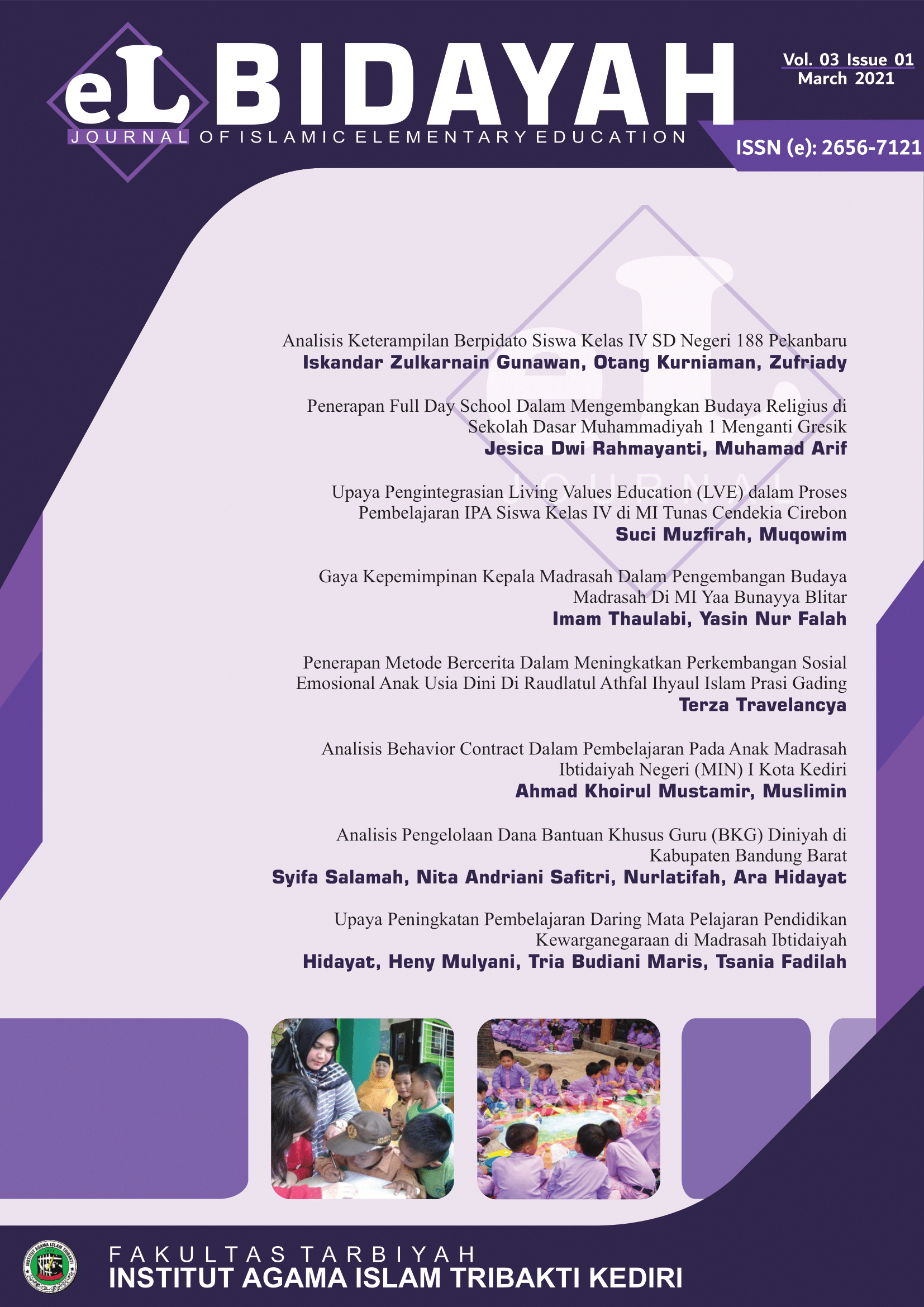
Penerapan Full Day School Dalam Mengembangkan Budaya Religius di Sekolah Dasar Muhammadiyah 1 Menganti Gresik
DOI:
https://doi.org/10.33367/jiee.v3i1.1551Keywords:
Full Day School, Culture, ReligiousAbstract
In general, elementary school-age children will feel bored when they are in school for longer, in contrast to the phenomenon that occurred at SD Muhammadiyah 1 Menganti. Students in this school look comfortable and very disciplined when they are at school, especially in terms of worship. Starting from this phenomenon, researchers want to know in depth about the application of full-day schools in developing religious culture at SD Muhammadiyah 1 Menganti, with a focus on the problem of how to implement full-day schools in developing religious culture at SD Muhammadiyah 1 Menganti ?. This study uses a qualitative method with a case study approach. Data collection techniques with observation, interviews, and documentation. The data analysis technique used the analysis of Miles and Huberman. Test the validity of the data by triangulation and reference adequacy. The results showed that full-day school learning at SD Muhammadiyah 1 Menganti starts at 07.00 until 16.00. The learning is combined with Islamic habituation which becomes an effort to develop a religious culture in schools, and is formed in several activities, namely: shaking hands and saying greetings to teachers, congregational prayers (dhuha prayer, midday prayer, Asr prayer, Friday prayer), Koran morning, mutual respect and tolerance, tahfiz juz 30, Thursday morning study, the study of women, Darul Arqom, MABIT, habituation of daily prayer, PHBI, social service, and habituation of giving.
References
Arif, Muhamad. “Adab Pergaulan Dalam Perspektif Al-Ghazâlî: Studi Kitab Bidâyat Al-Hidâyah†Islamuna: jurnal Studi Islam. Vol. 6 No. 1 (2019): 64-79. http://ejournal.iainmadura.ac.id/islamuna/article/view/2246
Arif, Muhamad and Eka Handayani. 2020. MODELING: Jurnal Program Studi PGMI 7 (2), 198-220. Accessed January 27, 2021. http://jurnal.stitnualhikmah.ac.id/index.php/modeling/article/view/660
David, Muhammad. Dkk. “Peran Full Day School Terhadap Penanaman Karakter Pada Peserta Didik Sekolah Dasar di Kota Makassar.†Jurnal Penelitian dan Penalaran, (online) Volume 4, No. 1, 2017, (https://www.neliti.com/publications/249058/peran-full-day-school-terhadap-penanaman-karakter-pada-peserta-didik-sekolah-das, diakses 20 November 2020).
Fathurrohman, Muhammad. Budaya Religius Dalam Peningkatan Mutu Pendidikan. Yogyakarta: Kalimedia, 2015.
Himawan, Royan dan M. Turhan Yani. “Upaya Sekolah Dalam Mewujudkan Budaya Religius Sebagai Upaya Peningkatan Kepatuhan Siswa Terhadap Tata Tertib di SMAN 1 Nglamesâ€. Kajian Moral dan Kewarganegaraan, (online) Volume 3, No. 2, 2014, (https://jurnalmahasiswa.unesa.ac.id/index.php/jurnal-pendidikan-kewarganegaraa/article/view/9328, diakses 20 November 2020).
Kolis, Nur dan Komari. “Pengembangan Budaya Religius Sekolah Islam Terpadu (Studi Kasus di SDIT Qurrota A’yun Ponorogo)â€. Journal Ar’Rihlah, (online) Volume 3, No. 1, 2018, (http://ejournal.iainu-kebumen.ac.id/index.php/Ar-rihlah/article/view/68, diakses 27 November 2020).
Ma’rufah, Afni. “Pelaksanaan Kurikulum Mata Pelajaran Pendidikan Agama Islam dalam Mewujudkan Budaya Religius di SD Muhammadiyah Terpadu dan SD Maarif Ponorogoâ€. Tesis. Ponorogo: Program Pascasarjana Institut Agama Islam Negeri Ponorogo, 2019.
Mufti, Umam. “Implementasi Kurikulum ISMUBA di Sekolah Muhammadiyahâ€. Jurnal Komunikasi dan Pendidikan Islam, (online) Volume 9, No. 2, 2020, (https://journal.staimsyk.ac.id/index.php/almanar/article/view/188, diakses 21 November 2020).
Muspiroh, Novianti. “Peran Kepala Sekolah Dalam Menciptakan Budaya Religius Siswa Studi Kasus di Sekolah Dasar Negeri Grenjeng Kota Cirebonâ€. Journal of Islamic Education Management, (online) Volume 2, No.2, 2018, (https://www.syekhnurjati.ac.id/jurnal/index.php/jiem/article/view/3617, diakses 26 November 2020).
Muzammil, Alfi Nikmatul. “Implementasi Budaya Religius dalam Membentuk Karakter Peserta Didik di MTsN 2 Trenggalekâ€. Skripsi. Tulungagung: Institut Agama Islam Negeri Tulungagung, 2019.
Nita. Nuryanti. “Penerapan Sistem Full Day School Dalam Upaya Meningkatkan Kualitas Akhlak di SMPN 23 Bandar Lampungâ€. Skripsi. Lampung: Universitas Islam Negeri Raden Intan Lampung, 2019.
Nu’man, Agus. “Pelaksanaan Full Day School Dalam Pembentukan Akhlak Siswa (Studi Kasus di SMA Negeri 1 Panjiâ€. At-Turost, (online), Volume 9, No. 2, 2019, (http://ejurnal.stainh.ac.id/index.php/jurnal/article/view/49, diakses 20 November 2020).
Putra, Kristiya Septian. “Implementasi Pendidikan Agama Islam Melalui Budaya Religius (Religius Culture) di Sekolahâ€. Jurnal Kependidikan, (Online) Volume 3, No.2, 2015,(http://www.ejournal.iainpurwokerto.ac.id/index.php/jurnalkependidikan/article/view/897, diakses 25 November 2020).
Roslaini. “Peran Kepala Madrasah Dalam Membangun Budaya Religius di MTs Mambaul Ulum Kecamatan Pondok Kubang Kabupaten Bengkulu Tengahâ€. Jurnal As-Salam, (online) Volume 3 No.2, 2019, (http://www.jurnal-assalam.org/index.php/JAS/article/view/130, diakses 25 November 2020).
Sahlan, Asmaun. Mewujudkan Budaya Religius di Sekolah. Malang: UIN Maliki Press, 2010.
Sari, Mustika. “Implementasi Budaya Religius Untuk Pengembangan Sikap Sosial di Madrasah Aliyah Negeri Bondowosoâ€. Skripsi. Malang: Universitas Islam Negeri Maulana Malik Ibrahim Malang, 2020.
Sufiyana, Atika Zuhrotus. “Strategi Pengembangan Budaya Religius untuk Membentuk Karakter Peserta Didik (Studi Multi Kasus di SMAN 1 Jember dan SMAN 2 Jember)â€. Tesis. Malang: Program Pascasarjana Universitas Islam Negeri Maulana Malik Ibrahim Malang, 2015.
Suyitno. “Strategi Pembentukan Budaya Religius Untuk Meningkatkan Karakter Islami di SD Muhammadiyah Wirobrajan 3 Yogyakartaâ€. Jurnal Pendidikan, (online) Volume 10, No. 2, 2018, (http://journal.ummgl.ac.id/index.php/edukasi/article/view/2310, diakses 21 November 2020).
Suyyinah. Full Day Education. Malang: Literasi Nusantara, 2020.
Utomo, Tri Prasetyo. “Meningkatkan Prestasi Peserta Didik Melalui Pendidikan Full Day Schoolâ€. Journal of Basic Education, (online) Volume 1, No.1, 2016, (http://journal.umpo.ac.id/index.php/al-asasiyya/article/view/312, diakses 28 November 2020).
Wicaksono, Anggit Grahito. “Fenomena Full Day School Dalam Sistem Pendidikan Indonesiaâ€. Jurnal Komunikasi Pendidikan, (online) Volume 1, No. 1, 2017, (http://journal.univetbantara.ac.id/index.php/komdik/article/view/12, diakses 23 November 2020).
Wulandari, Endah. dkk. “Analisis Implementasi Full Day School Sebagai Upaya Pembentukan Karakter Siswa di SD Muhammadiyah 4 Kota Malangâ€. Jurnal Pemikiran dan Pengembangan SD, (online) Volume 6, No. 1, 2018, (http://202.52.52.22/index.php/jp2sd/article/view/5904, diakses 20 November 2020).
Yasmansyah. “Strategi Guru Dalam Penerapan Budaya Religius Sekolah di SMA Negeri 3 Batusangkarâ€. Jurnal Al-Fikrah, (online) Volume 6, No.2, 2018, (http://ecampus.iainbatusangkar.ac.id/ojs/index.php/alfikrah/article/view/1380, diakses 22 November 2020).
 Abstract
Views:
497,
Abstract
Views:
497,  PDF downloads: 499
Published
Issue
Section
License
License and Copyright Agreement
In submitting the manuscript to the journal, the authors certify that:
- They are authorized by their co-authors to enter into these arrangements.
- The work described has not been formally published before, except in the form of an abstract or as part of a published lecture, review, thesis, or overlay journal.
- That it is not under consideration for publication elsewhere,
- That its publication has been approved by all the author(s) and by the responsible authorities – tacitly or explicitly – of the institutes where the work has been carried out.
- They secure the right to reproduce any material that has already been published or copyrighted elsewhere.
- They agree to the following license and copyright agreement.
Copyright
Authors who publish with El Bidayah:Journal of Islamic Elementary Education agree to the following terms:
- Authors retain copyright and grant the journal the right of first publication with the work simultaneously licensed under a Creative Commons Attribution License (CC BY-SA 4.0) that allows others to share the work with an acknowledgement of the work's authorship and initial publication in this journal.
- Authors are able to enter into separate, additional contractual arrangements for the non-exclusive distribution of the journal's published version of the work (e.g., post it to an institutional repository or publish it in a book), with an acknowledgment of its initial publication in this journal.
- Authors are permitted and encouraged to post their work online (e.g., in institutional repositories or on their website) before and during the submission process, as it can lead to productive exchanges, as well as earlier and greater citation of published work.
Licensing for Data Publication
El Bidayah: Journal of Islamic Elementary Education uses a variety of waivers and licenses, that are specifically designed for and appropriate for the treatment of data:
- Open Data Commons Attribution License, http://www.opendatacommons.org/licenses/by/1.0/ (default)
- Creative Commons CC-Zero Waiver, http://creativecommons.org/publicdomain/zero/1.0/
- Open Data Commons Public Domain Dedication and Licence, http://www.opendatacommons.org/licenses/pddl/1-0/
Other data publishing licenses may be allowed as exceptions (subject to approval by the editor on a case-by-case basis) and should be justified with a written statement from the author, which will be published with the article.
Open Data and Software Publishing and Sharing
The journal strives to maximize the replicability of the research published in it. Authors are thus required to share all data, code, or protocols underlying the research reported in their articles. Exceptions are permitted but have to be justified in a written public statement accompanying the article.
Datasets and software should be deposited and permanently archived in appropriate, trusted, general, or domain-specific repositories (please consult http://service.re3data.org and/or software repositories such as GitHub, GitLab, Bioinformatics.org, or equivalent). The associated persistent identifiers (e.g. DOI, or others) of the dataset(s) must be included in the data or software resources section of the article. Reference(s) to datasets and software should also be included in the reference list of the article with DOIs (where available). Where no domain-specific data repository exists, authors should deposit their datasets in a general repository such as ZENODO, Dryad, Dataverse, or others.
Small data may also be published as data files or packages supplementary to a research article, however, the authors should prefer in all cases a deposition in data repositories.

This work is licensed under a Creative Commons Attribution-ShareAlike 4.0 International License.