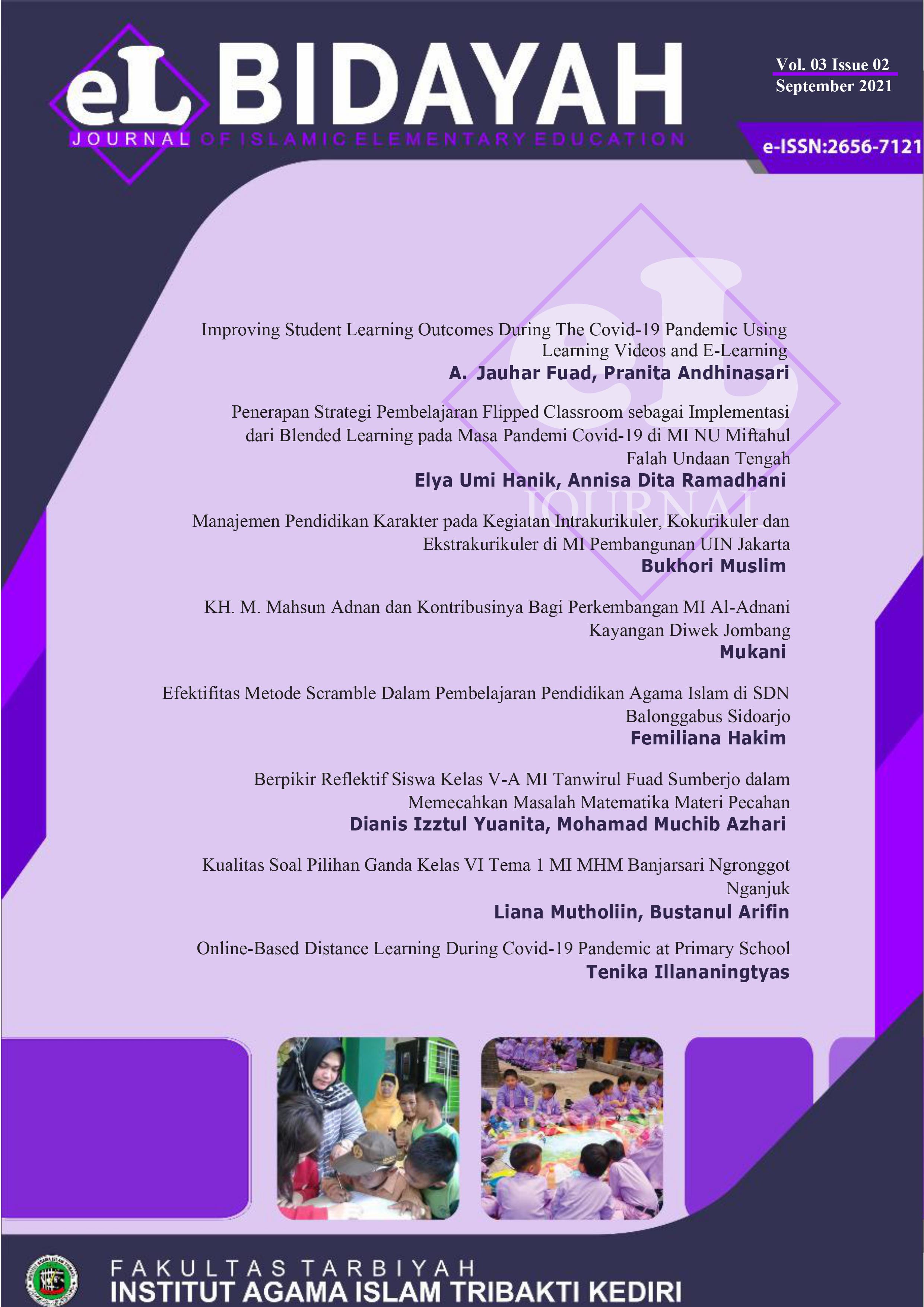
Penerapan Strategi Pembelajaran Flipped Classroom sebagai Implementasi dari Blended Learning pada Masa Pandemi Covid-19 di MI NU Miftahul Falah Undaan Tengah
DOI:
https://doi.org/10.33367/jiee.v3i2.1794Keywords:
Learning Strategies, Flipped Classroom, Blended LearningAbstract
This study aims to determine the process of implementing learning strategies with flipped classrooms as the implementation of blended learning in learning during the COVID-19 pandemic at MI NU Miftahul Falah Undaan Tengah. The research method used is a descriptive qualitative method by conducting interviews with class teachers. The learning process is carried out by combining online and offline learning with 50% online and 50% offline presentations. Students who do offline learning are divided into 2 stages, where 50% of the students leave on the first day, and the other 50% on the second day, and so on. With data collection techniques in the form of interviews and documentation, the results of the study indicated that the learning carried out with the flipped classroom blended learning strategy had several advantages and obstacles.
References
Andini, Dinar Westri. 2016. “Differentiated Instructionâ€: Solusi Pembelajaran dalam Keberagaman Siswa di Kelas Inklusif. Jurnal Pendidikan Ke-SD-an, Vol. 02, No. 3.
Anitah W., Sri. 2007. Modul Strategi Pembelajaran. (Jakarta: Universitas Terbuka)
Asrori, Mohammad. 2013. Pengertian, Tujuan dan Ruang Lingkup Strategi Pembelajaran. Jurnal Madrasah, Vol. 5, No. 2.
Bibi, Sarah dan Jati, Handaru. 2015. Efektivitas Model Blended Learning terhadap Motivasi dan Tingkat Pemahaman Mahasiswa Mata Kuliah Argoritma dan Pemrograman. Jurnal Pendidikan Vokasi, Vo. 5, No. 1.
Hendarita, Yane. 2012. Model Pembelajaran Blended Learning dengan Media Blog. Jurnal Pendidikan Vokasi, Vol.2, No.2.
Istiningsih, Siti dan Hasbullah. 2015. Blended Learning, Trend Strategi Pembelajaran Masa Depan. Jurnal Elemen, Vo. 1, No.1.
Majid, Abdul. 2017. Strategi Pembelajaran. (Bandung: PT. Remaja Rosdakarya).
Mudarwan. 2018. Penggunaan Model Pembelajaran Flipped Classroom dengan Moodle Sebagai Implementasi dari Blended Learning. Jurnal Pendidikan Penabur, No.31.
Muthmainnah, Siti. 2012. Model Pembelajaran Flipped Classroom. Jurnal Internasional, Vo. 9, No. 3.
Saputra, M. Eko Arif dan Mujib, Mujib. 2018. Efektifitas Model Classroom Menggunakan Video Pembelajaran Matematika terhadap Pemahaman Konsep. Jurnal Mtematika, Vol.1, No.2.
Sudarman. 2014. Pengaruh Strategi Pembelajaran Blended Learning terhadap Perolehan Belajar Konsep dan Prosedur pada Mahasiswa yang memiliki Self-Reguler Learning Berbeda. Jurnal Pendidikan dan Pembelajaran, Vol. 21, No. 1.
Syafruddin. 2014. Strategi Pembelajaran. (Medan: Perdana Publishing).
Ubaidillah, M. 2019. Penerapan Flipped Classroom Berbasis Teknologi Informasi pada Mata Pelajaran Fiqih di MTs Al- Chusnaniyah Surabaya. Jurnal Islamika: Jurnal Ilmu-Ilmu Keislaman, Vol. 19, No. 1.
Widiara, I Ketut. 2018. Blended Learning sebagai Alternatif Pembelajaran di Era Digital. Jurnal Purwadita, Vol. 2, No. 2.
Zain, Muhamad. 2017. Pengembangan Strategi Pembelajaran dan Pemilihan Bahan Ajar. IAIN Ternate, Vol. VI, No. 1.
 Abstract
Views:
300,
Abstract
Views:
300,  PDF downloads: 446
Published
Issue
Section
License
License and Copyright Agreement
In submitting the manuscript to the journal, the authors certify that:
- They are authorized by their co-authors to enter into these arrangements.
- The work described has not been formally published before, except in the form of an abstract or as part of a published lecture, review, thesis, or overlay journal.
- That it is not under consideration for publication elsewhere,
- That its publication has been approved by all the author(s) and by the responsible authorities – tacitly or explicitly – of the institutes where the work has been carried out.
- They secure the right to reproduce any material that has already been published or copyrighted elsewhere.
- They agree to the following license and copyright agreement.
Copyright
Authors who publish with El Bidayah:Journal of Islamic Elementary Education agree to the following terms:
- Authors retain copyright and grant the journal the right of first publication with the work simultaneously licensed under a Creative Commons Attribution License (CC BY-SA 4.0) that allows others to share the work with an acknowledgement of the work's authorship and initial publication in this journal.
- Authors are able to enter into separate, additional contractual arrangements for the non-exclusive distribution of the journal's published version of the work (e.g., post it to an institutional repository or publish it in a book), with an acknowledgment of its initial publication in this journal.
- Authors are permitted and encouraged to post their work online (e.g., in institutional repositories or on their website) before and during the submission process, as it can lead to productive exchanges, as well as earlier and greater citation of published work.
Licensing for Data Publication
El Bidayah: Journal of Islamic Elementary Education uses a variety of waivers and licenses, that are specifically designed for and appropriate for the treatment of data:
- Open Data Commons Attribution License, http://www.opendatacommons.org/licenses/by/1.0/ (default)
- Creative Commons CC-Zero Waiver, http://creativecommons.org/publicdomain/zero/1.0/
- Open Data Commons Public Domain Dedication and Licence, http://www.opendatacommons.org/licenses/pddl/1-0/
Other data publishing licenses may be allowed as exceptions (subject to approval by the editor on a case-by-case basis) and should be justified with a written statement from the author, which will be published with the article.
Open Data and Software Publishing and Sharing
The journal strives to maximize the replicability of the research published in it. Authors are thus required to share all data, code, or protocols underlying the research reported in their articles. Exceptions are permitted but have to be justified in a written public statement accompanying the article.
Datasets and software should be deposited and permanently archived in appropriate, trusted, general, or domain-specific repositories (please consult http://service.re3data.org and/or software repositories such as GitHub, GitLab, Bioinformatics.org, or equivalent). The associated persistent identifiers (e.g. DOI, or others) of the dataset(s) must be included in the data or software resources section of the article. Reference(s) to datasets and software should also be included in the reference list of the article with DOIs (where available). Where no domain-specific data repository exists, authors should deposit their datasets in a general repository such as ZENODO, Dryad, Dataverse, or others.
Small data may also be published as data files or packages supplementary to a research article, however, the authors should prefer in all cases a deposition in data repositories.

This work is licensed under a Creative Commons Attribution-ShareAlike 4.0 International License.