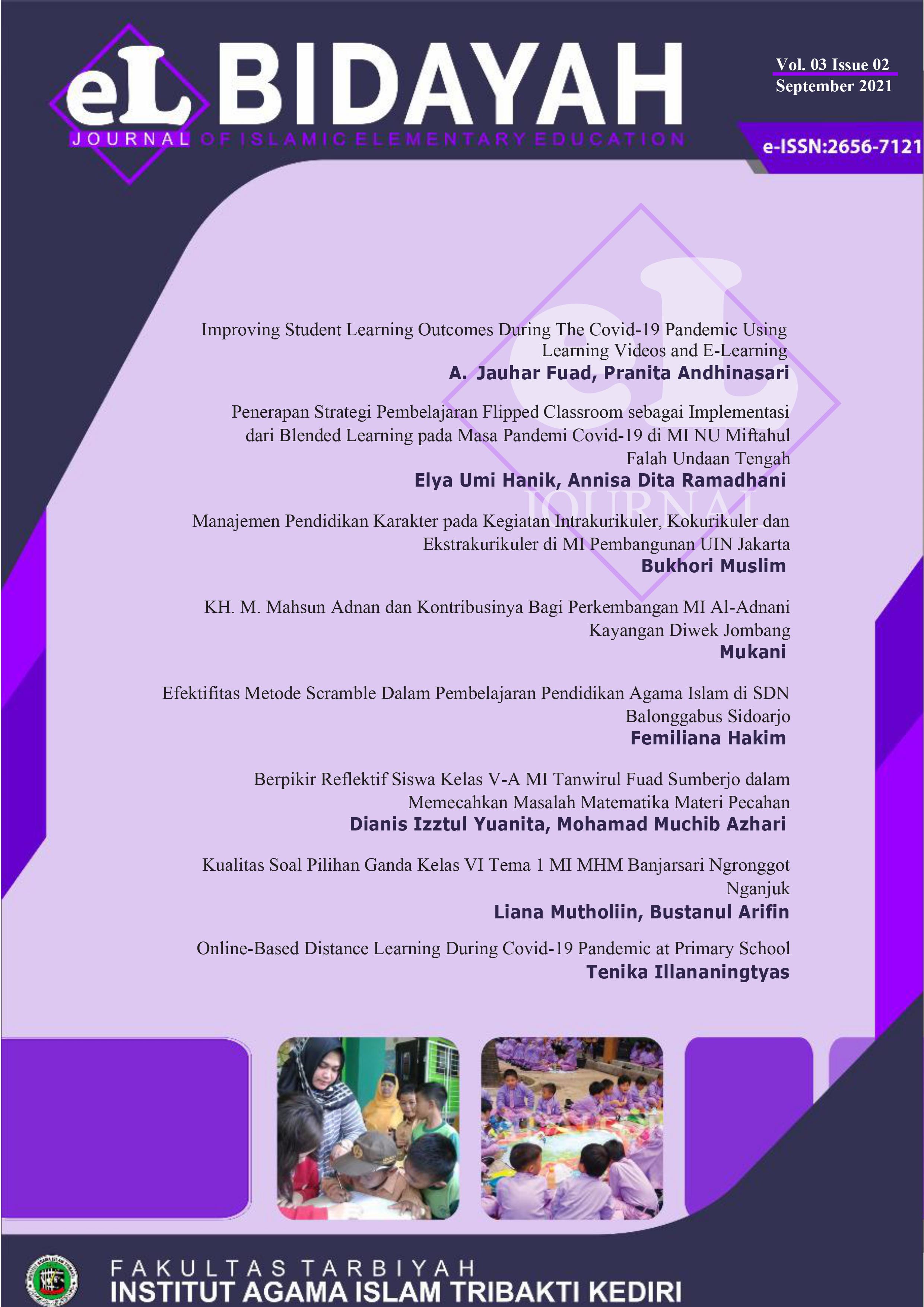
Manajemen Pendidikan Karakter pada Kegiatan Intrakurikuler, Kokurikuler dan Ekstrakurikuler di MI Pembangunan UIN Jakarta
DOI:
https://doi.org/10.33367/jiee.v3i2.1799Keywords:
Character Education, Intrakurikuler, Kokurikuler, ExtracurricularAbstract
Character education is one part of national development that is prioritized by the current government. In character education, every school/madrasah must integrate character values through activities, such as intra-curricular, co-curricular, and extra-curricular activities. However, the fact is that the character education implemented by schools/madrasas has not been implemented properly. One of the causes is the implementation of management functions in schools/madrasa that are less than optimal. The purpose of this study was to analyze and describe the implementation of character education management in intra-curricular, co-curricular, and extra-curricular activities at MI Pembangunan UIN Jakarta. This research uses a qualitative approach with a descriptive method. Data collection techniques through observation, interviews, and documentation. The data analysis technique uses the Miles and Huberman model, namely data reduction, data presentation, and conclusion. The results of this study are; Character education management refers to the management function, namely planning, organizing, implementing, and supervising the 5 main values of education, namely religious, nationalist, independent, cooperation, and integrity in every intracurricular, co-curricular, and extracurricular activity.
References
Adetule, Prince jide. The Handbook on Management Theories. USA: Author House, 2011. https://www.google.co.id/books/edition/The_Handbook_on_Management_Theories/6ABUhfT0wo0C?hl=id&gbpv=1&dq=Handbook+on+Management+Theories&printsec=frontcover.
Baharuddin. Manajemen Pendidikan Islam : Transformasi Menuju Sekolah Madrasah Unggul / Baharuddin. UIN Maliki Press, 2010. https://www.onesearch.id/Record/IOS3597.slims-24126#toc.
Bahri, Saiful. “MANAJEMEN PENDIDIKAN KEPRAMUKAAN DALAM PENGEMBANGAN PENDIDIKAN KARAKTER SANTRI (Studi Kasus Di Pondok Pesantren Darunnajah Ulujami Jakarta Selatan).†UIN Syarif Hidayatullah Jakarta, 2020.
Fransinatra, Ziko, Gita Sari Gustika, and Deci Ririen. “ANALISIS PENGARUH MANAJEMEN LEMBAGA PENDIDIKAN DAN PELATIHAN NON FORMAL (LPPNF) TERHADAP SUMBER DAYA MANUSIA DI KABUPATEN INDRAGIRI HULU†8, no. 2 (June 2019): 321–27. https://doi.org/https://doi.org/10.34006/jmbi.v8i2.115.
Hotman, Fritz, and S Damanik. “Hakikat Pancasila Dalam Membentuk Karakter Kebangsaan Melalui Organisasi Siswa Intra Sekolah.†Jurnal Pendidikan Ilmu-Ilmu Sosial 6, no. 2 (January 10, 2014): 49–60. https://doi.org/10.24114/JUPIIS.V6I2.2284.G1957.
Kemdikbud RI. Hari Sekolah (2017). http://luk.staff.ugm.ac.id/atur/bsnp/Permendikbud23-2017HariSekolah.pdf.
Kita, Kampus. “Problematika Pendidikan Di Sekolah Dasar.†14 oktober, 2019. http://koranbogor.com/berita/kampus-kita/problematika-pendidikan-di-sekolah-dasar/.
Mulyono; Manajemen Administrasi Dan Organisasi Pendidikan. Yogyakarta: Ar-Ruzz Media, 2010. http://library.fip.uny.ac.id/opac/index.php?p=show_detail&id=5202.
Nafiah, Wasilatun. “Manajemen Pendidikan Karakter (Studi Kasus Di SMP 2 Muhammadiyah Malang.†UIN Maulana malik ibrahim, 2019.
Nata, Abuddin. Akhlak Tasawuf Dan Karakter Mulia (Edisi Revisi) |. Revisi. jakarta: Raja Grafinfo Persada, 2017.
Rokhman, Fathur, M. Hum, Ahmad Syaifudin, and Yuliati. “Character Education for Golden Generation 2045 (National Character Building for Indonesian Golden Years).†Procedia - Social and Behavioral Sciences 141 (2014): 1161–65. https://doi.org/10.1016/j.sbspro.2014.05.197.
Sadikin, Ali, and Afreni Hamidah. “View of Pembelajaran Daring Di Tengah Wabah Covid-19.†Jurnal Ilmiah Biologi 6, no. 2 (2020): 214–24. https://doi.org/https://doi.org/10.22437/bio.v6i2.9759.
Setyowati, Eva Rusdiana Devi and Sri. “PARTISIPASI MASYARAKAT DALAM IMPLEMENTASI EKSTRAKURIKULER DI SDN AIRLANGGA 1/ 198 SURABAYA | RUSDIANA DEVI | Inspirasi Manajemen Pendidikan.†Inspirasi Manajemen Pendidikan 7, no. 1 (2019): 1–13. https://jurnalmahasiswa.unesa.ac.id/index.php/inspirasi-manajemen-pendidikan/article/view/28522/26100.
sugiyono‬. Metode Peneltian Pendidikan (Pendekatan Kuantitatif, Kualitatif, Dan R&D). 10th ed. bandung: alfabeta, 2010.
Zuriyah, Nurul, Moh. Syaifuddin, and Marhan Taufik. Pendidikan Karakter ACPI: Model Pendidikan Karakter Bangsa Untuk Kemandirian Pangan Melalui Gerakan Aku Cinta Produk Indonesia. malang, 2017.
 Abstract
Views:
1197,
Abstract
Views:
1197,  PDF downloads: 1435
Published
Issue
Section
License
License and Copyright Agreement
In submitting the manuscript to the journal, the authors certify that:
- They are authorized by their co-authors to enter into these arrangements.
- The work described has not been formally published before, except in the form of an abstract or as part of a published lecture, review, thesis, or overlay journal.
- That it is not under consideration for publication elsewhere,
- That its publication has been approved by all the author(s) and by the responsible authorities – tacitly or explicitly – of the institutes where the work has been carried out.
- They secure the right to reproduce any material that has already been published or copyrighted elsewhere.
- They agree to the following license and copyright agreement.
Copyright
Authors who publish with El Bidayah:Journal of Islamic Elementary Education agree to the following terms:
- Authors retain copyright and grant the journal the right of first publication with the work simultaneously licensed under a Creative Commons Attribution License (CC BY-SA 4.0) that allows others to share the work with an acknowledgement of the work's authorship and initial publication in this journal.
- Authors are able to enter into separate, additional contractual arrangements for the non-exclusive distribution of the journal's published version of the work (e.g., post it to an institutional repository or publish it in a book), with an acknowledgment of its initial publication in this journal.
- Authors are permitted and encouraged to post their work online (e.g., in institutional repositories or on their website) before and during the submission process, as it can lead to productive exchanges, as well as earlier and greater citation of published work.
Licensing for Data Publication
El Bidayah: Journal of Islamic Elementary Education uses a variety of waivers and licenses, that are specifically designed for and appropriate for the treatment of data:
- Open Data Commons Attribution License, http://www.opendatacommons.org/licenses/by/1.0/ (default)
- Creative Commons CC-Zero Waiver, http://creativecommons.org/publicdomain/zero/1.0/
- Open Data Commons Public Domain Dedication and Licence, http://www.opendatacommons.org/licenses/pddl/1-0/
Other data publishing licenses may be allowed as exceptions (subject to approval by the editor on a case-by-case basis) and should be justified with a written statement from the author, which will be published with the article.
Open Data and Software Publishing and Sharing
The journal strives to maximize the replicability of the research published in it. Authors are thus required to share all data, code, or protocols underlying the research reported in their articles. Exceptions are permitted but have to be justified in a written public statement accompanying the article.
Datasets and software should be deposited and permanently archived in appropriate, trusted, general, or domain-specific repositories (please consult http://service.re3data.org and/or software repositories such as GitHub, GitLab, Bioinformatics.org, or equivalent). The associated persistent identifiers (e.g. DOI, or others) of the dataset(s) must be included in the data or software resources section of the article. Reference(s) to datasets and software should also be included in the reference list of the article with DOIs (where available). Where no domain-specific data repository exists, authors should deposit their datasets in a general repository such as ZENODO, Dryad, Dataverse, or others.
Small data may also be published as data files or packages supplementary to a research article, however, the authors should prefer in all cases a deposition in data repositories.

This work is licensed under a Creative Commons Attribution-ShareAlike 4.0 International License.