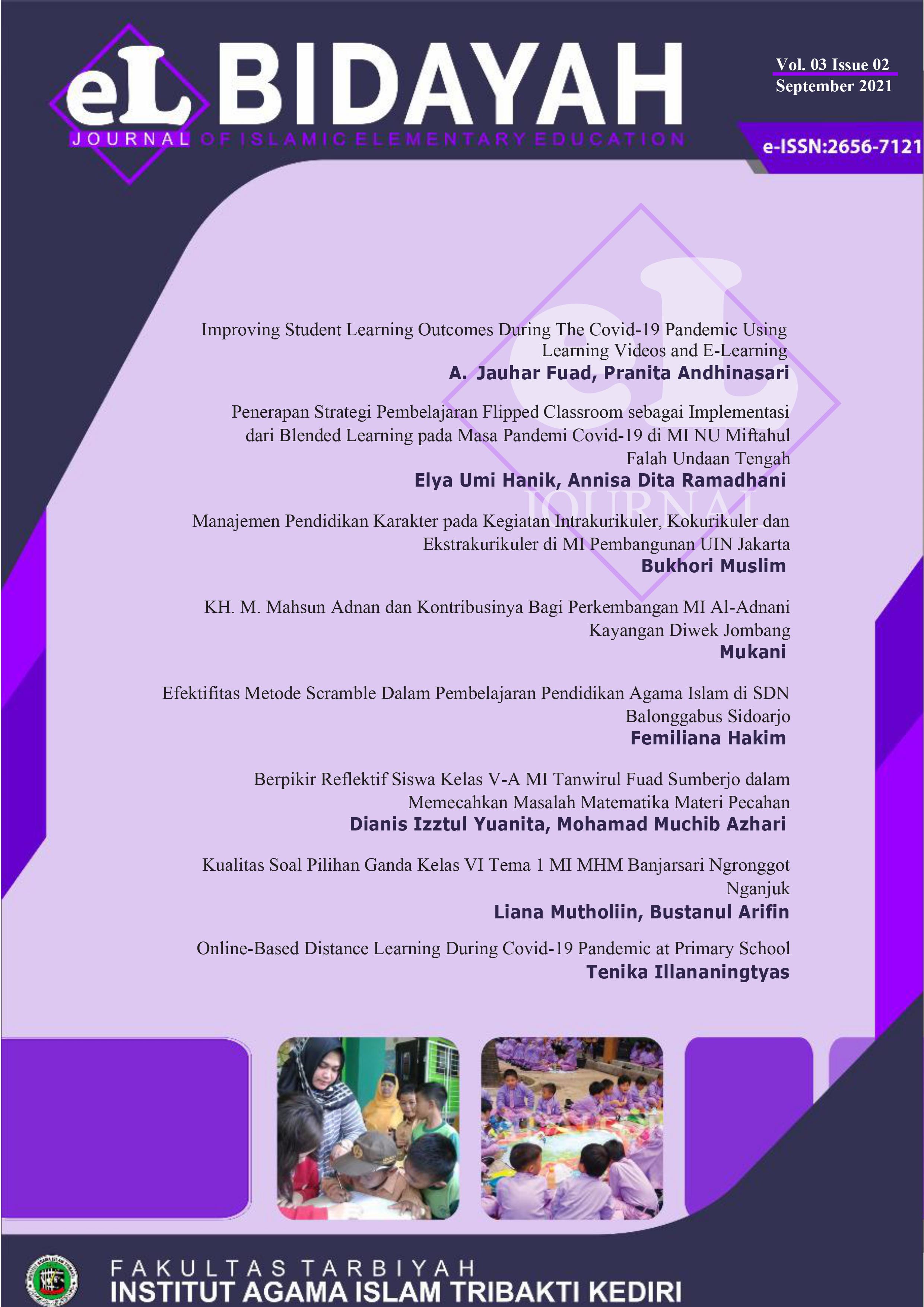
KH. M. Mahsun Adnan dan Kontribusinya Bagi Perkembangan MI Al-Adnani Kayangan Diwek Jombang
DOI:
https://doi.org/10.33367/jiee.v3i2.1872Keywords:
Contribution, Mahsun Adnan, Educational DevelopmentAbstract
The madrasa role has long been recognized by the community. Based on Law Number 20 of 2003 concerning the National Education System, the madrasa is a national education sub-system. This article is descriptive-analytic with a qualitative approach. The data was collected through interviews, documentation, and observation. The data is then analyzed by non-statistics, such as data reduction, data presentation, and conclusion drawing. The study describes a brief biography of KH. M. Mahsun Adnan was born in Nglaban, he studied at Tebuireng, and after that, he studied at PGA. After graduating, he continued his studies at Undar and then dedicated himself to da'wah and education until his death. The second focus is the struggle of KH. M. Mahsun Adnan toward Al-Adnani Islamic Elementary School Jombang, starting from being a pioneer, becoming the head of a madrasa, teaching in it, and fighting to make the madrasa run up. So far, Al-Adnani Islamic Elementary School Jombang has shown its existence continuously in bringing forward the community around through education.
References
Arikunto, Suharsimi. Prosedur Penelitian. Jakarta: Rineka Cipta, 2010.
Aminuddin, Muhammad. Ketua Yayasan Al-Adnani, wawancara, 27 Februari 2021.
Ahya, Akhmad Sauqi. Menantu Kiai Mahsun, wawancara, 9 Februari 2021.
Dokumen sajarah pendirian MI Al-Adanani Kayangan, tahun 2018.
Drajat, Manpan. “Sejarah Madrasah di Indonesia,†al-Afkar: Journal for Islamic Studies, Vol. 1 No. 1 (Januari 2018).
Haderani. “Pesantren, Madrasah dan Sekolah Dalam Perspektif Pemikiran Pendidikan Islam,†Jurnal Tarbiyah Darussalam, Vol. 4 No. 6 (2020).
Hadi, Sutrisno. Metodologi Research. Yogyakarta: Andi Offset, 1987.
Haningsih, Sri. “Peran Strategis Pesantren, Madrasah dan Sekolah Islam di Indonesia,†El-Tarbawi, Vol. 1 No. 1 (2008).
Hasri. “Madrasah Sebagai Lembaga Pendidikan Islam,†Al-Khwarizmi, Vol. 2, No. 1 (Maret 2014).
http://emispendis.kemenag.go.id/dashboard/index.php?content=madrasah&action=lbg&nss=11123570025, diunduh 20 Juli 2021.
Khotimah, Siti Nur. “Pengaruh pelaksanaan pendidikan agama dalam keluarga terhadap keaktifan belajar agama siswa kelas V di MI Al-Adnani Kayangan Diwek Jombang,†Skripsi. Mojokerto: STIT Raden Wijaya, 2012.
Kustoyo. Guru MI Al-Adnani, wawancara, 15 Juli 2021.
Mizani, Hilmi. “Pendidikan Madrasah: Kebijakan dan Sistem Madrasah di Indonesia,†Jurnal Tarbiyah Islamiyah, Vol. 3 No. 2 (2013).
Moleong, Lexy J. Metodologi Penelitian Kualitatif. Bandung: Remaja Rosdakarya, 2010.
Muhajir, Noeng. Metodologi Penelitian Kualitatif. Yogyakarta: Reke Sarasean, 2014.
Nasution, S. Metode Penelitian Naturalistik Kualitatif. Bandung: Tarsito, 2012.
Nazir, Moh. Metode Penelitian. Jakarta: Balai Aksara, 2015.
Observasi, 15 Juli 2021.
Qomariyah, Lailatul. “Pemanfaatan Aplikasi Kahoot Pada Evaluasi Jombang,†Prosiding Seminar Nasional Sainsteknopak 2020, Universitas Hasyim Asy’ari Tebuireng Jombang.
Rokhim, Abdur. Kepala TK Al-Husaini Kepuhpandak, wawancara, 11 Juli 2021.
Suwandi, Slamet. Kepala MI Al-Adnani, wawancara, 10 Juli 2021.
 Abstract
Views:
139,
Abstract
Views:
139,  PDF downloads: 121
Published
Issue
Section
License
License and Copyright Agreement
In submitting the manuscript to the journal, the authors certify that:
- They are authorized by their co-authors to enter into these arrangements.
- The work described has not been formally published before, except in the form of an abstract or as part of a published lecture, review, thesis, or overlay journal.
- That it is not under consideration for publication elsewhere,
- That its publication has been approved by all the author(s) and by the responsible authorities – tacitly or explicitly – of the institutes where the work has been carried out.
- They secure the right to reproduce any material that has already been published or copyrighted elsewhere.
- They agree to the following license and copyright agreement.
Copyright
Authors who publish with El Bidayah:Journal of Islamic Elementary Education agree to the following terms:
- Authors retain copyright and grant the journal the right of first publication with the work simultaneously licensed under a Creative Commons Attribution License (CC BY-SA 4.0) that allows others to share the work with an acknowledgement of the work's authorship and initial publication in this journal.
- Authors are able to enter into separate, additional contractual arrangements for the non-exclusive distribution of the journal's published version of the work (e.g., post it to an institutional repository or publish it in a book), with an acknowledgment of its initial publication in this journal.
- Authors are permitted and encouraged to post their work online (e.g., in institutional repositories or on their website) before and during the submission process, as it can lead to productive exchanges, as well as earlier and greater citation of published work.
Licensing for Data Publication
El Bidayah: Journal of Islamic Elementary Education uses a variety of waivers and licenses, that are specifically designed for and appropriate for the treatment of data:
- Open Data Commons Attribution License, http://www.opendatacommons.org/licenses/by/1.0/ (default)
- Creative Commons CC-Zero Waiver, http://creativecommons.org/publicdomain/zero/1.0/
- Open Data Commons Public Domain Dedication and Licence, http://www.opendatacommons.org/licenses/pddl/1-0/
Other data publishing licenses may be allowed as exceptions (subject to approval by the editor on a case-by-case basis) and should be justified with a written statement from the author, which will be published with the article.
Open Data and Software Publishing and Sharing
The journal strives to maximize the replicability of the research published in it. Authors are thus required to share all data, code, or protocols underlying the research reported in their articles. Exceptions are permitted but have to be justified in a written public statement accompanying the article.
Datasets and software should be deposited and permanently archived in appropriate, trusted, general, or domain-specific repositories (please consult http://service.re3data.org and/or software repositories such as GitHub, GitLab, Bioinformatics.org, or equivalent). The associated persistent identifiers (e.g. DOI, or others) of the dataset(s) must be included in the data or software resources section of the article. Reference(s) to datasets and software should also be included in the reference list of the article with DOIs (where available). Where no domain-specific data repository exists, authors should deposit their datasets in a general repository such as ZENODO, Dryad, Dataverse, or others.
Small data may also be published as data files or packages supplementary to a research article, however, the authors should prefer in all cases a deposition in data repositories.

This work is licensed under a Creative Commons Attribution-ShareAlike 4.0 International License.