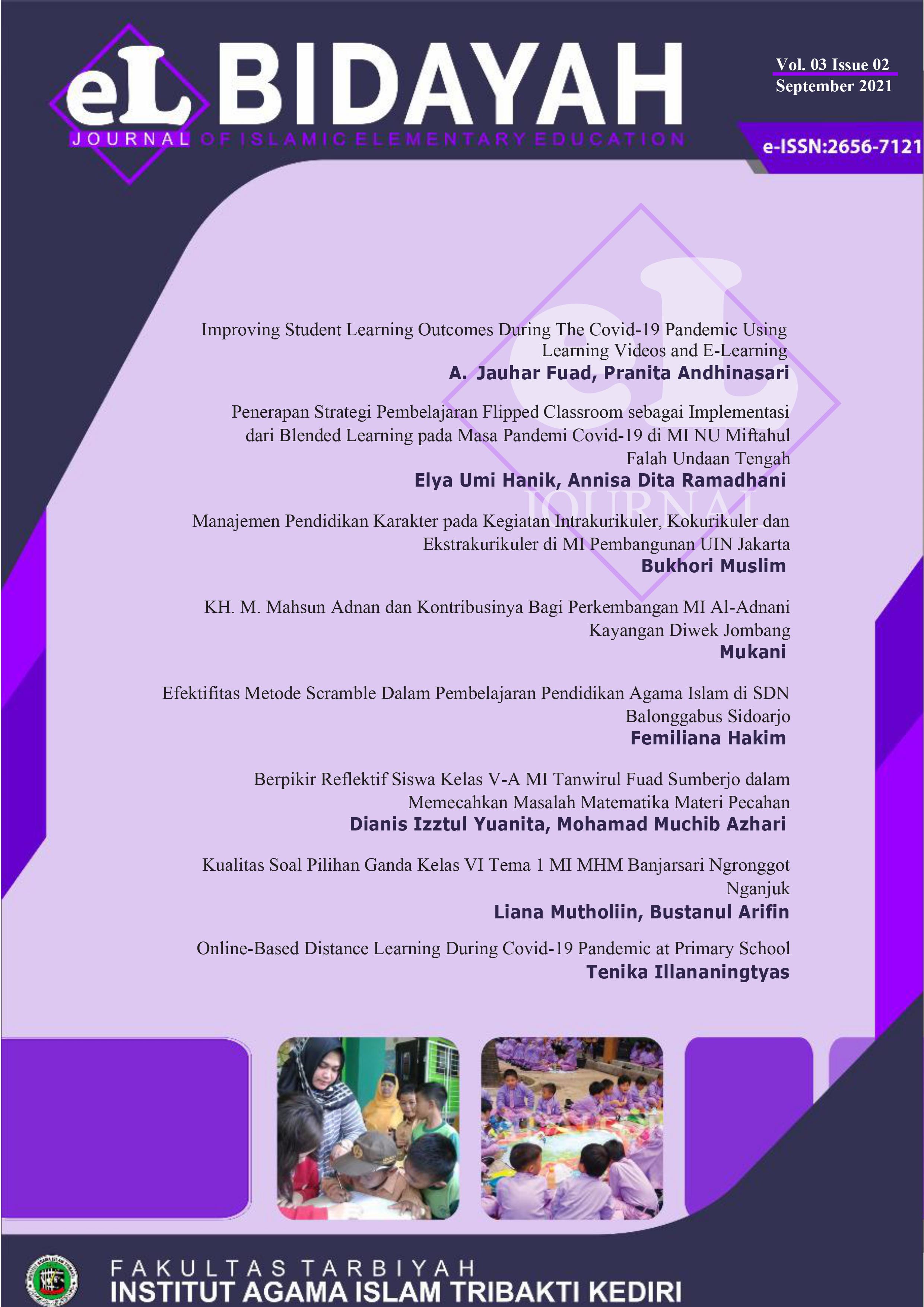
Efektifitas Metode Scramble Dalam Pembelajaran Pendidikan Agama Islam di SDN Balonggabus Sidoarjo
DOI:
https://doi.org/10.33367/jiee.v3i2.1917Keywords:
Scramble, Islamic Education, Elementary SchoolAbstract
Islamic religious education learning (PAI) at elementary school has been dominated teachers and is not conducted maximally. This causes students' attention less focused on the teaching and learning process. To overcome this problem, it needs an alternative learning method. This article is descriptive-analytic using a qualitative approach. The data is collected using a literature study. The research results indicate three things. The first is, that the scramble method is a relatively new learning technique, it also makes students actively involved in the teaching and learning process. The second is, that PAI learning is still dominated by the teacher which causes students to be less active and results in learning outcomes too low. The third is, that the scramble method is very important to be applied in PAI learning for elementary schools. This is done to improve student learning outcomes and change the monotonous learning methods.
References
Ahmad, Muhammad Abdul Qadir. Metodologi Pengajaran Agama Islam. Jakarta: Rineka Cipta, 2008.
Ali, Idrus dan Fachrudin Saudagar. Pengembangan Profesionalitas Guru. Jakarta: GP Pres, 2009.
Arikunto, Suharsimi. Prosedur Penelitian. Jakarta: Rineka Cipta, 2010.
Darajat, Zakiah. Ilmu Pendidikan Islam. Jakarta: Bumi Aksara, 2008.
Ditjen Dikdasmen Depdiknas. Pedoman Khusus Pengembangan Silabus Berbasis Kompetensi SekolahMenengah Pertama. Jakarta: Depdiknas, 2004.
Echols, Jhon M. dan Hasan Shadiliy, Kamus Ingrris Indonesia. Jakarta: Gramedia, 2003.
Fitriana, Isna. “Penerapan Model Pembelajaran Scramble Untuk Meningkatkan Hasil Belajar Siswa Pada Materi Tata Nama Senyawa Di SMAN 1 Bireuen.†Skripsi. Lampung: IAIN Randen Intan Lampung, 2016.
Fuad, Ihsan. Dasar-Dasar Kependidikan. Jakarta: Rineka Cipta, 2010.
Handini, Gian. “Penerapan Model Pembelajaran Scramble Untuk Meningkatkan Hasil Belajar IPS Siswa Kelas V SDN 21 Palembang.†Skripsi. Palembang: Universitas Sriwijaya, 2016.
H.M. Arifin. “Ilmu Pendidikan Islam,†dalam http: //wonk education network. blogspot. com/2007/03/pendidikan-agama-islam.html, diunduh 22 Februari 2021 jam 14.45 WIB.
Huda, Miftahul. Model Pengajaran dan Pembelajaran Isu-isu Metodis dan Pragmatis. Yogyakarta: Pustaka Pelajar, 2013.
Komalasari, Kokom. Pembelajaran Kontekstual Konsep dan Aplikasi. Bandung: Refika Aditama, 2010.
Majid, Abdul dan Dian Andayani. Pendidikan Agama Islam Berbasis Kompetensi. Bandung: PT Remaja Rosdakarya, 2004.
Nasution, S. Metode Penelitian Naturalistik Kualitatif. Bandung: Tarsito, 2012.
Nazir, Moh. Metode Penelitian. Jakarta: Balai Aksara, 2015.
Nurlina. “Penerapan Metode Scramble Untuk Meningkatkan Motivasi Belajar Fisika Siswa Kelas X SMA Muhammadiyah Unismuh Makassar.†Skripsi. Makassar: Universitas Muhammadiyah, 2018.
Nurwidar. ““Penerapan Strategi Pembelajaran Scramble Untuk Meningkatkan Kemampuan Membaca Al-Qur’an Surat Pendek Pilihan Pada Mata Pelajaran Pendidikan Agama Islam Siswa Kelas V SDN 018 Tandan Sari Kecamatan Tapung Hilir Kabupaten Kampar.†Skripsi. Pekanbaru: UIN Syarif kasim, 2010.
Octavia, Yenni. “Pengaruh Metode Scramble Terhadap Hasil Belajar Siswa Pada Mata Pelajaran Pendidikan Agama Islam SDN 007 Tembilahan Hilir Kecamatan Tembilahan Kabupaten Indragiri Hilir.†Jurnal Pendidikan Asatiza, Vol. 1 No. 2 (Mei 2020).
Ramayulis. Ilmu Pendidikan Islam. Jakarta: Kalam Mulia, 2010.
Sani, Ridwan Abdullah. Inovasi Pembelajaran. Jakarta: Bumi Aksara, 2013.
Sardiman. Interaksi dan Motivasi Belajar Mengajar. Jakarta: PT Grafindo Persada, 2012.
Shoimin, Aris. 68 Model Pembelajaran Inovatif dalam Kurikulum 2013. Bandung: Ar-Ruzz Media, 2014.
Sofyan, Andika. “Penerapan Metode Scramble Untuk Meningkatkan Hasil Belajar Fiqih Siswa Kelas VIII E MTS Negeri 1 Lampung Timur Tahun Pelajaran 2018/2019.†Skripsi. Lampung Timur: IAIN Metro, 2019.
Syafika, Nurul. “Pengaruh Penerapan Metode Pembelajaran Scramble Terhadap Hasil Belajar Peserta Didik Pada Bidang Studi Pendidikan Agama Islam Kelas VIII di SMPN 5 Maiwa Kabupaten Enrekang.†Skripsi. Makasar: UIN Alauddin, 2017.
Trianto. Mendesain Model Pembelajaran Inovatif Progresif. Jakarta: Kencana Media Group, 2011.
Yunahar, Ilyas. Kuliah Akhlak. Yogyakarta: LPPIUMG, 2006.
 Abstract
Views:
345,
Abstract
Views:
345,  PDF downloads: 517
Published
Issue
Section
License
License and Copyright Agreement
In submitting the manuscript to the journal, the authors certify that:
- They are authorized by their co-authors to enter into these arrangements.
- The work described has not been formally published before, except in the form of an abstract or as part of a published lecture, review, thesis, or overlay journal.
- That it is not under consideration for publication elsewhere,
- That its publication has been approved by all the author(s) and by the responsible authorities – tacitly or explicitly – of the institutes where the work has been carried out.
- They secure the right to reproduce any material that has already been published or copyrighted elsewhere.
- They agree to the following license and copyright agreement.
Copyright
Authors who publish with El Bidayah:Journal of Islamic Elementary Education agree to the following terms:
- Authors retain copyright and grant the journal the right of first publication with the work simultaneously licensed under a Creative Commons Attribution License (CC BY-SA 4.0) that allows others to share the work with an acknowledgement of the work's authorship and initial publication in this journal.
- Authors are able to enter into separate, additional contractual arrangements for the non-exclusive distribution of the journal's published version of the work (e.g., post it to an institutional repository or publish it in a book), with an acknowledgment of its initial publication in this journal.
- Authors are permitted and encouraged to post their work online (e.g., in institutional repositories or on their website) before and during the submission process, as it can lead to productive exchanges, as well as earlier and greater citation of published work.
Licensing for Data Publication
El Bidayah: Journal of Islamic Elementary Education uses a variety of waivers and licenses, that are specifically designed for and appropriate for the treatment of data:
- Open Data Commons Attribution License, http://www.opendatacommons.org/licenses/by/1.0/ (default)
- Creative Commons CC-Zero Waiver, http://creativecommons.org/publicdomain/zero/1.0/
- Open Data Commons Public Domain Dedication and Licence, http://www.opendatacommons.org/licenses/pddl/1-0/
Other data publishing licenses may be allowed as exceptions (subject to approval by the editor on a case-by-case basis) and should be justified with a written statement from the author, which will be published with the article.
Open Data and Software Publishing and Sharing
The journal strives to maximize the replicability of the research published in it. Authors are thus required to share all data, code, or protocols underlying the research reported in their articles. Exceptions are permitted but have to be justified in a written public statement accompanying the article.
Datasets and software should be deposited and permanently archived in appropriate, trusted, general, or domain-specific repositories (please consult http://service.re3data.org and/or software repositories such as GitHub, GitLab, Bioinformatics.org, or equivalent). The associated persistent identifiers (e.g. DOI, or others) of the dataset(s) must be included in the data or software resources section of the article. Reference(s) to datasets and software should also be included in the reference list of the article with DOIs (where available). Where no domain-specific data repository exists, authors should deposit their datasets in a general repository such as ZENODO, Dryad, Dataverse, or others.
Small data may also be published as data files or packages supplementary to a research article, however, the authors should prefer in all cases a deposition in data repositories.

This work is licensed under a Creative Commons Attribution-ShareAlike 4.0 International License.