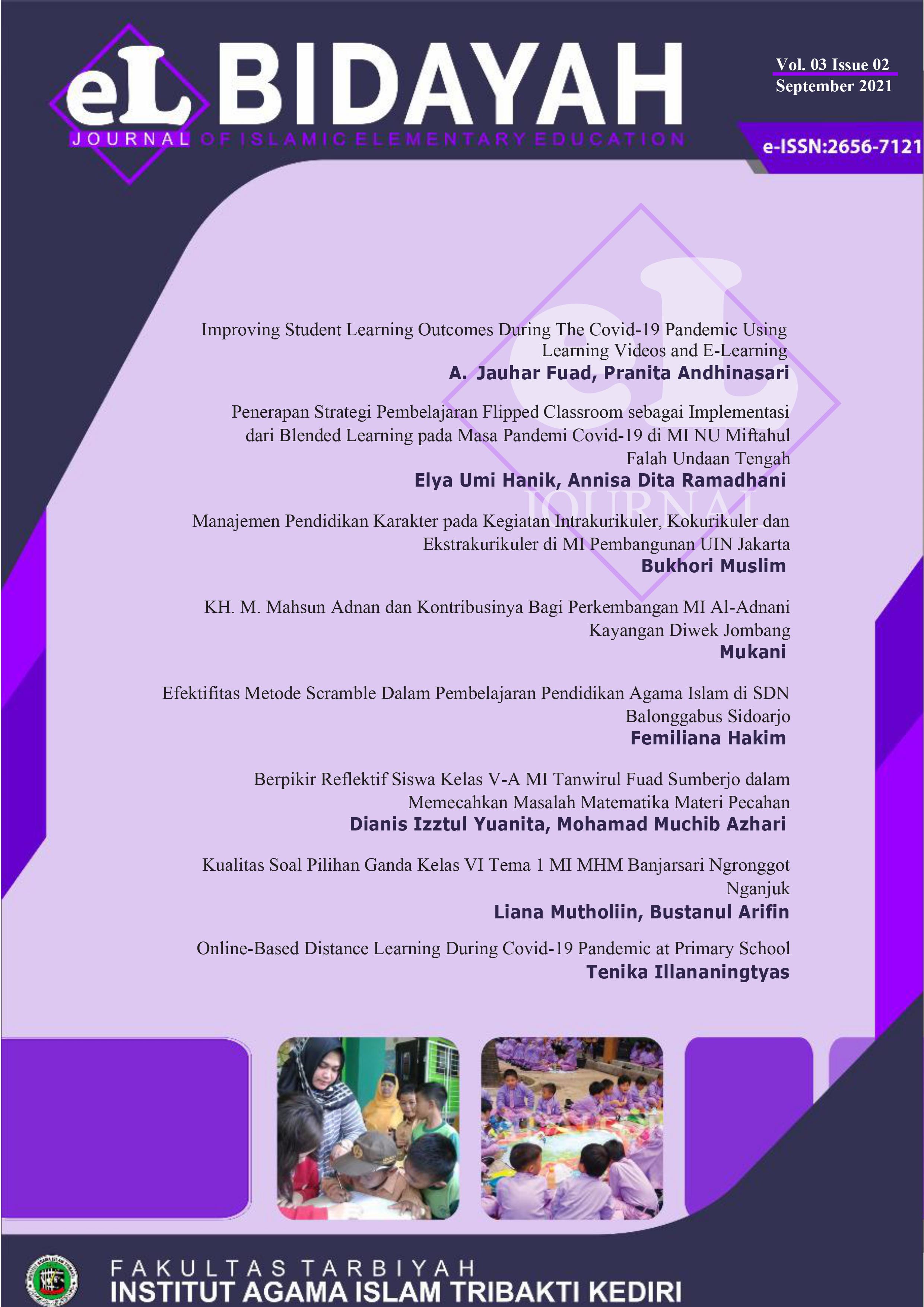
Kualitas Soal Pilihan Ganda Kelas VI Tema 1 MI MHM Banjarsari Ngronggot Nganjuk
DOI:
https://doi.org/10.33367/jiee.v3i2.1930Keywords:
Quality, Multiple Choice Questions, Islamic Elementary SchoolAbstract
This research was conducted to find out how to compile and analyze the Odd End Semester Assessment questions at MI MHM Banjarsari, and to determine the quality of the multiple-choice items of the Odd End Semester Assessment Grade VI Theme 1 MI MHM Banjarsari Academic Year 2019/2020. The research design used in the analysis of the quality of the multiple-choice items Final Assessment of the odd semester class VI Theme 1 MI MHM Banjarsari Academic Year 2019/2020 is quantitative descriptive. Data collection in this study used the document analysis method. The source of the data of this study was the question sheets and answer sheets of students participating in the Odd End Semester Assessment (PAS) of Class VI Theme 1 MI MHM Banjarsari. Calculation of the level of difficulty, different powers, the effectiveness of deceit, and the validity and reliability of the instrument in this study using the Anates V 0.4 program. The results of the research that have been done show that the quality of the final semester 1 question items in MI MHM Banjarsari in 2019/2020 from a total of 35 multiple choice questions viewed from the difficulty level obtained as many as 10 items (28.57%) with the difficulty level of questions in very easy category, 7 items (20%) in the easy category, 14 items (40%) in the medium category, 3 items (8.57%) in the difficult category, and 1 item (2.86%) in the very difficult category. Judging from the different power of the final semester assessment questions, theme 1 found 5 items (14.29%) in the very bad category, 13 items (37.14%) in the bad category, 6 items (17.14%) in the category enough, 10 items (28.57%) in the good category, and 1 item (2.86%) in the very good category. Judging from the deception of answers to the odd semester final assessment questions, there were 3 questions (8.57% in the very bad category, 6 questions (17.14%) in the bad category, 4 questions (11.48%) in the good category, and 22 questions (62.86%) in the very good category Judging from the validity of the odd semester final evaluation questions theme 1 obtained valid questions (significant / very significant) of 15 questions (42.86%) and for invalid questions a total of 20 questions (57.14%) In terms of reliability, it was obtained 0.81. Thus it can be concluded that the quality of the items can be said to be less good.
References
Alpusari, M. Analisis Butir Soal Konsep Dasar IPA 1 melalui Penggunaan Program Komputer Anates Versi 4.0 For Windows. Jurnal Primary, tersedia Online di https://media.neliti.com/media/ publications/258202-analisis-butir-soal-konsep-dasar-ipa-1m2d710558 .pd (diakses pada 27 Januari 2021).
Amanaturrakhmah, I., Kardoyo., & Rifai, A. (2017). Manajemen Pembelajaran Tematik di Kelas Tinggi SD Percontohan Kabupaten Indramayu. Journal of Primary Education, tersedia Online di https://journal.unnes.ac.id/sju/index.php/jpe/article/view/17570 (diakses pada 27 Januari 2021).
Ahmad Khoirul Mustamir, Resistensi Kepemimpinan Perempuan Eks - Hizbut Tahrir Indonesia Dalam Lembaga Pendidikan Dasar Islam Di Kota Kediri, h. 27. https://jurnal.iainponorogo.ac.id/index.php/ijougs/article/view/2492 diakses 5 Mei 2021.
Aksarahttps://geografikritis.blogspot.com/2016/01/anates-v-409-software-evaluasi.html Anidi, Evaluasi Program Pembelajaran. Yogyakarta:Parama Publishing, 2017.
Arifin, Z. Evaluasi Pembelajaran. Bandung: PT Remaja Rosdakarya, 2013.
Arikunto, Suharsimi. Dasar-Dasar Evaluasi Pendidikan. Jakarta: PT. Bumi, 2011
Firmansyah, Hasim. Analisis Butir Soal Tes Plihan Ganda Mata Pelajaran Pendidikan Jasmani Olahraga dan Kesehatan Kelas VIII SMPN 1 Wonosari Tahun 2017/2018. Yogyakarta, 2018
Halik, Andi Surahma. Analisis Butir Soal Ujian Akhir Sekolah (UAS) Mata Pelajaran Matematika pada Tahun 2016 SMP Negeri 36 Makassar. Makasar, 2017.
https://suaidinmath.wordpress.com/2014/04/23/manfaat-penilaian-pembelajaran/. https://bimbelbrilian.com/jenis-jenis-soal-untuk-evaluasi-pembelajaran-sekolah-beserta-contohnya/ https://www.asikbelajar.com/pengertian-penilaian-hasil-belajar/.
Isnaeni, Ahmad. Analisis Butir Soal Tes Plihan Ganda Mata Pelajaran Pendidikan Jasmani Olahraga dan Kesehatan Kelas VIII SMPN 1 Wonosari Tahun 2017/2018. Purworejo, 2018.
Karim, Nurman. Kisi-kisi soal dan kartu soal, https://nurmanspd. wordpress.com /2009/09/27/kisi- kisi-soal-dan-kartu-soal/.
Kurniawan, Tutut. Analisis Butir Soal Ujian Akhir Semester Gasal Mata Pelajaran IPS Sekolah Dasar, Journal of eElementary Education 4, no.1, 2015.
Lubis, Syarifuddin, & Dongoran (2016). Analisis Butir Soal dan Kemampuan Siswa Menjawab Tes UN dan UAS Ganjil Mata Pelajaran Biologi Kelas XI SMAN/MAN di Kota Medan. Universitas Negeri Medan. Jurnal Pelita Pendidikan, tersedia online di http:// jurnalpelitapendidikan. pdf (diakses pada 1 Februari 2021.
Paturusi, Aji. Analisis Butir Soal Ujian Akhir Semester Gasal (UAS) Mata Pelajaran Pendidikan Kewarganegaraan Kelas IV SDN 1 Banjarsari Kulon Kecamatan Sumbang Tahun Ajaran 2016/2017. Purwokerto, 2018.
Sukardi, Dewa Ketut dan Desak P. E. Nila Kusmawati. Analisis Tes Psikologis Tes Psikologis Teori dan Praktik. Jakarta: Rineka Cipta, 2009.
Umronah, Analisis Kualitas Butir Soal Ujian Akhir Semester Genap Mata Pelajaran Ekonomi Akuntansi Kelas XI PS SMA Negeri 1 Imogiri Tahun Ajaran 2016/2017. Yogyakarta, 2018.
 Abstract
Views:
199,
Abstract
Views:
199,  PDF downloads: 140
Published
Issue
Section
License
License and Copyright Agreement
In submitting the manuscript to the journal, the authors certify that:
- They are authorized by their co-authors to enter into these arrangements.
- The work described has not been formally published before, except in the form of an abstract or as part of a published lecture, review, thesis, or overlay journal.
- That it is not under consideration for publication elsewhere,
- That its publication has been approved by all the author(s) and by the responsible authorities – tacitly or explicitly – of the institutes where the work has been carried out.
- They secure the right to reproduce any material that has already been published or copyrighted elsewhere.
- They agree to the following license and copyright agreement.
Copyright
Authors who publish with El Bidayah:Journal of Islamic Elementary Education agree to the following terms:
- Authors retain copyright and grant the journal the right of first publication with the work simultaneously licensed under a Creative Commons Attribution License (CC BY-SA 4.0) that allows others to share the work with an acknowledgement of the work's authorship and initial publication in this journal.
- Authors are able to enter into separate, additional contractual arrangements for the non-exclusive distribution of the journal's published version of the work (e.g., post it to an institutional repository or publish it in a book), with an acknowledgment of its initial publication in this journal.
- Authors are permitted and encouraged to post their work online (e.g., in institutional repositories or on their website) before and during the submission process, as it can lead to productive exchanges, as well as earlier and greater citation of published work.
Licensing for Data Publication
El Bidayah: Journal of Islamic Elementary Education uses a variety of waivers and licenses, that are specifically designed for and appropriate for the treatment of data:
- Open Data Commons Attribution License, http://www.opendatacommons.org/licenses/by/1.0/ (default)
- Creative Commons CC-Zero Waiver, http://creativecommons.org/publicdomain/zero/1.0/
- Open Data Commons Public Domain Dedication and Licence, http://www.opendatacommons.org/licenses/pddl/1-0/
Other data publishing licenses may be allowed as exceptions (subject to approval by the editor on a case-by-case basis) and should be justified with a written statement from the author, which will be published with the article.
Open Data and Software Publishing and Sharing
The journal strives to maximize the replicability of the research published in it. Authors are thus required to share all data, code, or protocols underlying the research reported in their articles. Exceptions are permitted but have to be justified in a written public statement accompanying the article.
Datasets and software should be deposited and permanently archived in appropriate, trusted, general, or domain-specific repositories (please consult http://service.re3data.org and/or software repositories such as GitHub, GitLab, Bioinformatics.org, or equivalent). The associated persistent identifiers (e.g. DOI, or others) of the dataset(s) must be included in the data or software resources section of the article. Reference(s) to datasets and software should also be included in the reference list of the article with DOIs (where available). Where no domain-specific data repository exists, authors should deposit their datasets in a general repository such as ZENODO, Dryad, Dataverse, or others.
Small data may also be published as data files or packages supplementary to a research article, however, the authors should prefer in all cases a deposition in data repositories.

This work is licensed under a Creative Commons Attribution-ShareAlike 4.0 International License.