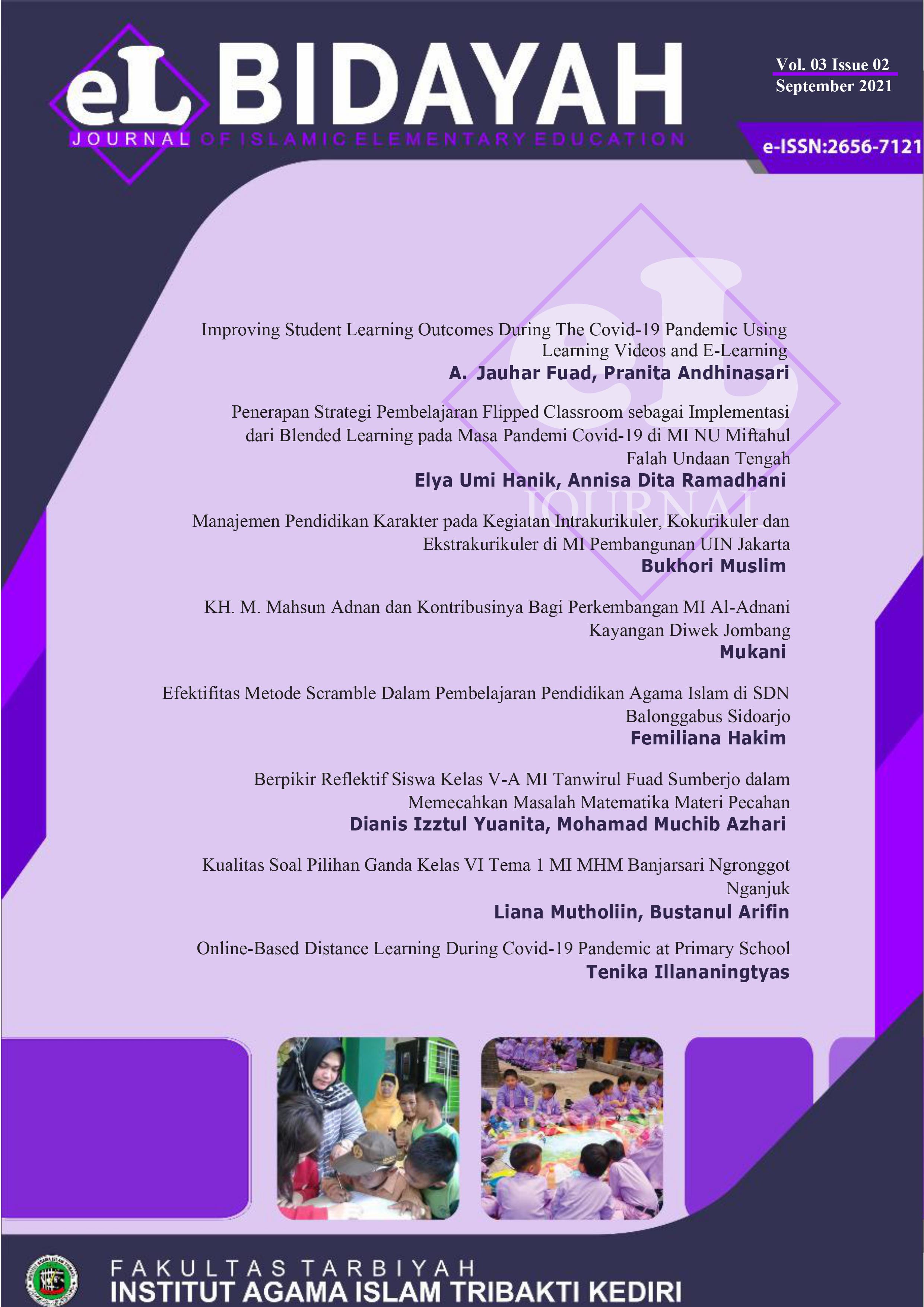
Online-Based Distance Learning During Covid-19 Pandemic at Primary School
DOI:
https://doi.org/10.33367/jiee.v3i2.1946Keywords:
Online Distance Learning, Covid-19 Pandemic, Primary SchoolAbstract
The Indonesian government is currently facing a Covid-19 pandemic that is still beyond its control. From print media to electronic media, the mass media continues to report on the number of victims infected with this virus, and the number is declining. One of the predictive steps to prevent the spread of this virus is to maintain social distancing. As a formal educational institution, the school responded quickly to this situation. The school does not hope that by changing the face-to-face learning mode, the virus will spread in its environment. I.e. through distance learning or online learning (online). Therefore, this is the task of the teacher, that is, to be able to create various activities in online learning that can attract students' interest in learning. Especially learning English requires not only theory, but also a lot of practice. Therefore, interactive learning in the form of activities is required to allow students to actively participate in the online learning process. This research aims to obtain important information about the effectiveness of online distance learning (PJJ) for primary schools in Kediri City. The research methods used descriptive qualitative methods to 20 respondents. According to the analysis data, the research results show that online distance learning for elementary schools is considered to be quite effective.
References
Bahri, M. F. (2019). Kemampuan Berpikir Kritis Menggunakan Tes Terintegrasi Agama dan Sains dalam Pembelajaran PAI di SMA. Edukasi Islami: Jurnal Pendidikan Islam, 8(02).
Daheri, Mirzon, D. (2020). Efektifitas WhatsApp sebagai Media Belajar Daring. BASICEDU, 4(04).
Hamalik, O. (2010). Psikologi Belajar dan Mengajar (8th ed.). Sinar Baru Algensindo.
Krishnan, I.A. Ching, H.S. Ramalingam, S J. Maruthai,E. Kandasamy, P. Mello,
G.D. Munian, S. Ling, W.W. Challenges of Learning English in 21st Century: Online vs Traditional During Covid 19. Malaysian Journal of Social Sciences and Humanities. Volume 5, Issue 9.
Khusniyah, Nurul Lailatul & Hakim, L. (2019). Efektifitas Pembelajaran Berbasis Daring: Sebuah Bukti Pada Pembelajaran Bahasa Inggris. Tatsqif: Jurnal Pemikiran Dan Penelitian Pendidikan, 17(01).
Kuntarto, E. (2017). Keefektifan Model Pembelajaran Daring Dalam Perkuliahan Bahasa Indonesia di Perguruan tinggi. Journal Indonesian Language Education and Literature, 3(01).
Manurung, M.P. Simatupang, D. 2019. Meningkatkan Konsentrasi Anak Usia 5-6 Tahun Melalui Penggunaan Metode Bercerita di TK ST Theresia Binjai. Jurnal Usia Dini, Volume 5 No.1
Mulyasa, E. (2012). Manajemen Pendidikan Anak Usia Dini (Pertama). Remaja Rosdakarya.
Oktavian, R., & Aldya, R. F. (2020). Efektivitas PembelajaraN Daring Terintegrasi di Era Pendidikan 4.0. Didaktis: Jurnal Pendidikan Dan Ilmu Pengetahuan, 20(02). https://doi.org/10.30651/didaktis.v20i 2.4763
Prawiyogi, Anggi Giri, D. (2020). Efektifitas Pembelajaran Jarak Jauh Terhadap Pembelajaran Peserta didik di SDIT Purwakarta. JPD: Jurnal Pendidikan Dasar, 11(01).
Rohmawati, A. (2015). Efektivitas Pembelajaran. Jurnal Pendidikan Usia Dini, 9(1).
Rukayah. 2014. The Writing Skill Of 3th Grade Students Of Sibulue Subdistrict Junior High School Of Bone Regency. International Journal of Linguistics Volume 6 No.2
Yulianti, N. 2014. Improving The Writing Skills Through Diary Writing Of The Tenth Grade Students Of Sma N 1 Ngemplak. Skripsi.
 Abstract
Views:
171,
Abstract
Views:
171,  PDF downloads: 140
Published
Issue
Section
License
License and Copyright Agreement
In submitting the manuscript to the journal, the authors certify that:
- They are authorized by their co-authors to enter into these arrangements.
- The work described has not been formally published before, except in the form of an abstract or as part of a published lecture, review, thesis, or overlay journal.
- That it is not under consideration for publication elsewhere,
- That its publication has been approved by all the author(s) and by the responsible authorities – tacitly or explicitly – of the institutes where the work has been carried out.
- They secure the right to reproduce any material that has already been published or copyrighted elsewhere.
- They agree to the following license and copyright agreement.
Copyright
Authors who publish with El Bidayah:Journal of Islamic Elementary Education agree to the following terms:
- Authors retain copyright and grant the journal the right of first publication with the work simultaneously licensed under a Creative Commons Attribution License (CC BY-SA 4.0) that allows others to share the work with an acknowledgement of the work's authorship and initial publication in this journal.
- Authors are able to enter into separate, additional contractual arrangements for the non-exclusive distribution of the journal's published version of the work (e.g., post it to an institutional repository or publish it in a book), with an acknowledgment of its initial publication in this journal.
- Authors are permitted and encouraged to post their work online (e.g., in institutional repositories or on their website) before and during the submission process, as it can lead to productive exchanges, as well as earlier and greater citation of published work.
Licensing for Data Publication
El Bidayah: Journal of Islamic Elementary Education uses a variety of waivers and licenses, that are specifically designed for and appropriate for the treatment of data:
- Open Data Commons Attribution License, http://www.opendatacommons.org/licenses/by/1.0/ (default)
- Creative Commons CC-Zero Waiver, http://creativecommons.org/publicdomain/zero/1.0/
- Open Data Commons Public Domain Dedication and Licence, http://www.opendatacommons.org/licenses/pddl/1-0/
Other data publishing licenses may be allowed as exceptions (subject to approval by the editor on a case-by-case basis) and should be justified with a written statement from the author, which will be published with the article.
Open Data and Software Publishing and Sharing
The journal strives to maximize the replicability of the research published in it. Authors are thus required to share all data, code, or protocols underlying the research reported in their articles. Exceptions are permitted but have to be justified in a written public statement accompanying the article.
Datasets and software should be deposited and permanently archived in appropriate, trusted, general, or domain-specific repositories (please consult http://service.re3data.org and/or software repositories such as GitHub, GitLab, Bioinformatics.org, or equivalent). The associated persistent identifiers (e.g. DOI, or others) of the dataset(s) must be included in the data or software resources section of the article. Reference(s) to datasets and software should also be included in the reference list of the article with DOIs (where available). Where no domain-specific data repository exists, authors should deposit their datasets in a general repository such as ZENODO, Dryad, Dataverse, or others.
Small data may also be published as data files or packages supplementary to a research article, however, the authors should prefer in all cases a deposition in data repositories.

This work is licensed under a Creative Commons Attribution-ShareAlike 4.0 International License.