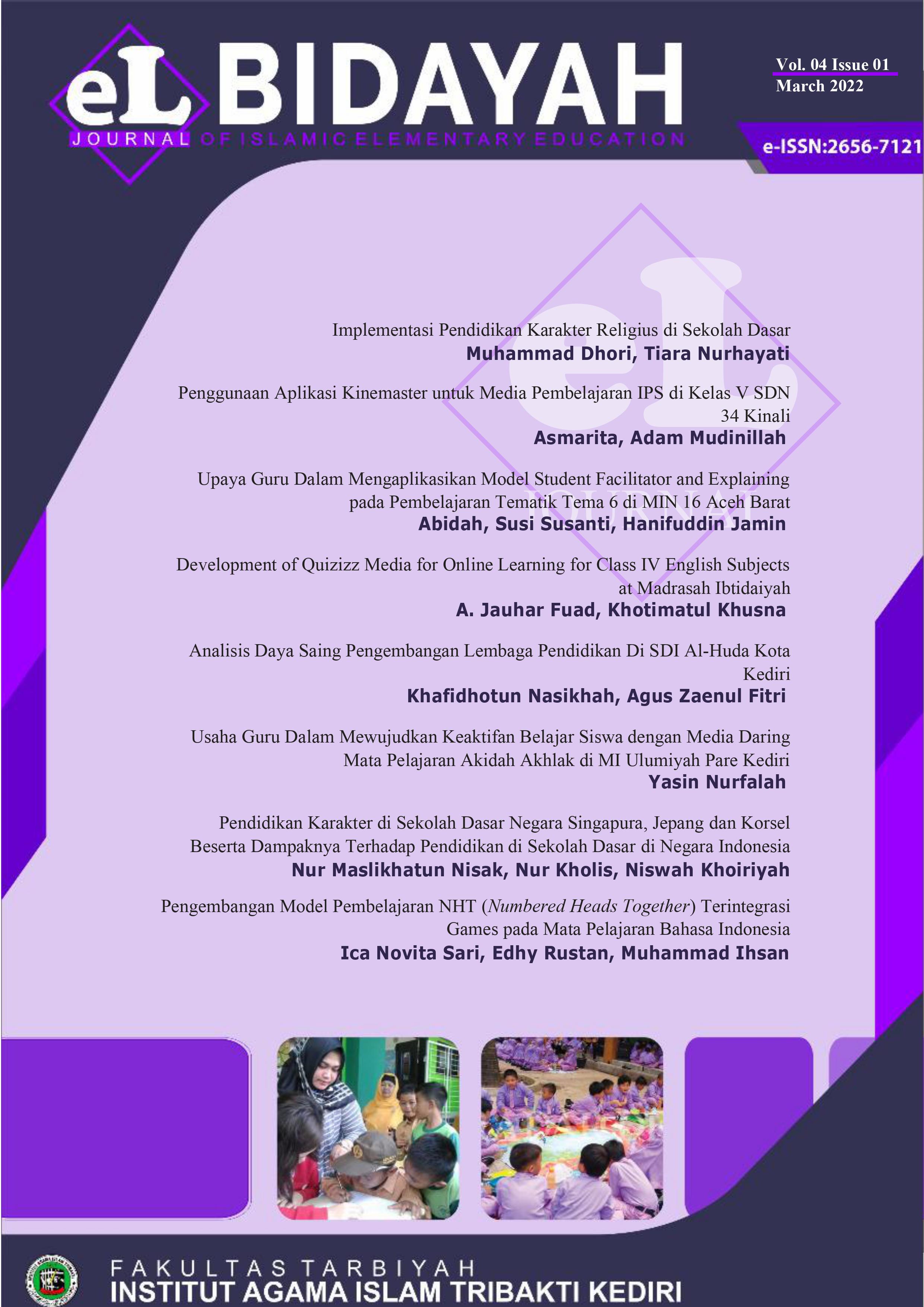
Implementasi Pendidikan Karakter Religius Di Sekolah Dasar
DOI:
https://doi.org/10.33367/jiee.v4i1.1966Keywords:
Implementation, Character, ReligiousAbstract
The background of this research is the increasing incidence of character deviations in the community which shows the weak behavior of students. This is due to the lack of maximum enforcement of religious character in schools. The purpose of the study was to describe the implementation, strategy, and supporting aspects as well as aspects of the implementation of religious character education in elementary schools. The writing method uses descriptive qualitative and literature review. The data to support the writing of this journal paper comes from the literature related to the problem being studied. Various kinds of reference books, namely books, papers, proceedings, scientific journals, and scientific articles come from the internet. Writing maximizes mutual continuity with each other and the subject matter. The data obtained are filtered and sorted by subject matter. Then, write papers based on data that has been designed to be mutually sustainable in a coherent manner. The data study method is descriptive and argumentative. The results showed that the implementation of religious character implementation can be seen from 1) The dimensions of the religious character developed. 2) The strategy is implemented through layers of artifacts and layers of values and beliefs. 3) Supporting factors and inhibiting factors. The method of shaping the religious character of the students is packaged in the subject matter as well as in the school environment. Thus, the teacher has the most important role in shaping religious character. Regarding how to use it, there are model guides, story methods, and traditional ways of doing things.
References
Ahmadi, Abu. “Psikologi Umum, Cet. III.†Jakarta: PT. Rineka Cipta, 2003.
Daryanto dan Suryatri, Darmiatun. Implementasi Pendidikan Karakter Di Sekolah. yogyakarta: Gava Media, 2013.
Fitri, Agus Zaenul. “Pendidikan Karakter Berbasis Nilai Dan Etika Di Sekolah.†Yogyakarta: Ar-Ruzz Media, 2012.
Hasanah, Hasanah. “Implementasi Nilai-Nilai Karakter Inti Di Perguruan Tinggi.†Jurnal Pendidikan Karakter, no. 2 (2013): 123326.
Kurniawan, Irma T, Marc Guitart-Masip, Peter Dayan, and Raymond J Dolan. “Effort and Valuation in the Brain: The Effects of Anticipation and Execution.†Journal of Neuroscience 33, no. 14 (2013): 6160–69.
Listyarti, Retno. “Pendidikan Karakter Dalam Metode Aktif, Inovatif, Dan Kreatif.†Jakarta: Erlangga 4, no. 1 (2012).
Majid, Abdul dan Dian Andayani. Pendidikan Karakter Perspektif Islam. Bandung. Bandung: PT Rosda Karya, 2013.
Majid, Muhammad Fadhil Alghi Fari, and Suyadi Suyadi. “Penerapan Teori Belajar Behavioristik Dalam Pembelajaran PAI Di SDN Nogopura Yogyakarta.†Jurnal PAI Raden Fatah 2, no. 2 (2020): 148–55.
Suroso, Djamaludin Ancok Fuat Nashori. Psikologi Islami Solusi Islam Atas Problem-Problem Psikologi. Yogyakarta: Pustaka Pelajar, 2004.
Suyadi, Suyadi. “Perencanaan Dan Asesmen Perkembangan Pada Anak Usia Dini.†Golden Age: Jurnal Ilmiah Tumbuh Kembang Anak Usia Dini 1, no. 1 (2016): 65–74.
Suyatno at al. “Strategy of Values Education System.†International Journal of Instruction 12, no. 1 (2019): 607–24.
Syafei, Isop, and Ai Fitria Ulfah. “Implementation of Behaviorism Learning Theories in Arabic Learning Planning.†Al Mi’yar: Jurnal Ilmiah Pembelajaran Bahasa Arab Dan Kebahasaaraban 3, no. 2 (2020): 197–214.
Widodo, Hendro. Pendidikan Holistik Berbasis Budaya Sekolah. UAD PRESS, 2019.
Yanto, Murni, and Syaripah Syaripah. “Penerapan Teori Sosial Dalam Menumbuhkan Akhlak Anak Kelas I Madrasah Ibtidaiyah Negeri 1 Rejang Lebong.†TERAMPIL: Jurnal Pendidikan Dan Pembelajaran Dasar 4, no. 2 (2017): 65–85.
 Abstract
Views:
529,
Abstract
Views:
529,  PDF downloads: 628
Published
Issue
Section
License
License and Copyright Agreement
In submitting the manuscript to the journal, the authors certify that:
- They are authorized by their co-authors to enter into these arrangements.
- The work described has not been formally published before, except in the form of an abstract or as part of a published lecture, review, thesis, or overlay journal.
- That it is not under consideration for publication elsewhere,
- That its publication has been approved by all the author(s) and by the responsible authorities – tacitly or explicitly – of the institutes where the work has been carried out.
- They secure the right to reproduce any material that has already been published or copyrighted elsewhere.
- They agree to the following license and copyright agreement.
Copyright
Authors who publish with El Bidayah:Journal of Islamic Elementary Education agree to the following terms:
- Authors retain copyright and grant the journal the right of first publication with the work simultaneously licensed under a Creative Commons Attribution License (CC BY-SA 4.0) that allows others to share the work with an acknowledgement of the work's authorship and initial publication in this journal.
- Authors are able to enter into separate, additional contractual arrangements for the non-exclusive distribution of the journal's published version of the work (e.g., post it to an institutional repository or publish it in a book), with an acknowledgment of its initial publication in this journal.
- Authors are permitted and encouraged to post their work online (e.g., in institutional repositories or on their website) before and during the submission process, as it can lead to productive exchanges, as well as earlier and greater citation of published work.
Licensing for Data Publication
El Bidayah: Journal of Islamic Elementary Education uses a variety of waivers and licenses, that are specifically designed for and appropriate for the treatment of data:
- Open Data Commons Attribution License, http://www.opendatacommons.org/licenses/by/1.0/ (default)
- Creative Commons CC-Zero Waiver, http://creativecommons.org/publicdomain/zero/1.0/
- Open Data Commons Public Domain Dedication and Licence, http://www.opendatacommons.org/licenses/pddl/1-0/
Other data publishing licenses may be allowed as exceptions (subject to approval by the editor on a case-by-case basis) and should be justified with a written statement from the author, which will be published with the article.
Open Data and Software Publishing and Sharing
The journal strives to maximize the replicability of the research published in it. Authors are thus required to share all data, code, or protocols underlying the research reported in their articles. Exceptions are permitted but have to be justified in a written public statement accompanying the article.
Datasets and software should be deposited and permanently archived in appropriate, trusted, general, or domain-specific repositories (please consult http://service.re3data.org and/or software repositories such as GitHub, GitLab, Bioinformatics.org, or equivalent). The associated persistent identifiers (e.g. DOI, or others) of the dataset(s) must be included in the data or software resources section of the article. Reference(s) to datasets and software should also be included in the reference list of the article with DOIs (where available). Where no domain-specific data repository exists, authors should deposit their datasets in a general repository such as ZENODO, Dryad, Dataverse, or others.
Small data may also be published as data files or packages supplementary to a research article, however, the authors should prefer in all cases a deposition in data repositories.

This work is licensed under a Creative Commons Attribution-ShareAlike 4.0 International License.