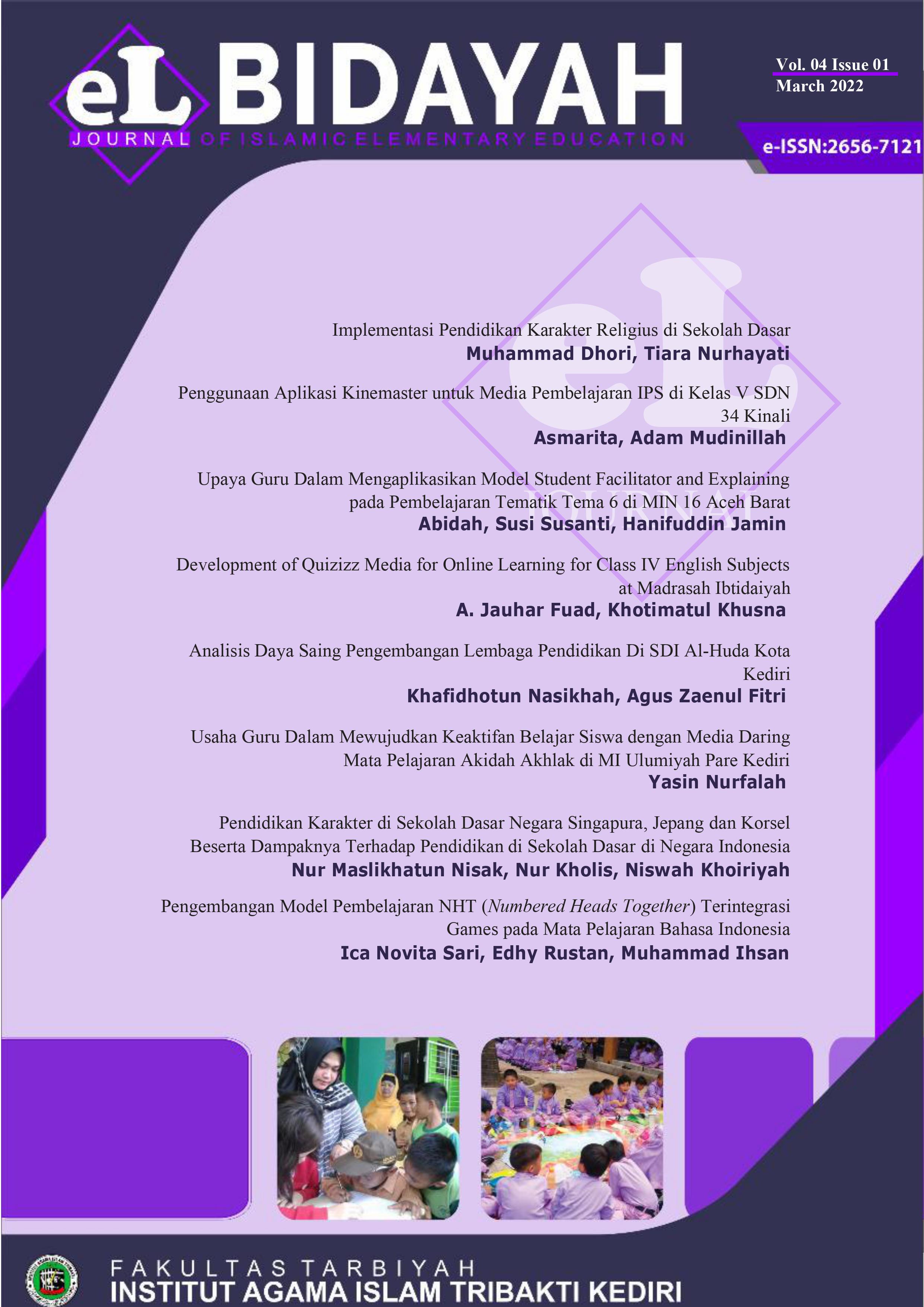
Upaya Guru Dalam Mengaplikasikan Model Student Facilitator and Explaining Pada Pembelajaran Tematik Tema 6 di MIN 16 Aceh Barat
DOI:
https://doi.org/10.33367/jiee.v4i1.2312Keywords:
Learning Model, Thematic, Student Facilitator and ExplainingAbstract
Learning is a process of delivering knowledge carried out by the teacher. In the learning process, a teacher must be creative and innovative in choosing a learning model to create a pleasant learning atmosphere. The purpose of this study is to find out the teacher's efforts in implementing the Student Facilitator and Explaining the learning model in Theme 6 Thematic Learning and to find out the obstacles experienced by teachers at MIN 16 West Aceh in thematic learning theme 6 by using the student facilitator and learning model. This research is field research with a qualitative technical approach. In collecting data using interviews, observation, and documentation as well as using qualitative analysis techniques. The results showed that the teacher's efforts in implementing the Student Facilitator and Explaining the learning model in Theme 6 Thematic Learning at MIN 16 West Aceh were by the teacher explaining the learning competencies to be achieved, presenting the material, providing opportunities for students to explain their conclusions, and re-explaining the material. presented and concluded the learning material and finally closed the lesson. Furthermore, the obstacles faced in the application of the Student Facilitator and Explaining learning model are the different levels of student absorption and the allocation of short lesson hours so that students do not perform optimally in conveying the material in front of the class.
References
Abbas, Afifi Fauzi, Metodologi Penelitian, Jakarta: Fakultas Syari’ah dan Hukum, 2005.
Ibrahim, M., Pembelajaran Kooperatif, Surabaya: University press, 2000. Jurnal Edcomtech, (2016), vol 1/ 2, Oktober 2016.
Munawaroh, Isniatun. Pembelajaran Tematik dan Aplikasinya di Sekolah Dasar (SD). Modul disampaikan di forum ilmiah guru SD.
Muslim, Siska Ryane. “Pengaruh Penggunaan Metode Student Facilitator and Explaining dalam Pembelajaran Kooperatif terhadap Kemampuan Pemecahan Masalah Matematik Siswa SMK di Kota Tasikmalayaâ€, Jurnal Penelitian Pendidikan dan Pengajaran Matematika, (2015), vol. 1/1: 67-68.
Nur Fauzi, Mohamad dan Nur Hidayat Damar Jati, Penerapan Model Pembelajaran Student Facilitator And Explaining (Sfe) Berbasis Mind Mapping Untuk Meningkatkan Kreativitas Siswa, Seminar Nasional Matematika dan Pendidikan Matematika, 2016.
Rezki, Mawarni, dkk. “Pengaruh Model Student Facilitator and Explaining terhadap Kompetensi Belajar Peserta Didik pada Materi Pemanasan Global di SMPN 4 Koto XI Tarusanâ€. Jurnal Atrium Pendidikan Biologi, (2019), vol.4/2.
Shoimin, Aris, Model Pembelajaran Inovatif dalam Kurikulum 2013, Yogyakarta: A-Russ Media, 2014.
Sugiyono, Metode Penelitian Kuantitatif, Kualitatif, R&D, Bandung: Alfabeta, 2018.
Sukmadinata, Nana Syaodih, Metode Penelitian Pendidikan, Jakarta: Remaja Rosdakarya, 2010.
Suprijono, Agus, Cooperatif learning: Teori dan Aplikasi PAIKEM, Yogyakarta: Pustaka Pelajar, 2011.
Thabrani & Mustafa, Belajar dan Pembelajaran, Yogyakarta: Ar-Ruzz Media, 2011.
Tri Wahyuni, Hermin, et.al.†Implementasi Pembelajaran Tematik Kelas 1 SDâ€.
 Abstract
Views:
158,
Abstract
Views:
158,  PDF downloads: 118
Published
Issue
Section
License
License and Copyright Agreement
In submitting the manuscript to the journal, the authors certify that:
- They are authorized by their co-authors to enter into these arrangements.
- The work described has not been formally published before, except in the form of an abstract or as part of a published lecture, review, thesis, or overlay journal.
- That it is not under consideration for publication elsewhere,
- That its publication has been approved by all the author(s) and by the responsible authorities – tacitly or explicitly – of the institutes where the work has been carried out.
- They secure the right to reproduce any material that has already been published or copyrighted elsewhere.
- They agree to the following license and copyright agreement.
Copyright
Authors who publish with El Bidayah:Journal of Islamic Elementary Education agree to the following terms:
- Authors retain copyright and grant the journal the right of first publication with the work simultaneously licensed under a Creative Commons Attribution License (CC BY-SA 4.0) that allows others to share the work with an acknowledgement of the work's authorship and initial publication in this journal.
- Authors are able to enter into separate, additional contractual arrangements for the non-exclusive distribution of the journal's published version of the work (e.g., post it to an institutional repository or publish it in a book), with an acknowledgment of its initial publication in this journal.
- Authors are permitted and encouraged to post their work online (e.g., in institutional repositories or on their website) before and during the submission process, as it can lead to productive exchanges, as well as earlier and greater citation of published work.
Licensing for Data Publication
El Bidayah: Journal of Islamic Elementary Education uses a variety of waivers and licenses, that are specifically designed for and appropriate for the treatment of data:
- Open Data Commons Attribution License, http://www.opendatacommons.org/licenses/by/1.0/ (default)
- Creative Commons CC-Zero Waiver, http://creativecommons.org/publicdomain/zero/1.0/
- Open Data Commons Public Domain Dedication and Licence, http://www.opendatacommons.org/licenses/pddl/1-0/
Other data publishing licenses may be allowed as exceptions (subject to approval by the editor on a case-by-case basis) and should be justified with a written statement from the author, which will be published with the article.
Open Data and Software Publishing and Sharing
The journal strives to maximize the replicability of the research published in it. Authors are thus required to share all data, code, or protocols underlying the research reported in their articles. Exceptions are permitted but have to be justified in a written public statement accompanying the article.
Datasets and software should be deposited and permanently archived in appropriate, trusted, general, or domain-specific repositories (please consult http://service.re3data.org and/or software repositories such as GitHub, GitLab, Bioinformatics.org, or equivalent). The associated persistent identifiers (e.g. DOI, or others) of the dataset(s) must be included in the data or software resources section of the article. Reference(s) to datasets and software should also be included in the reference list of the article with DOIs (where available). Where no domain-specific data repository exists, authors should deposit their datasets in a general repository such as ZENODO, Dryad, Dataverse, or others.
Small data may also be published as data files or packages supplementary to a research article, however, the authors should prefer in all cases a deposition in data repositories.

This work is licensed under a Creative Commons Attribution-ShareAlike 4.0 International License.