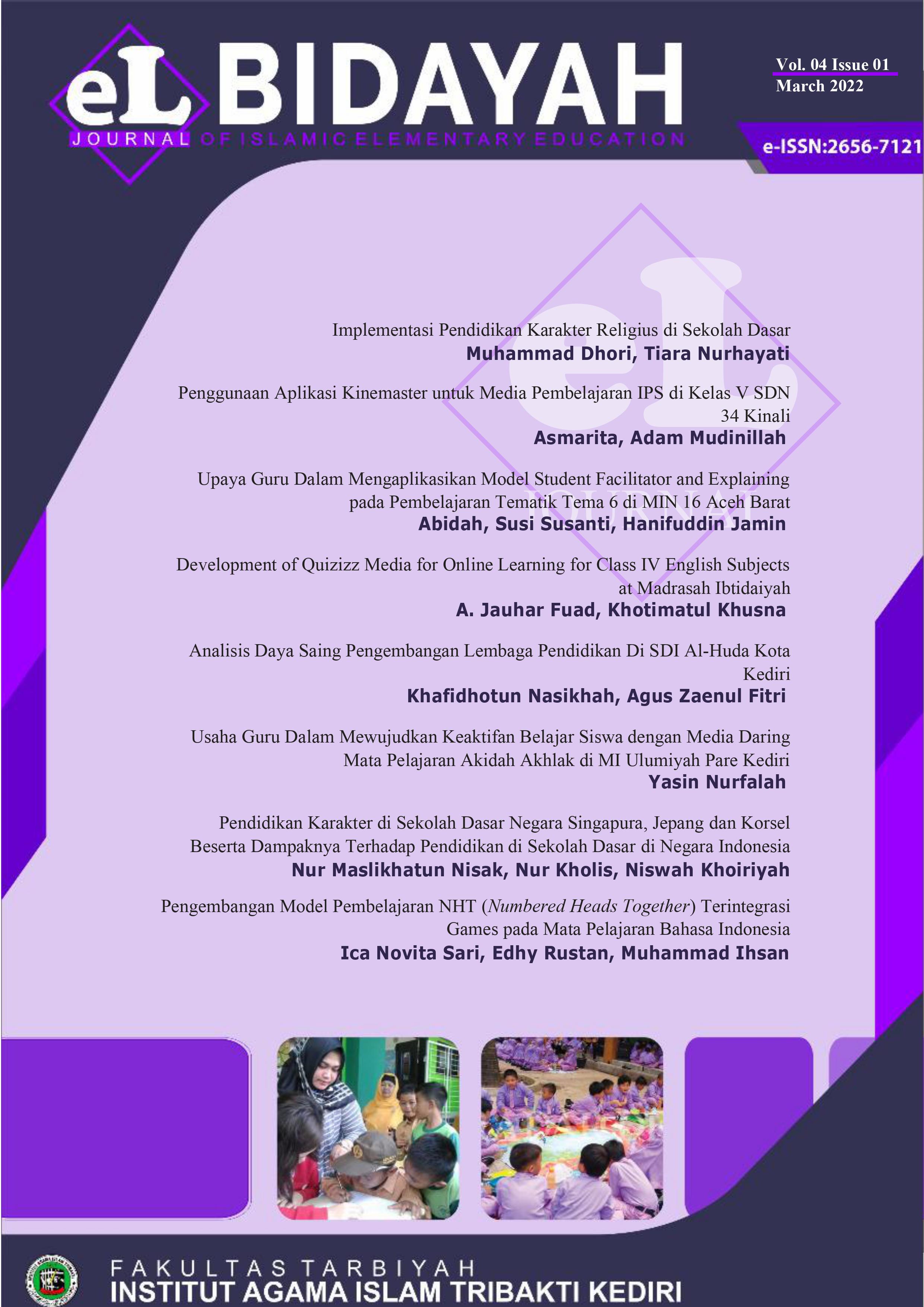
Pendidikan Karakter di Sekolah Dasar Negara Singapura, Jepang Dan Korsel Beserta Dampaknya Terhadap Pendidikan di Sekolah Dasar Di Negara Indonesia
DOI:
https://doi.org/10.33367/jiee.v4i1.2427Keywords:
Character Education, Elementary School, Southeast AsiaAbstract
This article aims to compare character education policies in primary schools in three countries namely Singapore, Japan, and South Korea, and the impact of these policies on primary schools in Indonesia. this article is motivated by the fact that Indonesia is one of the most populous countries in the world. This is because Indonesia has not been able to control the number of births in Indonesia. Therefore, it is necessary to strive to foster creativity by improving the quality of Education. This is because Indonesia is a developing country, it cannot be separated from the process of improving the quality of Education. This study is a diagnostic study. This writing uses doctrinal (normative) methods, and this article aims to clarify the Policy Foundation in character education. All the information that has been collected is processed by analyzing the results of the literature review by comparing the character of Education from three countries and seeing the impact on character education in Indonesian primary schools. Indonesia's education is becoming more community-centric. International education must be redeveloped to change for the better. Comparing the character of Primary School Education of the three countries related to education in East Asia and the Pacific, recorded in the WEF World Economic Forum, Singapore ranked 11th and Japan ranked 17th. While South Korea's maraih ranked 27th. The three countries are countries that have a high commitment to improving human resources through education. While Indonesia ranked 65th out of 130 countries in the world.
References
Alfirzan, A, Y Nasri, and N Gistituati. “Kebijakan Pendidikan Serta Implementasi Kebijakan Pendidikan.†Jurnal Pendidikan Tambusai 5, no. 1 (2021): 1521–1529.
Autoridad Nacional del Servicio Civil. “済無No Title No Title No Title.†Angewandte Chemie International Edition, 6(11), 951–952. 2, no. 2 (2021): 2013–2015.
Hastuti, Tri Puji, and Soehartono Soehartono. “Kebijakan Pendidikan Di Tinjau Dari Segi Hukum Kebijakan Publik.†Jurnal Jurisprudence 8, no. 1 (2018): 34–41.
Labuhanbatu, D I Kabupaten. “Studi Kasus SDN 10 Rantau Selatan PASCASARJANA UNIVERSITAS MEDAN AREA†(2020).
Pendidikan, Kebijakan, Sekolah Dasar, Negara Singapur, Korea Selatan, and D A N Implikasinya. “PENDIDIKAN SEKOLAH DASAR INDONESIA Pascasarjana Pendidikan Pendidikan Bahasa Dan Sastra Universitas Pascasarjana Pendidikan Pendidikan Biologi Fakultas Keguruan Dan Ilmu Pendidikan Universitas Muhammadiyah Surabaya Surabaya 2 PG PAUD Fakultas Keguruan Dan†7 (2021): 141–149.
Prasojo, Lantip Diat. “Financial Resources Sebagai Faktor Penentu Dalam Implementasi Kebijakan Pendidikan.†Jurnal Internasional Manajemen Pendidikan 4, no. 02 (2012): 19–27.
Putra, Andika Kelana. “Resistensi Finlandia Terhadap Global Educational Reform Movement.†Tim Pengembangan Jurnal Universitas Airlangga 4, no. 1 (2015): 1393–1421. http://journal.unair.ac.id/downloadfull/JAHI8813-b1e79fe631fullabstract.pdf.
Ridlwan, M, and Ansya’ri. “Kebijakan Pendidikan Sekolah Dasar 3 Negara (Singapur, Jepang, Korea Selatan) Dan Implikasinya Terhadap Pendidikan Sekolah Dasar Indonesia.†PEDAGOGI: Jurnal Anak Usia Dini dan Pendidikan Andak Usia Dini 7, no. 2 (2021): 141–149.
Satria, Rachmat, Achmad Supriyanto, Agus Timan, and Maulana Amirul Adha. “Peningkatan Mutu Sekolah Melalui Manajemen Hubungan Masyarakat.†Jurnal Akuntabilitas Manajemen Pendidikan 7, no. 2 (2019): 199–207.
Shim, Hyewon, Naechul Shin, Avigail Stern, Sigalit Aharon, Tal Binyamin, Abeer Karmi, Dvir Rotem, et al. “No 主観的å¥åº·æ„Ÿã‚’ä¸å¿ƒã¨ã—ãŸåœ¨å®…高齢者ã«ãŠã‘ã‚‹ å¥åº·é–¢é€£æŒ‡æ¨™ã«é–¢ã™ã‚‹å…±åˆ†æ•£æ§‹é€ 分æžTitle.†Advanced Optical Materials 10, no. 1 (2018): 1–9. https://doi.org/10.1103/PhysRevB.101.089902%0Ahttp://dx.doi.org/10.1016/j.nantod.2015.04.009%0Ahttp://dx.doi.org/10.1038/s41467-018-05514-9%0A
Sulistyadi, Hery Kurnia. “Implementasi Kebijakan Penyelenggaraan Layanan Pendidikan Inklusif Di Kabupaten Sidoarjo.†Kebijakan dan Manajemen Publik 2, no. 1 (2014): 1–10.
Sutrisno, and Muhammad Rusdi. “Analisis Kebijakan Peningkatan Mutu Pendidikan Dasar Dan Menengah Di Provinsi Jambi.†Jurnal Pendidikan Inovatif 3, no. 1 (2007): 25–31.
Witri, Gustimal, Zetra Hainul Putra, and Nori Gustina. “Analisis Kemampuan Siswa Sekolah Dasar Dalam Menyelesaikan Soal-Soal Matematika Model the Trends for International Mathematics and Scinece Study (Timss) Di Pekanbaru.†Primary: Jurnal Pendidikan Guru Sekolah Dasar
 Abstract
Views:
796,
Abstract
Views:
796,  PDF downloads: 1145
Published
Issue
Section
License
License and Copyright Agreement
In submitting the manuscript to the journal, the authors certify that:
- They are authorized by their co-authors to enter into these arrangements.
- The work described has not been formally published before, except in the form of an abstract or as part of a published lecture, review, thesis, or overlay journal.
- That it is not under consideration for publication elsewhere,
- That its publication has been approved by all the author(s) and by the responsible authorities – tacitly or explicitly – of the institutes where the work has been carried out.
- They secure the right to reproduce any material that has already been published or copyrighted elsewhere.
- They agree to the following license and copyright agreement.
Copyright
Authors who publish with El Bidayah:Journal of Islamic Elementary Education agree to the following terms:
- Authors retain copyright and grant the journal the right of first publication with the work simultaneously licensed under a Creative Commons Attribution License (CC BY-SA 4.0) that allows others to share the work with an acknowledgement of the work's authorship and initial publication in this journal.
- Authors are able to enter into separate, additional contractual arrangements for the non-exclusive distribution of the journal's published version of the work (e.g., post it to an institutional repository or publish it in a book), with an acknowledgment of its initial publication in this journal.
- Authors are permitted and encouraged to post their work online (e.g., in institutional repositories or on their website) before and during the submission process, as it can lead to productive exchanges, as well as earlier and greater citation of published work.
Licensing for Data Publication
El Bidayah: Journal of Islamic Elementary Education uses a variety of waivers and licenses, that are specifically designed for and appropriate for the treatment of data:
- Open Data Commons Attribution License, http://www.opendatacommons.org/licenses/by/1.0/ (default)
- Creative Commons CC-Zero Waiver, http://creativecommons.org/publicdomain/zero/1.0/
- Open Data Commons Public Domain Dedication and Licence, http://www.opendatacommons.org/licenses/pddl/1-0/
Other data publishing licenses may be allowed as exceptions (subject to approval by the editor on a case-by-case basis) and should be justified with a written statement from the author, which will be published with the article.
Open Data and Software Publishing and Sharing
The journal strives to maximize the replicability of the research published in it. Authors are thus required to share all data, code, or protocols underlying the research reported in their articles. Exceptions are permitted but have to be justified in a written public statement accompanying the article.
Datasets and software should be deposited and permanently archived in appropriate, trusted, general, or domain-specific repositories (please consult http://service.re3data.org and/or software repositories such as GitHub, GitLab, Bioinformatics.org, or equivalent). The associated persistent identifiers (e.g. DOI, or others) of the dataset(s) must be included in the data or software resources section of the article. Reference(s) to datasets and software should also be included in the reference list of the article with DOIs (where available). Where no domain-specific data repository exists, authors should deposit their datasets in a general repository such as ZENODO, Dryad, Dataverse, or others.
Small data may also be published as data files or packages supplementary to a research article, however, the authors should prefer in all cases a deposition in data repositories.

This work is licensed under a Creative Commons Attribution-ShareAlike 4.0 International License.