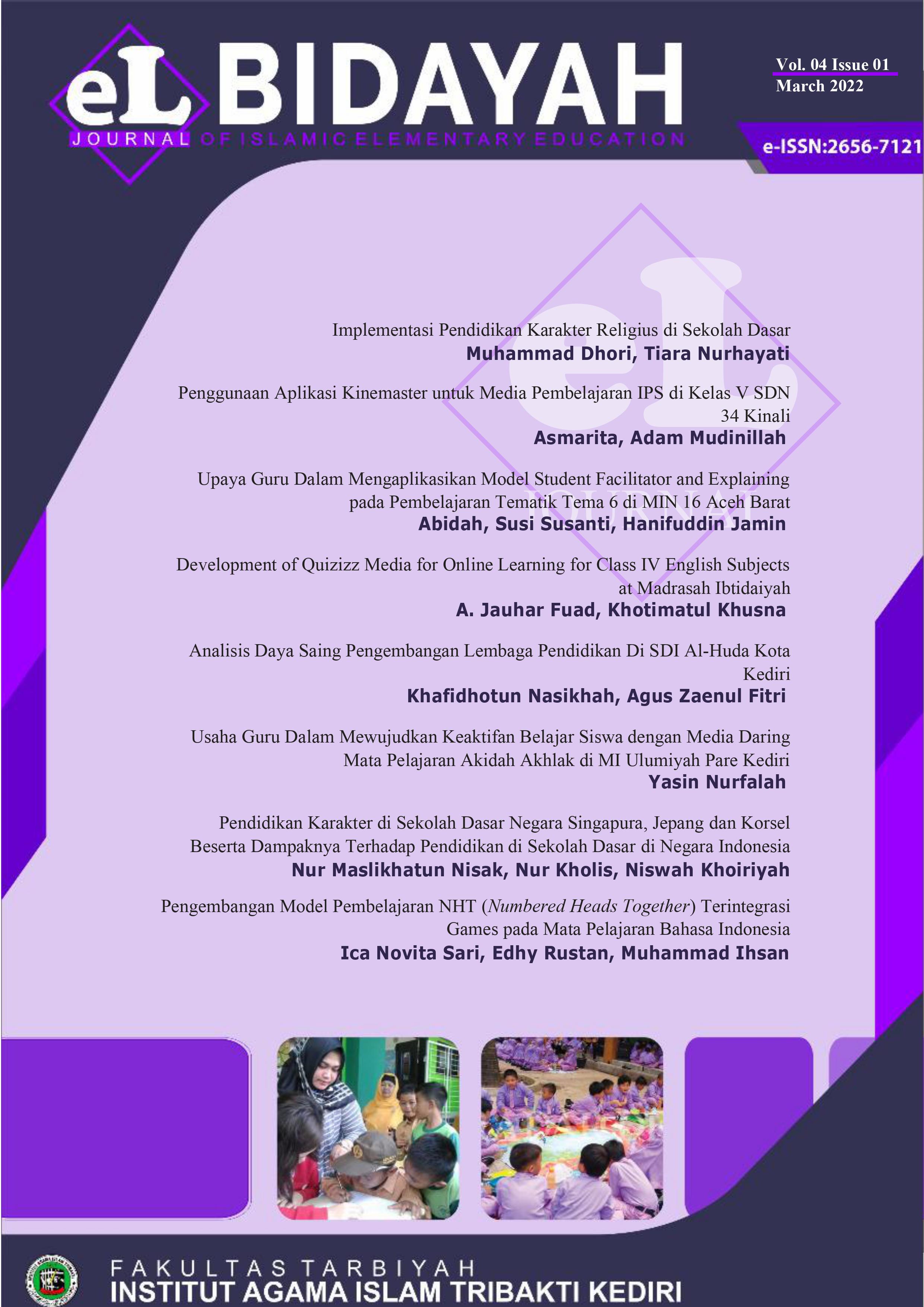
Pengembangan Model Pembelajaran NHT (Numbered Heads Together) Terintegrasi Games Pada Mata Pelajaran Bahasa Indonesia
DOI:
https://doi.org/10.33367/jiee.v4i1.2501Keywords:
Learning Model, Numbered Heads Together, GamesAbstract
Learning is a process of delivering knowledge carried out by the teacher. In the The objective of this developing approach is to understand the description of the needs analysis of the games-integrated Numbered Heads Together (NHT) learning model in the Bahasa Indonesia subject, how to design games-integrated Numbered Heads Together (NHT) learning model in the Bahasa Indonesia subject, and to measure the validity of games-integrated Numbered Heads Together (NHT) learning model. The type of this research is R&D and was developed using the ADDIE model which consists of the analysis, design, development, implementation, and evaluation stages. The data collection technique was carried out using interview guidelines given to fifth-grade teachers to find out the curriculum used, and the problems experienced by the teacher during the learning process. As for the use of questionnaires and student knowledge tests, they were given to fifth-grade students of SDN 9 Matekko as subjects to measure the level of understanding, knowledge, and learning abilities of students. Needs analysis using tests showed that students' lack of understanding of the essay material resulted in a score below the Cut Score Grading (KKM), and student questionnaires showed that students liked the learning model carried out in groups and integrated with games. The game-integrated NHT learning model's design is in the form of a guidebook containing detailed syntax according to the learning objectives. The validity of the games-integrated NHT learning model showed valid results with a score of 79% for design validation, and very valid with a score of 90% for language validation, and 91% for validation of the learning model implementation.
References
Aji, Sudi, Muhammad Nur Hudha, dan Astri Rismawati. “Pengembangan Modul Pembelajaran Fisika Berbasis Problem Based Learning untuk Meningkatkan Kemampuan Pemecahan Masalah Fisika.†SEJ (Science Education Journal) 1, no. 1 (30 Mei 2017): 36–51. https://doi.org/10.21070/sej.v1i1.830.
Andri, Andri, dan Ratih Sarni Purwanti. “Meningkatkan Minat Dan Hasil Belajar Siswa Menggunakan Model Number Heads Together (NHT) Pada Mata Pelajaran Matematika.†J-PiMat : Jurnal Pendidikan Matematika 1, no. 1 (9 Mei 2019): 26–37. https://doi.org/10.31932/j-pimat.v1i1.407.
Anggraini, Anita, dan Johan Syahbrudin. “Pentingnya Pengembangan Buku Ajar Statistika Berbasis Praktik Penyelesaian Masalah dalam Penelitian Pendidikan.†Jurnal Ilmiah Wahana Pendidikan 7, no. 2 (1 April 2021): 17–26. https://doi.org/10.5281/zenodo.4657108.
Astrawan, I. Gede Budi. “Penerapan Model Kooperatif Tipe NHT Dalam Meningkatkan Hasil Belajar Siswa Pada Mata Pelajaran IPA Di Kelas V SDn 3 Tonggolobibi.†Jurnal Kreatif Online 3, no. 4 (10 Oktober 2014). http://jurnal.untad.ac.id/jurnal/index.php/JKTO/article/view/3080.
Atika, Nur, dan Zubaidah Amir Mz. “Pengembangan LKS Berbasis Pendekatan RME Untuk Menumbuhkembangkan Kemampuan Berpikir Kritis Matematis Siswa.†Suska Journal of Mathematics Education 2, no. 2 (30 November 2016): 103–10. https://doi.org/10.24014/sjme.v2i2.2126.
Dadang Wino Hocky Oktavia, 3217113021. “Penerapan Model Pembelajaran Kooperatif Tipe Numbered Heads Together (NHT) Untuk Meningkatkan Hasil Belajar IPS Siswa Kelas V MI Miftahul Huda Bacem Sutojayan Blitar.†Skripsi, 15 Desember 2015. http://repo.iain-tulungagung.ac.id/2979/.
Ernawati, Ernawati. “Meningkatkan Hasil Belajar Siswa Melalui Belajar Kelompok (Learning Group) Pada Pembelajaran PKn Kelas V SDN 1 Palasa.†Jurnal Kreatif Online 1, no. 1 (10 Mei 2014). http://jurnal.untad.ac.id/jurnal/index.php/JKTO/article/view/2518.
Ginting, Nurlia. “Meningkatkan Minat Belajar Siswa Dengan Menggunakan Model Pembelajaran Kooperatif Tipe Numbered Heads Together (NHT) Pada Mata Pelajaran IPA Materi Pokok Gaya Magnet Di Kelas V SD.†Jurnal Handayani PGSD FIP UNIMED 1, no. 1 (4 September 2014). https://doi.org/10.24114/jh.v1i1.1257.
Hastuti, Hikmah Wiji, Sunan Baedowi, dan Qoriati Mushafanah. “Keefektifan Model Pembelajaran Numbered Heads Together Berbantu Media Panelpa (Papan Flanel IPA) Terhadap Hasil Belajar.†International Journal of Elementary Education 3, no. 2 (16 Juli 2019): 108–15. https://doi.org/10.23887/ijee.v3i2.18513.
Lisnawati, Lisnawati. “Pengembangan Modul Cerita Rakyat Terintegrasi Latar Cerita Daerah Sulawesi Selatan pada Siswa Sekolah Dasar.†Pedagogik Journal of Islamic Elementary School 4, no. 1 (21 April 2021): 59–74. https://doi.org/10.24256/pijies.v4i1.1824.
Marfuah, Iim, Mardiyana Mardiyana, dan Tri Atmojo Kusmayadi. “Pengembangan Model Pembelajaran NHT (Numbered Heads Together) Berbasis Outdoor Study Untuk Meningkatkan Prestasi Belajar Siswa SMA Kelas X Pada Materi Pokok Sistem Persamaan Dan Pertidaksamaan.†Jurnal Pembelajaran Matematika 2, no. 6 (19 Agustus 2014). https://jurnal.fkip.uns.ac.id/index.php/s2math/article/view/4536.
Putri, Darlya Ika. “Penerapan Model Pembelajaran Kooperatif Tipe Numbered Heads Together (NHT) Untuk Meningkatkan Komunikasi Matematis Siswa Kelas XI MAN 3 Medan T.A 2017/2018.†Undergraduate, UNIMED, 2018. http://digilib.unimed.ac.id/28698/.
Saidah, Naila, Parmin Parmin, dan Novi Ratna Dewi. “Pengembangan LKS IPA Terpadu Berbasis Problem Based Learning Melalui Lesson Study Tema Ekosistem Dan Pelestarian Lingkungan.†Unnes Science Education Journal 3, no. 2 (1 Juli 2014). https://doi.org/10.15294/usej.v3i2.3357.
Siregar, Faridah Anum. “Pengaruh Model Kooperatif Tipe NHT Terhadap Hasil Belajar Siswa Kelas VIII SMP Negeri 18 Medan.†Jurnal Pendidikan Fisika 1, no. 1 (2012): 33–38. https://doi.org/10.22611/jpf.v1i1.3379.
Sumarsono, Adi. “Implementasi Model Pembelajaran Atletik Melalui Permainan Berbasis Alam.†Magistra: Jurnal Keguruan Dan Ilmu Pendidikan 4, no. 2 (17 Juli 2017): 70–83. https://doi.org/10.35724/magistra.v4i2.697.
Susanto, Joko. “Pengembangan Perangkat Pembelajaran Berbasis Lesson Study Dengan Kooperatif Tipe Numbered Heads Together Untuk Meningkatkan Aktivitas Dan Hasil Belajar IPA Di SD.†Journal of Primary Education 1, no. 2 (2012). https://doi.org/10.15294/jpe.v1i2.785.
Tania, Lisa. “Pengembangan Bahan Ajar E-Modul Sebagai Pendukung Pembelajaran Kurikulum 2013 Pada Materi Ayat Jurnal Penyesuaian Perusahaan Jasa Siswa Kelas X Akutansi SMK Negeri 1 Surabaya.†Jurnal Pendidikan Akuntansi (JPAK) 5, no. 2 (9 Agustus 2017). https://ejournal.unesa.ac.id.
Wardianti, Yunita, dan Ria Dwi Jayati. “Validitas Modul Biologi Berbasis Kearifan Lokal.†BIOEDUSAINS: Jurnal Pendidikan Biologi Dan Sains 1, no. 2 (25 Desember 2018): 136–42. https://doi.org/10.31539/bioedusains.v1i2.366.
Winarni, Dyah Setyanigrum, Janatun Naimah, dan Yeni Widiyawati. “Pengembangan Game Edukasi Science Adventure Untuk Meningkatkan Keterampilan Pemecahan Masalah Siswa.†Jurnal Pendidikan Sains Indonesia 7, no. 2 (2019): 91–100. https://doi.org/10.24815/jpsi.v7i2.14462.
Wiratman, A, M Mustaji, dan W Widodo. “The Effect Of Activity Sheet Based On Outdoor Learning On Student’s Science Process Skills.†Journal of Physics: Conference Series 1157 (Februari 2019): 022007. https://doi.org/10.1088/1742-6596/1157/2/022007.
Yumarlin, M. Z. “Pengembangan Permainan Ular Tangga Untuk Kuis Mata Pelajaran Sains Sekolah Dasar.†Jurnal Teknik 3, no. 1 (2013): 75–84.
 Abstract
Views:
363,
Abstract
Views:
363,  PDF downloads: 433
Published
Issue
Section
License
License and Copyright Agreement
In submitting the manuscript to the journal, the authors certify that:
- They are authorized by their co-authors to enter into these arrangements.
- The work described has not been formally published before, except in the form of an abstract or as part of a published lecture, review, thesis, or overlay journal.
- That it is not under consideration for publication elsewhere,
- That its publication has been approved by all the author(s) and by the responsible authorities – tacitly or explicitly – of the institutes where the work has been carried out.
- They secure the right to reproduce any material that has already been published or copyrighted elsewhere.
- They agree to the following license and copyright agreement.
Copyright
Authors who publish with El Bidayah:Journal of Islamic Elementary Education agree to the following terms:
- Authors retain copyright and grant the journal the right of first publication with the work simultaneously licensed under a Creative Commons Attribution License (CC BY-SA 4.0) that allows others to share the work with an acknowledgement of the work's authorship and initial publication in this journal.
- Authors are able to enter into separate, additional contractual arrangements for the non-exclusive distribution of the journal's published version of the work (e.g., post it to an institutional repository or publish it in a book), with an acknowledgment of its initial publication in this journal.
- Authors are permitted and encouraged to post their work online (e.g., in institutional repositories or on their website) before and during the submission process, as it can lead to productive exchanges, as well as earlier and greater citation of published work.
Licensing for Data Publication
El Bidayah: Journal of Islamic Elementary Education uses a variety of waivers and licenses, that are specifically designed for and appropriate for the treatment of data:
- Open Data Commons Attribution License, http://www.opendatacommons.org/licenses/by/1.0/ (default)
- Creative Commons CC-Zero Waiver, http://creativecommons.org/publicdomain/zero/1.0/
- Open Data Commons Public Domain Dedication and Licence, http://www.opendatacommons.org/licenses/pddl/1-0/
Other data publishing licenses may be allowed as exceptions (subject to approval by the editor on a case-by-case basis) and should be justified with a written statement from the author, which will be published with the article.
Open Data and Software Publishing and Sharing
The journal strives to maximize the replicability of the research published in it. Authors are thus required to share all data, code, or protocols underlying the research reported in their articles. Exceptions are permitted but have to be justified in a written public statement accompanying the article.
Datasets and software should be deposited and permanently archived in appropriate, trusted, general, or domain-specific repositories (please consult http://service.re3data.org and/or software repositories such as GitHub, GitLab, Bioinformatics.org, or equivalent). The associated persistent identifiers (e.g. DOI, or others) of the dataset(s) must be included in the data or software resources section of the article. Reference(s) to datasets and software should also be included in the reference list of the article with DOIs (where available). Where no domain-specific data repository exists, authors should deposit their datasets in a general repository such as ZENODO, Dryad, Dataverse, or others.
Small data may also be published as data files or packages supplementary to a research article, however, the authors should prefer in all cases a deposition in data repositories.

This work is licensed under a Creative Commons Attribution-ShareAlike 4.0 International License.