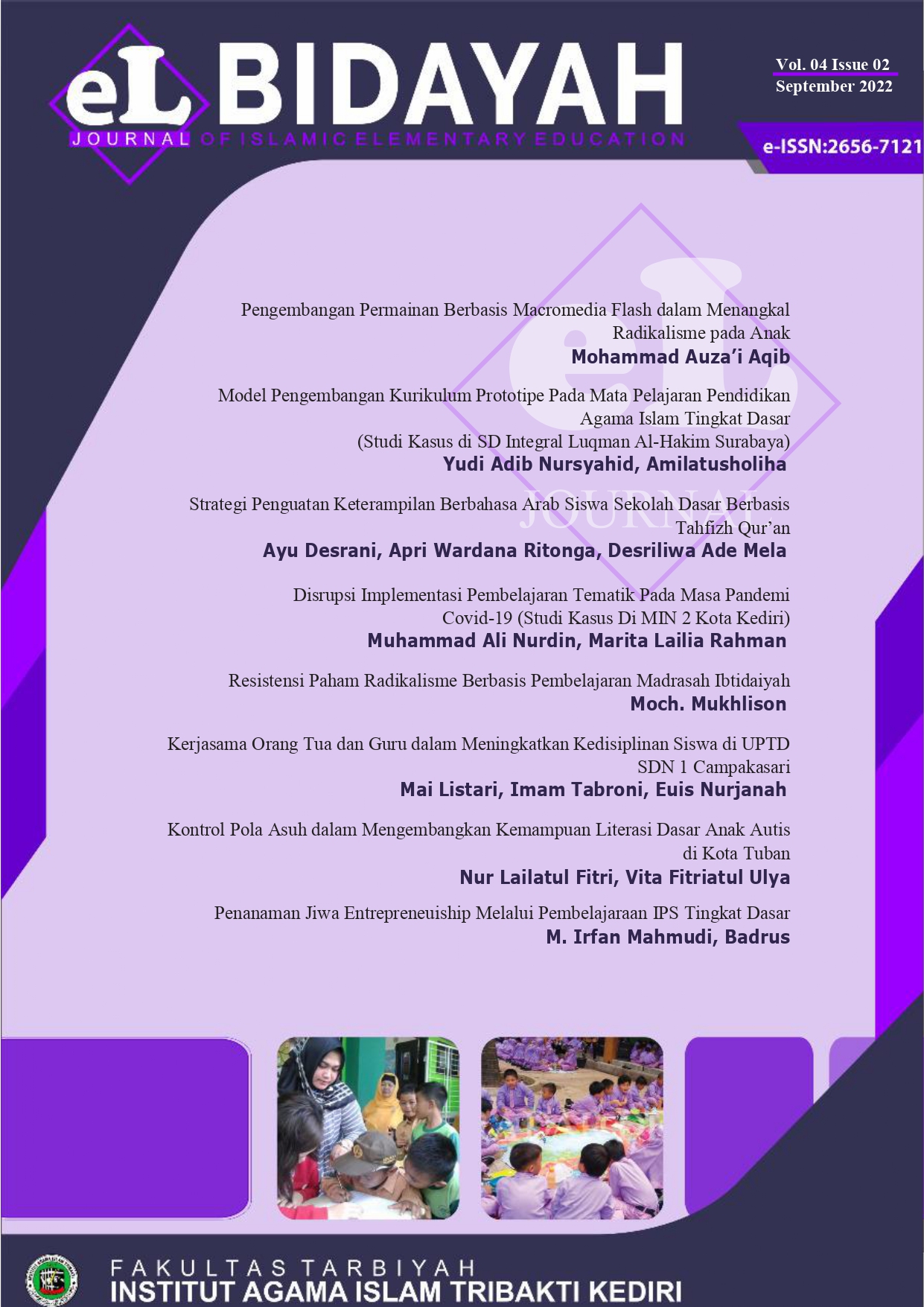
Disrupsi Implementasi Pembelajaran Tematik Pada Masa Pandemi Covid-19; Studi Kasus Di MIN 2 Kota Kediri
DOI:
https://doi.org/10.33367/jiee.v4i2.2536Keywords:
Disruption, Thematic Learning, Covid-19 PandemicAbstract
At this time, the term disruption emerged, which is a technological development that has penetrated all fields, including education. Coupled with the conditions during the pandemic that did not allow for intense face-to-face meetings. So it requires using technology in learning. So, what if the application of technology in learning is applied at Madarasah Ibtidaiyah? This research is classified as descriptive qualitative research with a case study method. The results showed that the impact of disruption to thematic learning during the pandemic resulted in the disruption of thematic learning in MIN 2 Kediri City. Implementation of thematic learning that has not been massive and evenly distributed in each class in using online learning applications. This happened because student teachers and student guardians were not ready to face the wave of disruption that occurred during the COVID-19 pandemic. Then, the MIN 2 Kediri Strategy in dealing with disruptions that occur in the implementation of Thematic learning is carried out by instilling understanding in teachers for self-disruption (self-disruption) and choosing to reshape, namely improving learning that has been carried out, and making the best use of time when there are meetings. face-to-face with students. Then learning is combined using digital media to support student understanding.
References
Arafat Lubis, Maulana. Pengembangan Kurikulum 2013 Pembelajaran Tematik SD/MI. Yogyakarta: Samudra Biru, 2018.
Emawati. “Disrupsi Pembelajaran Bahasa dan Sastra Indonesia di Era Digital.†Prosiding Seminar Nasional Pendidikan Pascasarjana Universitas PGRI Palembang, 10 Januari 2020.
Ilham Syarif, Muhammad. “Disrupsi Pendidikan IPA SD dalam Merespon Merdeka Belajar dan Kampus Merdeka Menuju New Normal Pasca COVID-19.†Jurnal Basicedu Volume 4 Nomor 4 (Tahun 2020).
Kartini, dan Lia Istiana. “Reformasi Madrasah di Era Disrupsi: Peran Pandemi Covid -19 Dalam Pendidikan Teknologi.†Paedagoria : Jurnal Kajian, Penelitian dan Pengembangan Vol. 11, No. 2 (Juli 2020).
Kasali, Rhenald. Disruption: tidak ada yang tidak bisa diubah sebelum dihadapi dan motivasi saja tidak cukup. Jakarta: Gramedia Pustaka Utama, 2017.
Kemendikbud. “Surat Edaran Nomor 15 Tahun 2020 Tentang Pedoman Penyelenggaraan Belajar Dari Rumah Dalam Masa Pandemi Covid- 19,†18 Mei 2020. Jakarta. www.kemedikbud.go.id.
Kementerian Agama RI. “SK Dirjen Pendidikan Islam tentang Kurikulum Darurat Madrasah,†19 Mei 2020. Jakarta.
Lailia Rahman, Marita. “Manajemen Kurikulum 2013 Dalam Pembentukan Karakter Peserta Didik (Studi Multikasus di MIN 2 Doko Kediri dan SD Plus Rahmat Kediri).†UIN Syarif Hidayatulloh Tulungagung, 2022.
Maryati, dan Rusmida Siantur. “Strategi Implementasi Pendidikan Karakter Pada Era Disrupsi.†Prosiding Seminar Nasional Pendidikan Pascasarjana Universitas PGRI Palembang, 10 Januari 2020.
Mujiati, Endang. “Pendidikan di Era Disrupsi.†https://www.harianbhirawa.co.id/pendidikan-di-era-disrupsi/, 21 Januari 2019.
Ohoitimur, Johanis. “Disrupsi: Tantangan Perkembangan Ilmu Pengetahuan dan Peluang Perguruan Tinggi.†RESPONS Vol. XXIII, 2 (Desember 2018).
Ramdhani, Intan Sari, dan Sumiyani. “Disrupsi Pembelajaran Bahasa Indonesia Menuju Merdeka Belajar Di Era New Normal.†Jurnal Sasindo Unpam Vol. VIII, 2 (Desember 2020).
Ria Angelina,dkk, Putri. “Kompetensi Pedagogik Guru Di Era Disrupsi Pendidikan Dalam Pandangan Islam.†Ta’dibuna Vol. 10 No. 2 (Juni 2021).
Wartoni. “Disrupsi Asesmen: Peran Teknologi Dalam Pelaksanaan Asesmen Di Masa Pandemi Covid-19.†Prosiding Seminar Nasional Pascasarjana Universitas Negeri Jakarta, 2020.
 Abstract
Views:
130,
Abstract
Views:
130,  PDF downloads: 88
Published
Issue
Section
License
License and Copyright Agreement
In submitting the manuscript to the journal, the authors certify that:
- They are authorized by their co-authors to enter into these arrangements.
- The work described has not been formally published before, except in the form of an abstract or as part of a published lecture, review, thesis, or overlay journal.
- That it is not under consideration for publication elsewhere,
- That its publication has been approved by all the author(s) and by the responsible authorities – tacitly or explicitly – of the institutes where the work has been carried out.
- They secure the right to reproduce any material that has already been published or copyrighted elsewhere.
- They agree to the following license and copyright agreement.
Copyright
Authors who publish with El Bidayah:Journal of Islamic Elementary Education agree to the following terms:
- Authors retain copyright and grant the journal the right of first publication with the work simultaneously licensed under a Creative Commons Attribution License (CC BY-SA 4.0) that allows others to share the work with an acknowledgement of the work's authorship and initial publication in this journal.
- Authors are able to enter into separate, additional contractual arrangements for the non-exclusive distribution of the journal's published version of the work (e.g., post it to an institutional repository or publish it in a book), with an acknowledgment of its initial publication in this journal.
- Authors are permitted and encouraged to post their work online (e.g., in institutional repositories or on their website) before and during the submission process, as it can lead to productive exchanges, as well as earlier and greater citation of published work.
Licensing for Data Publication
El Bidayah: Journal of Islamic Elementary Education uses a variety of waivers and licenses, that are specifically designed for and appropriate for the treatment of data:
- Open Data Commons Attribution License, http://www.opendatacommons.org/licenses/by/1.0/ (default)
- Creative Commons CC-Zero Waiver, http://creativecommons.org/publicdomain/zero/1.0/
- Open Data Commons Public Domain Dedication and Licence, http://www.opendatacommons.org/licenses/pddl/1-0/
Other data publishing licenses may be allowed as exceptions (subject to approval by the editor on a case-by-case basis) and should be justified with a written statement from the author, which will be published with the article.
Open Data and Software Publishing and Sharing
The journal strives to maximize the replicability of the research published in it. Authors are thus required to share all data, code, or protocols underlying the research reported in their articles. Exceptions are permitted but have to be justified in a written public statement accompanying the article.
Datasets and software should be deposited and permanently archived in appropriate, trusted, general, or domain-specific repositories (please consult http://service.re3data.org and/or software repositories such as GitHub, GitLab, Bioinformatics.org, or equivalent). The associated persistent identifiers (e.g. DOI, or others) of the dataset(s) must be included in the data or software resources section of the article. Reference(s) to datasets and software should also be included in the reference list of the article with DOIs (where available). Where no domain-specific data repository exists, authors should deposit their datasets in a general repository such as ZENODO, Dryad, Dataverse, or others.
Small data may also be published as data files or packages supplementary to a research article, however, the authors should prefer in all cases a deposition in data repositories.

This work is licensed under a Creative Commons Attribution-ShareAlike 4.0 International License.