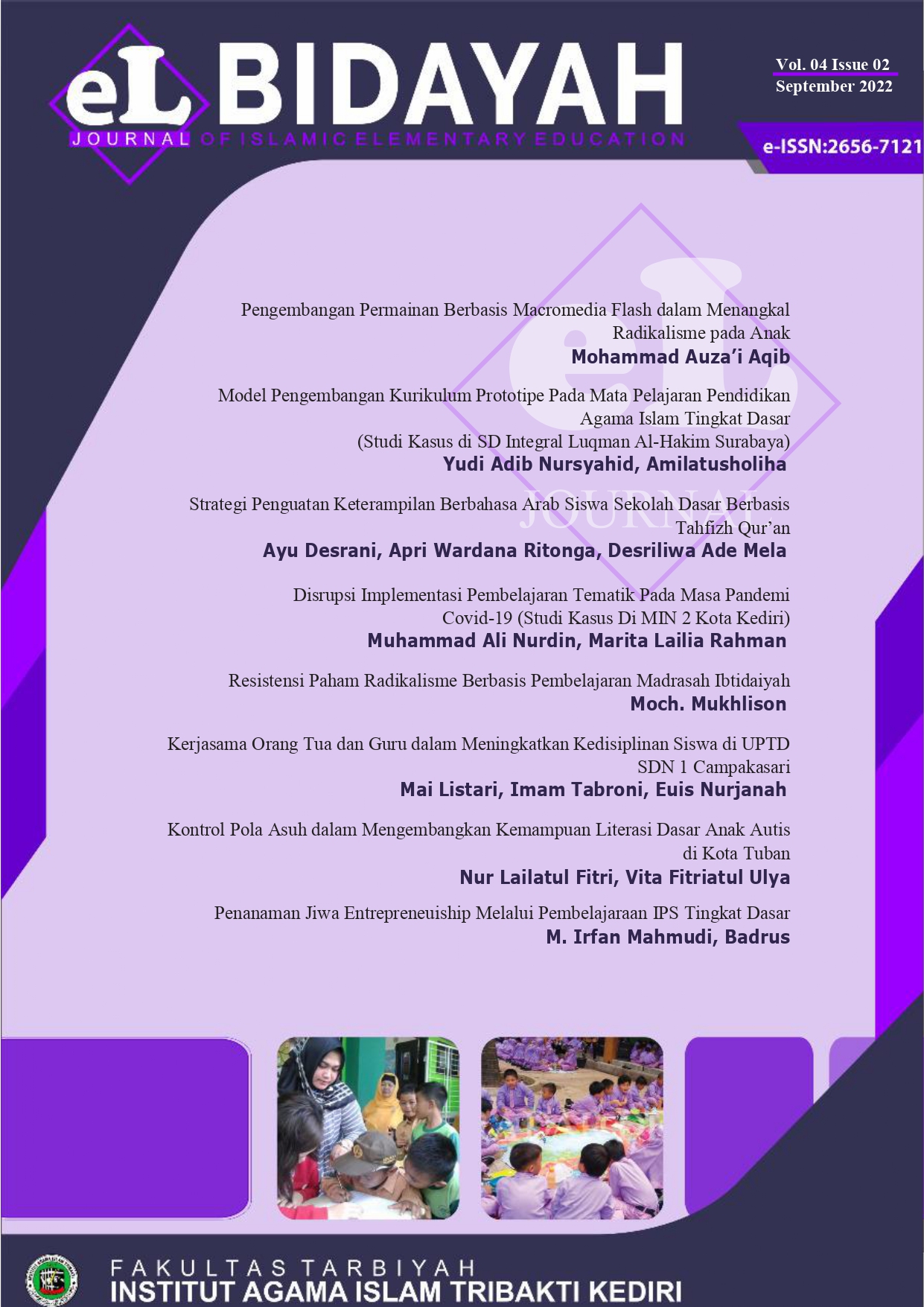
Strategi Penguatan Keterampilan Berbahasa Arab Siswa Sekolah Dasar Berbasis Tahfizh Qur’an
DOI:
https://doi.org/10.33367/jiee.v4i2.2825Keywords:
Arabic Language, Elementary School Students, Play While LearningAbstract
The rapid development of globalization has made global competition even tougher. Improving language skills has become a necessity for everyone, including Arabic. Arabic is important to be taught to students since they are in elementary school so that Arabic will be a provision for them when they grow up, one of which is to study religious knowledge. This study aimed to describe the strategy of strengthening the Arabic skills of elementary school students based on the catfish Qur'an. This study adopted a descriptive qualitative approach with a case study method at SD Tahfizh Al-Qur'an Daarul Ukhuwwah Malang. Data collection techniques through observation, interviews, and documentation. The collected data is then analyzed through the stages of reduction, presentation, and verification or conclusion. The results of this study indicate that: a) game-based Arabic learning strategies to attract students' attention to learning; b) the Arabic language learning program must be followed by teachers and students, teacher activities are directly guided by the principal, while the student program is guided by the teacher in the form of making Arabic videos, Arabic songs, and depositing Arabic vocabulary via Whatsapp; c) obstacles found during the learning process in the form of student delays when depositing Arabic vocabulary due to lack of parental supervision and motivationThe findings of this study reveal the positive impact that arises from the game-based Arabic learning process, namely that students can communicate Arabic with their teachers and friends.
References
Al-Khresheh, Mohammad H., Ahmad Khaerurrozikin, and Abdul Hafidz Zaid. “The Efficiency of Using Pictures in Teaching Speaking Skills of Non-Native Arabic Beginner Students.†Universal Journal of Educational Research 8, no. 3 (2020): 872–78. https://doi.org/10.13189/ujer.2020.080318.
Amaliati, Siti. “Pendidikan Karakter Perspektif Abdullah Nashih Ulwan Dalam Kitab Tarbiyatul Aulad Fil Islam Dan Relevansinya Menjawab Problematika Anak Di Era Milenial.†Child Education Journal (CEJ) 2, no. 1 (2020): 34–47.
Bahruddin, Uril, and Suci Ramadhanti Febriani. “Student’s Perceptions of Arabic Online Learning During Covid-19 Emergency.†Journal for the Education of Gifted Young Scientists 8, no. 4 (2020): 1483–92. https://doi.org/10.17478/jegys.763705.
Bustam, Betty Mauli Rosa, Iswanto, Mhd. Lailan Arqam, Wikanti Iffah Juliani, and Akhmad Najibul Khairi. “The Effectiveness of Fun Learning Approach in Arabic Learning.†Jurnal Al Bayan Jurusan Pendidikan Bahasa Arab 13, no. 2 (2021): 286–304. https://doi.org/10.24042/albayan.v.
Ediyani, Muhammad, Kasful Anwar, Husaini Husaini, Ridha Zuhaimi, and Taufiq Hidayat. “The Analysis of Arabic Learning Materials in Al-‘Arabiyah Baina Yadaik Book with the Principle of Material Development Approach.†Budapest International Research and Critics Institute (BIRCI-Journal): Humanities and Social Sciences 3, no. 2 (2020): 965–74. https://doi.org/10.33258/birci.v3i2.924.
El-Omari, Abdallah Hussein, and Hussein Mohammad Bataineh. “Problems of Learning Arabic by Non-Arabic Speaking Children: Diagnosis and Treatment.†Journal of Language Teaching and Research 9, no. 5 (2018): 1095–1100. https://doi.org/10.17507/jltr.0905.25.
F.Y., Mustaffa, A.R. Salam, N.H. Mohd Sharif, A. Sirri, and A.H. Abdullah. “Needs and Preferences of Qur’anic Arabic Vocabulary Learners Regarding Learning through Qur’anic Arabic Mobile Applications.†International Journal of Psychosocial Rehabilitation 24, no. 5 (2020): 152–62. https://doi.org/10.37200/ijpr/v24i5/pr201678.
Fakhrurrazi, Fakhrurrazi. “Hakikat Pembelajaran Yang Efektif.†At-Tafkir 11, no. 1 (2018): 85–99. https://doi.org/10.32505/at.v11i1.529.
Hafiz, Salama Abdul, and Attary Abeer F. “The Effect of Using Electronic Games in Developing The Intuitive English Language Skills for Basic First Grade Female Pupils.†International Journal of Research in Educational Sciences 2, no. 2 (2019): 285–306. https://doi.org/10.29009/ijres.2.2.8 International.
Hapnita, Widia, Rijal Abdullah, Yuwalitas Gusmareta, and Fahmi Rizal. “Faktor Internal Dan Eksternal Yang Dominan Mempengaruhi Hasil Belajar Menggambar Dengan Perangkat Lunak Siswa Kelas Xi Teknik Gambar Bangunan Smk N 1 Padang Tahun 2016/2017.†CIVED (Journal of Civil Engineering and Vocational Education) 5, no. 1 (2018). https://doi.org/10.24036/cived.v5i1.9941.
Hassunah-Arafat, Safieh Muhamad, Dorit Aram, and Ofra Korat. “Early Literacy in Arabic: The Role of SES, Home Literacy Environment, Mothers’ Early Literacy Beliefs and Estimation of Their Children’s Literacy Skills.†Reading and Writing, no. 0123456789 (2021). https://doi.org/10.1007/s11145-021-10158-1.
Muslimah, Maziyyatul. “Students’ Perception on Phenomena and Challenges in Arabic Learning at Islamic Elementary School.†Sittah: Journal of Primary Education 2, no. 1 (2021): 1–18. https://doi.org/10.30762/sittah.v2i1.2547.
Nurdyansah, Fitriyani Toyiba. “Pengaruh Strategi Pembelajaran Aktif Terhadap Hasil Belajar Madrasah Obtiaiyah.†Jurnal Pendidikan 3, no. 1 (2018): 929–30. http://eprints.umsida.ac.id/1610.
Oudeh, Thaer Yousef. “Teaching Arabic Language to Speakers of Other Languages (Between Tradition and Innovation).†Elementary Education Online 18, no. 4 (2019): 2157–71. https://doi.org/10.17051/ilkonline.2019.641214.
Pimada, Luluk Humairo, Rostanti Toba, and Abdul Wahab Rasyidi. “Learning of Imla’ Using Flashcards on Writing Skill at Islamic Elementary School Level in Samarinda.†Izdihar : Journal of Arabic Language Teaching, Linguistics, and Literature 3, no. 1 (2020): 1–16. https://doi.org/10.22219/jiz.v3i1.11682.
Rachmayanti, Irma, and Mochamad Arifin Alatas. “The Learning of Arabic Alphabets for Special Needs Students in Elementary School.†Izdihar : Journal of Arabic Language Teaching, Linguistics, and Literature 3, no. 2 (2020): 79–94. https://doi.org/10.22219/jiz.v3i2.11931.
Ritonga, Apri Wardana, and Aulia Fitri. “Maharah Qira’ah Learning Strategy for Integrated Islamic Elementary School (SDIT) Students During Covid-19 Pandemic.†Jurnal Elementary: Kajian Teori Dan Hasil Penelitian Pendidikan Sekolah Dasar 4, no. 2 (2021): 103–7. https://doi.org/10.31764/elementary.v4i2.4501.
Ritonga, Apri Wardana, Mahyudin Ritonga, Talqis Nurdianto, Martin Kustati, Rehani, Lahmi Ahmad, Yasmadi, and Pahri. “E-Learning Process of Maharah Qira’ah in Higher Education during the Covid-19 Pandemic.†International Journal of Higher Education 9, no. 6 (2020). https://doi.org/10.5430/ijhe.v9n6p227.
Setiono, P, E Handayani, and S Selvia. “Strategi Guru Dalam Pembelajaran Daring Pada Masa Covid-19 Di Sekolah Dasar.†JURIDIKDAS: Jurnal Riset … 3, no. 3 (2020): 402–7. https://ejournal.unib.ac.id/index.php/juridikdasunib/article/view/14570.
Sobri, Muhammad, Nursaptini Nursaptini, and Setiani Novitasari. “Mewujudkan Kemandirian Belajar Melalui Pembelajaran Berbasis Daring Diperguruan Tinggi Pada Era Industri 4.0.†Jurnal Pendidikan Glasser 4, no. 1 (2020): 64. https://doi.org/10.32529/glasser.v4i1.373.
Susanthi, I Gusti Ayu Agung Dian. “Kendala Dalam Belajar Bahasa Inggris Dan Cara Mengatasinya.†Linguistic Comunity Service Journal 1, no. 2 (2021): 64–70. https://www.ejournal.warmadewa.ac.id.
Wahyuningtyas, Rizki, and Bambang Suteng Sulasmono. “Pentingnya Media Dalam Pembelajaran Guna Meningkatkan Hasil Belajar Di Sekolah Dasar.†Edukatif : Jurnal Ilmu Pendidikan 2, no. 1 (2020): 23–27. https://doi.org/10.31004/edukatif.v2i1.77.
Widianto, Edi. “Peran Orang Tua Dalam Meningkatkan Pendidikan Karakter Anak Usia Dini Dalam Keluarga.†PG-PAUD Trunojoyo 2, no. 1 (2015): 31–39.
Wijayanti, Resti Mia, and Puji Yanti Fauziah. “Perspektif Dan Peran Orangtua Dalam Program PJJ Masa Pandemi Covid-19 Di PAUD.†Jurnal Obsesi : Jurnal Pendidikan Anak Usia Dini 5, no. 2 (2020): 1304–12. https://doi.org/10.31004/obsesi.v5i2.768.
 Abstract
Views:
228,
Abstract
Views:
228,  PDF downloads: 275
Published
Issue
Section
License
License and Copyright Agreement
In submitting the manuscript to the journal, the authors certify that:
- They are authorized by their co-authors to enter into these arrangements.
- The work described has not been formally published before, except in the form of an abstract or as part of a published lecture, review, thesis, or overlay journal.
- That it is not under consideration for publication elsewhere,
- That its publication has been approved by all the author(s) and by the responsible authorities – tacitly or explicitly – of the institutes where the work has been carried out.
- They secure the right to reproduce any material that has already been published or copyrighted elsewhere.
- They agree to the following license and copyright agreement.
Copyright
Authors who publish with El Bidayah:Journal of Islamic Elementary Education agree to the following terms:
- Authors retain copyright and grant the journal the right of first publication with the work simultaneously licensed under a Creative Commons Attribution License (CC BY-SA 4.0) that allows others to share the work with an acknowledgement of the work's authorship and initial publication in this journal.
- Authors are able to enter into separate, additional contractual arrangements for the non-exclusive distribution of the journal's published version of the work (e.g., post it to an institutional repository or publish it in a book), with an acknowledgment of its initial publication in this journal.
- Authors are permitted and encouraged to post their work online (e.g., in institutional repositories or on their website) before and during the submission process, as it can lead to productive exchanges, as well as earlier and greater citation of published work.
Licensing for Data Publication
El Bidayah: Journal of Islamic Elementary Education uses a variety of waivers and licenses, that are specifically designed for and appropriate for the treatment of data:
- Open Data Commons Attribution License, http://www.opendatacommons.org/licenses/by/1.0/ (default)
- Creative Commons CC-Zero Waiver, http://creativecommons.org/publicdomain/zero/1.0/
- Open Data Commons Public Domain Dedication and Licence, http://www.opendatacommons.org/licenses/pddl/1-0/
Other data publishing licenses may be allowed as exceptions (subject to approval by the editor on a case-by-case basis) and should be justified with a written statement from the author, which will be published with the article.
Open Data and Software Publishing and Sharing
The journal strives to maximize the replicability of the research published in it. Authors are thus required to share all data, code, or protocols underlying the research reported in their articles. Exceptions are permitted but have to be justified in a written public statement accompanying the article.
Datasets and software should be deposited and permanently archived in appropriate, trusted, general, or domain-specific repositories (please consult http://service.re3data.org and/or software repositories such as GitHub, GitLab, Bioinformatics.org, or equivalent). The associated persistent identifiers (e.g. DOI, or others) of the dataset(s) must be included in the data or software resources section of the article. Reference(s) to datasets and software should also be included in the reference list of the article with DOIs (where available). Where no domain-specific data repository exists, authors should deposit their datasets in a general repository such as ZENODO, Dryad, Dataverse, or others.
Small data may also be published as data files or packages supplementary to a research article, however, the authors should prefer in all cases a deposition in data repositories.

This work is licensed under a Creative Commons Attribution-ShareAlike 4.0 International License.