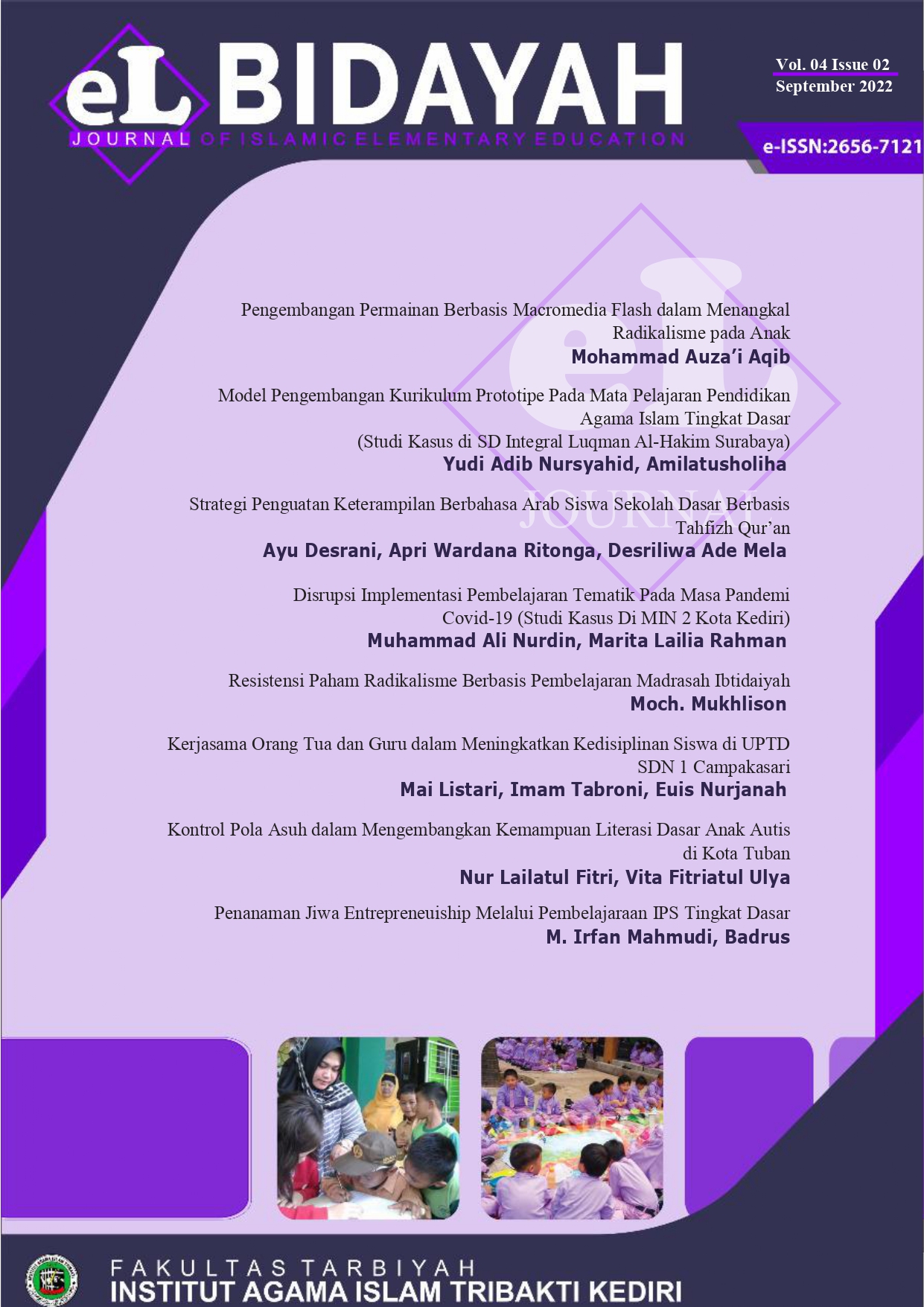
Kerjasama Orang Tua dan Guru dalam Meningkatkan Kedisiplinan Siswa di UPTD SDN 1 Campakasari
DOI:
https://doi.org/10.33367/jiee.v4i2.2944Keywords:
Parents, Teachers, DisciplineAbstract
This study aims to find out what collaborations have been carried out by parents and teachers in improving student discipline at UPTD SDN 1 Campakasari. The research method uses qualitative data collection techniques using observation, interviews, and documentation of teachers, parents, and students. Data triangulation analysis technique. The results showed the cooperation that has been carried out by parents and teachers in improving student discipline at UPTD SDN 1 Campakasari by holding a meeting at the beginning of the new school year, establishing good communication, and holding book relationships. The results and improvements are changes in increasing discipline, a sense of responsibility, visits to students' homes, holding parent meetings at school, and holding correspondence between family and school.
References
Aisyah, Siti. 2010. “Pengaruh Pola Asuh Orang Tua Terhadap Tingkat Agresivitas Anak.†Jurnal Universitas Negeri Makassar.
Departemen Pendidikan Nasional. 2003. Undang-Undang Sistem Pendidikan Nasional 2003. Jakarta: Sinar Grafika.
Imam Tabroni. 2019. Model Pendidikan Islam. Bandung: Cendikia Press.
Iswantiningtyas, V, and W. Wulansari. 2019. “Penanaman Pendidikan Karakter Pada Anak.†Jurnal Obsesi: Jurnal Pendidikan Anak Usia Dini 3 (1): 110–16. https://doi.org/10.31004/obsesi.
Lickona, Thomas. 2013. EducatingFor Character Mendidik Untuk Membentuk Karakter Bagaimana Sekolah Dapat Mengajarkan Sikap Hormat Dan Tanggung Jawab Terjemahan Oleh Juma Abdu Wamaungo. Jakarta: Bumi Aksara.
Nana Rukmana. 2006. Strategic Partnering For Educational Management: Model Manajemen Pendidikan Berbasis Kemitraan. Bandung: Alfabeta.
Sugiyono. 2017. Metode Penelitian Kuantitatif, Kualitatif, Dan R&D. Bandung: Alfabeta.
Syamsu Yusuf. 2012. Psikologi Perkembangan Anak Dan Remaja. Bandung: Remaja Rosdakarya.
Wiyani, Novan Ardy. 2014. Psikologi Perkembangan Anak Usia Dini.
 Abstract
Views:
831,
Abstract
Views:
831,  PDF downloads: 1208
Published
Issue
Section
License
License and Copyright Agreement
In submitting the manuscript to the journal, the authors certify that:
- They are authorized by their co-authors to enter into these arrangements.
- The work described has not been formally published before, except in the form of an abstract or as part of a published lecture, review, thesis, or overlay journal.
- That it is not under consideration for publication elsewhere,
- That its publication has been approved by all the author(s) and by the responsible authorities – tacitly or explicitly – of the institutes where the work has been carried out.
- They secure the right to reproduce any material that has already been published or copyrighted elsewhere.
- They agree to the following license and copyright agreement.
Copyright
Authors who publish with El Bidayah:Journal of Islamic Elementary Education agree to the following terms:
- Authors retain copyright and grant the journal the right of first publication with the work simultaneously licensed under a Creative Commons Attribution License (CC BY-SA 4.0) that allows others to share the work with an acknowledgement of the work's authorship and initial publication in this journal.
- Authors are able to enter into separate, additional contractual arrangements for the non-exclusive distribution of the journal's published version of the work (e.g., post it to an institutional repository or publish it in a book), with an acknowledgment of its initial publication in this journal.
- Authors are permitted and encouraged to post their work online (e.g., in institutional repositories or on their website) before and during the submission process, as it can lead to productive exchanges, as well as earlier and greater citation of published work.
Licensing for Data Publication
El Bidayah: Journal of Islamic Elementary Education uses a variety of waivers and licenses, that are specifically designed for and appropriate for the treatment of data:
- Open Data Commons Attribution License, http://www.opendatacommons.org/licenses/by/1.0/ (default)
- Creative Commons CC-Zero Waiver, http://creativecommons.org/publicdomain/zero/1.0/
- Open Data Commons Public Domain Dedication and Licence, http://www.opendatacommons.org/licenses/pddl/1-0/
Other data publishing licenses may be allowed as exceptions (subject to approval by the editor on a case-by-case basis) and should be justified with a written statement from the author, which will be published with the article.
Open Data and Software Publishing and Sharing
The journal strives to maximize the replicability of the research published in it. Authors are thus required to share all data, code, or protocols underlying the research reported in their articles. Exceptions are permitted but have to be justified in a written public statement accompanying the article.
Datasets and software should be deposited and permanently archived in appropriate, trusted, general, or domain-specific repositories (please consult http://service.re3data.org and/or software repositories such as GitHub, GitLab, Bioinformatics.org, or equivalent). The associated persistent identifiers (e.g. DOI, or others) of the dataset(s) must be included in the data or software resources section of the article. Reference(s) to datasets and software should also be included in the reference list of the article with DOIs (where available). Where no domain-specific data repository exists, authors should deposit their datasets in a general repository such as ZENODO, Dryad, Dataverse, or others.
Small data may also be published as data files or packages supplementary to a research article, however, the authors should prefer in all cases a deposition in data repositories.

This work is licensed under a Creative Commons Attribution-ShareAlike 4.0 International License.