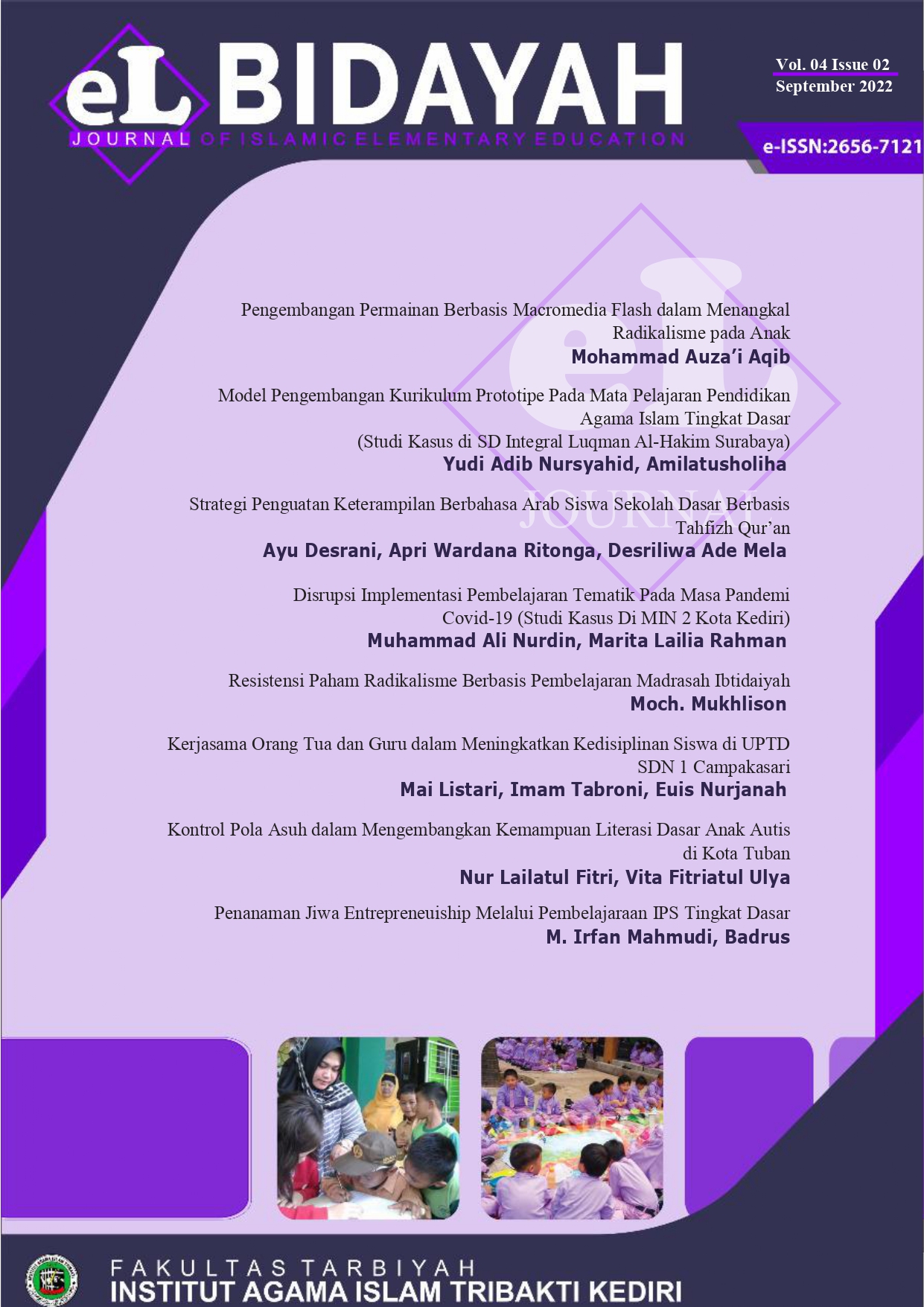
Penanaman Jiwa Entrepreneuiship Melalui Pembelajaraan IPS Tingkat Dasar
DOI:
https://doi.org/10.33367/jiee.v4i2.2970Keywords:
Cultivating the Spirit, Entrepreneurship, LearningSocialAbstract
The development of subject-based learning strategies integrated with entrepreneurship has become a new awareness in basic Islamic education. Children are not only required to be sensitive to business opportunities. Interestingly, many basic Islamic educational institutions have tried to implement it, but have not attracted much interest from researchers. The reason, the phase or stages of child development, is not yet feasible to understand the spirit of entrepreneurship. In this context, this research uses qualitative methods to get a more comprehensive and in-depth picture of the application of learning to increase the entrepreneurial spirit in Islam as if it were the basis of Islam. The data generated are the results of interviews, periodic field observations and document studies in accordance with the research focus. During data mining, the researcher simultaneously analyzed and condensed the data to be presented in the research report. The results of this study indicate that, 1) the design of entrepreneurship learning for upper-class students at MI Al Karim Gondang uses a fairly complete step, namely: 1) setting learning objectives in words that are operational and easy to understand for students, 2) determining the form of practice, with details a) using concrete materials, in the school environment. b) using visual tools, pictures, real materials, c) using examples that have been understood by students. d) Presenting material in an organized manner, starting from understanding, examples, and increasing to more detailed (complicated) material, e) providing exercises with various methods. f) contextual assignment of tasks, g) determine the form of process and outcome evaluation. The results of the second study (2) The implementation of entrepreneurship cultivation in Social Sciences (IPS) learning is carried out by a) introducing money, the function of money, saving and how to get it, b) conducting observations on local tofu and tempeh business products, the practice of planting flowers and fruit in madrasas and participate in organizing marked day.
References
admin. “Gagne’s Hierarchy of Learning Types | Dr. V.K. Maheshwari, Ph.D.†Accessed March 24, 2022. http://www.vkmaheshwari.com/WP/?p=854.
Anwar, Yaskinul, Alvin Fadillah, and Muliati Syam. “Pengaruh Model Pembelajaran Project Based Learning Terhadap Hasil Belajar Peserta didik Kelas X di SMA Negeri 11 Samarinda.†JURNAL PENDIDIKAN 30, no. 3 (November 7, 2021): 399–408. https://doi.org/10.32585/jp.v30i3.1753.
Fatmawati, Indria, and Lutfi Lutfi. “Pengaruh Lokus Pengendalian Dan Pengetahuan Keuangan Pada Perilaku Manajemen Keuangan Generasi Milenial Dengan Moderasi Pendapatan.†Jurnal Manajemen Dan Keuangan 10 (June 7, 2021): 58–71.
Fitri, Naila, and Sita Sari. “PENGARUH KREATIVITAS DAN MINAT BELAJAR TERHADAP HASIL BELAJAR MATEMATIKA.†JURNAL SILOGISME : Kajian Ilmu Matematika Dan Pembelajarannya 4 (April 18, 2020): 68. https://doi.org/10.24269/silogisme.v4i2.988.
Hartati, Sri, Eka Damayanti, M. Rusdi T, and Dahlia Patiung. “Peran Metode Bercerita Terhadap Perkembangan Bahasa Anak Usia Dini.†Jurnal PG-PAUD Trunojoyo : Jurnal Pendidikan Dan Pembelajaran Anak Usia Dini 8, no. 2 (October 30, 2021): 74–86. https://doi.org/10.21107/pgpaudtrunojoyo.v8i2.10513.
Khalil, Mohammed K., and Ihsan A. Elkhider. “Applying Learning Theories and Instructional Design Models for Effective Instruction.†Advances in Physiology Education 40, no. 2 (June 2016): 147–56. https://doi.org/10.1152/advan.00138.2015.
Khotijah, Septiani, Agus Trianto, and Padi Utomo. “PENERAPAN MODEL PEMROSESAN INFORMASI PADA PEMBELAJARAN MEMBACA PESERTA DIDIK DI SMP NEGERI 02 BENGKULU UTARA.†Jurnal Ilmiah KORPUS 1, no. 2 (2017): 199–209. https://doi.org/10.33369/jik.v1i2.4121.
Khuluq, Khusnul, Zainul Abidin, and Saida Ulfa. “Pengaruh Model Pembelajaran Group Investigation Terhadap Hasil Belajar Ditinjau Dari Gaya Belajar Peserta didik Kelas XI IPS.†JKTP: Jurnal Kajian Teknologi Pendidikan 4, no. 2 (May 30, 2021): 197–206. https://doi.org/10.17977/um038v4i22021p197.
Malik, Fatima, and Raman Marwaha. “Developmental Stages of Social Emotional Development In Children.†In StatPearls. Treasure Island (FL): StatPearls Publishing, 2022. http://www.ncbi.nlm.nih.gov/books/NBK534819/.
Matondang, Armansyah, Yurial Lubis, and Agung Suharyanto. “Eksistensi Budaya Lokal Dalam Usaha Pembangunan Karater Peserta didik Smp Kota Padang Sidimpuan.†Anthropos: Jurnal Antropologi Sosial Dan Budaya (Journal of Social and Cultural Anthropology) 3 (December 29, 2017): 103. https://doi.org/10.24114/antro.v3i2.8306.
Nemenzo, Norlita. “Problems Encountered by Teachers in the Teaching-Learning Process: A Basis of an Action Plan,†April 20, 2018.
Nurhayati, Eni Candra. “PENGARUH MARKET DAY (BAZAR) TERHADAP MEMBANGUN JIWA WIRAUSAHA MAHAPESERTA DIDIK UNSIQ JAWA TENGAH DI WONOSOBO.†PARAMUROBI: JURNAL PENDIDIKAN AGAMA ISLAM 1, no. 2 (2018): 1.
Rehalat, Aminah. “MODEL PEMBELAJARAN PEMROSESAN INFORMASI.†JURNAL PENDIDIKAN ILMU SOSIAL 23 (April 7, 2016): 1. https://doi.org/10.17509/jpis.v23i2.1625.
Salmaa. “Metode Penelitian Kualitatif: Pengertian Menurut Ahli, Jenis-Jenis, dan Karakteristiknya.†Penerbit Deepublish (blog), July 1, 2021. https://penerbitdeepublish.com/metode-penelitian-kualitatif/.
Wijaya, Hadi, Mukminah Mukminah, and Miftahul Hasanah. “Pengaruh Metode Karya Wisata Terhadap Hasil Belajar Peserta didik Kelas VI Materi Wirausaha Di MI Qur’aniyah Batu Kuta Narmada Tahun Pelajaran 2019/2020.†JISIP (Jurnal Ilmu Sosial Dan Pendidikan) 4, no. 1 (January 31, 2020). https://doi.org/10.36312/jisip.v4i1.1169.
 Abstract
Views:
133,
Abstract
Views:
133,  PDF downloads: 147
Published
Issue
Section
License
License and Copyright Agreement
In submitting the manuscript to the journal, the authors certify that:
- They are authorized by their co-authors to enter into these arrangements.
- The work described has not been formally published before, except in the form of an abstract or as part of a published lecture, review, thesis, or overlay journal.
- That it is not under consideration for publication elsewhere,
- That its publication has been approved by all the author(s) and by the responsible authorities – tacitly or explicitly – of the institutes where the work has been carried out.
- They secure the right to reproduce any material that has already been published or copyrighted elsewhere.
- They agree to the following license and copyright agreement.
Copyright
Authors who publish with El Bidayah:Journal of Islamic Elementary Education agree to the following terms:
- Authors retain copyright and grant the journal the right of first publication with the work simultaneously licensed under a Creative Commons Attribution License (CC BY-SA 4.0) that allows others to share the work with an acknowledgement of the work's authorship and initial publication in this journal.
- Authors are able to enter into separate, additional contractual arrangements for the non-exclusive distribution of the journal's published version of the work (e.g., post it to an institutional repository or publish it in a book), with an acknowledgment of its initial publication in this journal.
- Authors are permitted and encouraged to post their work online (e.g., in institutional repositories or on their website) before and during the submission process, as it can lead to productive exchanges, as well as earlier and greater citation of published work.
Licensing for Data Publication
El Bidayah: Journal of Islamic Elementary Education uses a variety of waivers and licenses, that are specifically designed for and appropriate for the treatment of data:
- Open Data Commons Attribution License, http://www.opendatacommons.org/licenses/by/1.0/ (default)
- Creative Commons CC-Zero Waiver, http://creativecommons.org/publicdomain/zero/1.0/
- Open Data Commons Public Domain Dedication and Licence, http://www.opendatacommons.org/licenses/pddl/1-0/
Other data publishing licenses may be allowed as exceptions (subject to approval by the editor on a case-by-case basis) and should be justified with a written statement from the author, which will be published with the article.
Open Data and Software Publishing and Sharing
The journal strives to maximize the replicability of the research published in it. Authors are thus required to share all data, code, or protocols underlying the research reported in their articles. Exceptions are permitted but have to be justified in a written public statement accompanying the article.
Datasets and software should be deposited and permanently archived in appropriate, trusted, general, or domain-specific repositories (please consult http://service.re3data.org and/or software repositories such as GitHub, GitLab, Bioinformatics.org, or equivalent). The associated persistent identifiers (e.g. DOI, or others) of the dataset(s) must be included in the data or software resources section of the article. Reference(s) to datasets and software should also be included in the reference list of the article with DOIs (where available). Where no domain-specific data repository exists, authors should deposit their datasets in a general repository such as ZENODO, Dryad, Dataverse, or others.
Small data may also be published as data files or packages supplementary to a research article, however, the authors should prefer in all cases a deposition in data repositories.

This work is licensed under a Creative Commons Attribution-ShareAlike 4.0 International License.