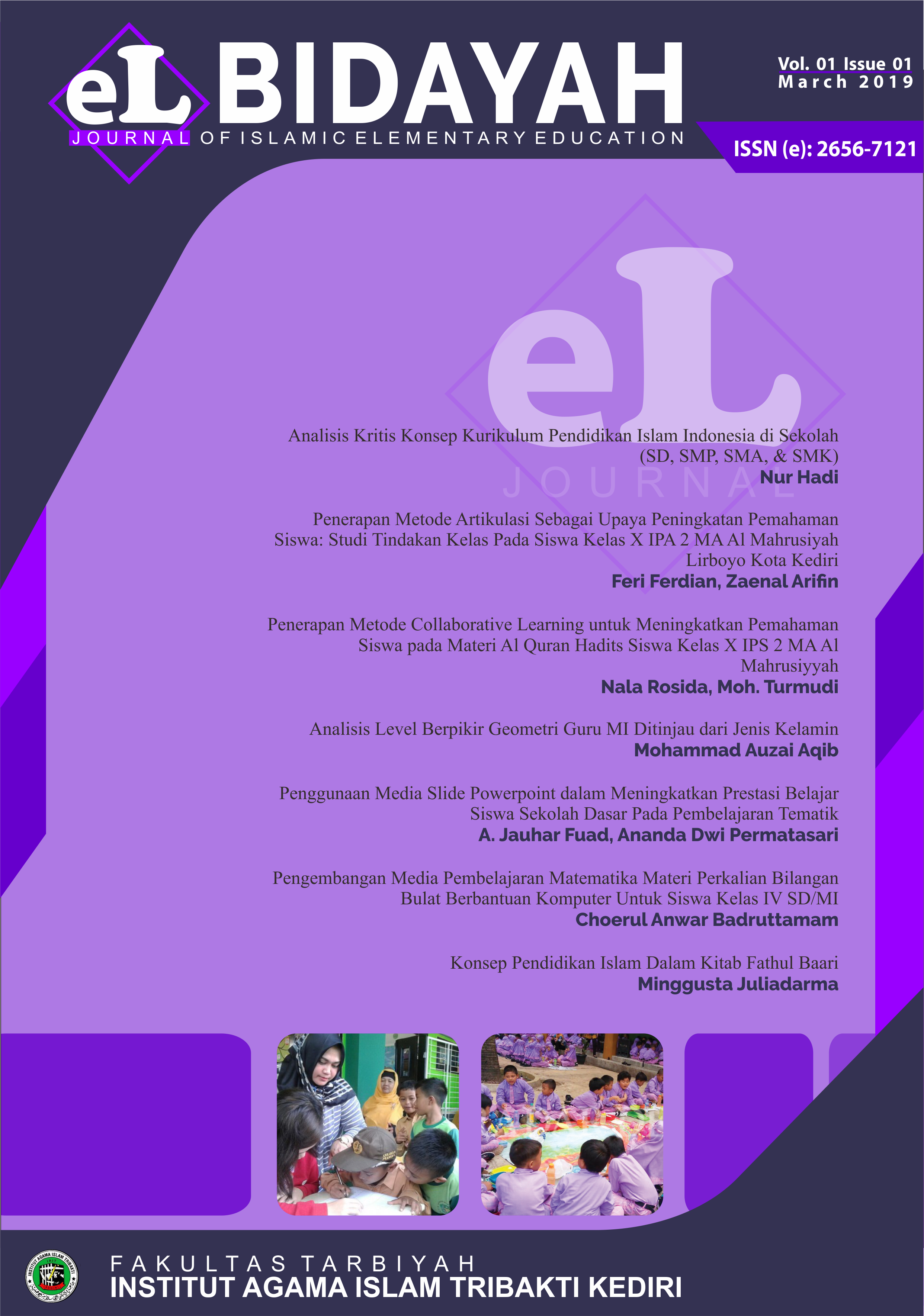
Pengembangan Media Pembelajaran Matematika Materi Perkalian Bilangan Bulat Berbantuan Komputer Untuk Siswa Kelas IV SD/MI
DOI:
https://doi.org/10.33367/jiee.v1i1.686Keywords:
Media Development, Mathematics, Multiplication, Computer AssistedAbstract
Multiplication is difficult topic to be understood by a lot of students. This can be observed from students in elementary that have not understood about multiplication, therefore, they difficult to learn mathematics in high stage. In developing and implementing effective, efficiency and interesting media also teacher’s guides that be hoped to help the students in learning and memorizing about multiplication.
In the developing learning mathematic media has allowed the procedures of developing by Alessi dan Trollip, they are (1) goals determining, (2) collecting references material, (3) learn about references material, (4) developing idea, (5) designing learning, (6) arranging flowchart, (7) arranging storyboard, (8) arranging program, (9) arranging support materials, and (10) evaluation and revision. This package has programmed by Adobe System, Adobe Flash CS 5. This program has produced in 1 file execution that be called “GAME.exe”.
Evaluation and revision of learning media by computer-assisted instruction has allowed four steps, they are, (1) validation and suggestion by expert of mathematics’ contents, (2) validation and suggestion by expert of learning media design, (3) validation and suggestion by teacher 4th MI Muhammadiyyah Probolinggo, (4) validation and suggestion from trial out 4th students MI Muhammadiyyah Probolinggo about 24 students.
References
Abdussakir dan Sudarman. 2000. Pembelajaran Matematika Berbantuan Komputer: Strategi Pembelajaran, Komponen Pembelajaran, Model Pengembangan dan Skenario Pelaksanaannya. Malang: Seminar Nasional HMJ Matematika FMIPA UM.
Abdussakir. 2003. Pengembangan Paket Pembelajaran Berbantuan Komputer Materi Irisan pada Kelas III Sekolah Menengah Umum. Tesis. Tidak diterbitkan. Program Pascasarjana. Malang: Program Studi Pendidikan Matematika.
Arsyad. Azhar. 1997. Media Pengajaran. Jakarta: PT Raja Grafindo Persada.
Permendikanas nomor 2. 2008. Bab 1 tetang Ketentuan Umum.
Supatmono. Catur. Matematika Asyik, Asyik Mengajarnya, Asyik Belajarnya. Jakarta: PT. Gramedia Widiasarana Indonesia Kompas Gramedia Building.
D. Sewell. F. 1990. New Tools for New Mind. Great Britain: Harvester Wheatsheaf.
Gora . Winastwan & Sunarto. PAKEMATIK Strategi Pembelajaran Inovatif Berbasis TIK. Jakarta: Elex Media Computindo.
J. Soulier. S. 1998. The Design and Development of Computer Based Instruction. Massachusetts: Allyn and Bacon, Inc.
Halim. Abdul. Fathani. 2009. Matematika Hakikat dan Logika. Jogjakarta: Ar-Ruzz Media.
J. Lockard. Abrams. P. D dan W. Many. A. 1990. Microcomputers for Educators, Second Edition. USA: Harpes Collins Publisher.
Murni . Wahid. 2008. Cara Mudah Menulis Proposal dan Laporan Penelitian Lapangan; Pendekatan Kualitatif dan Kuantitatif (Skripsi, Thesis, dan Disertasi). Malang: UM Press.
P. Cole. dan L. Chan. 1990. Methods and Strategies for Special Education. Australia: Prantice Hall.
S. Alessi. M. Dan S. Trollip. R. 1991. Computer Based Instruction: Methods and Development. New Jersey: Prantice Hall.
Simanjuntak. Lisnawaty. 1993. Metode Mengajar Matematika. Jakarta: Rineka Cipta.
Sugiyono. 2011. Metode Penelitian Kuantitatif, Kualitatif, dan R&D. Bandung: Alfabeta.
V. Gerlach. S, dan D. Ely. P. 1980. Teaching and Media. New Jersey: Practice Hall, Inc.
Wijaya. Aryadi. 2012. PENDIDIKAN MATEMATIKA REALISTIK: Suatu Alternatif Pendekatan Pembelajaran Matematika. Yogyakarta: Graha Ilmu .
Wina. Sanjaya. 2008. Perencanaan Dan Desain Pembelajaran .Jakarta: Kencana.
 Abstract
Views:
369,
Abstract
Views:
369,  PDF downloads: 466
Published
Issue
Section
License
License and Copyright Agreement
In submitting the manuscript to the journal, the authors certify that:
- They are authorized by their co-authors to enter into these arrangements.
- The work described has not been formally published before, except in the form of an abstract or as part of a published lecture, review, thesis, or overlay journal.
- That it is not under consideration for publication elsewhere,
- That its publication has been approved by all the author(s) and by the responsible authorities – tacitly or explicitly – of the institutes where the work has been carried out.
- They secure the right to reproduce any material that has already been published or copyrighted elsewhere.
- They agree to the following license and copyright agreement.
Copyright
Authors who publish with El Bidayah:Journal of Islamic Elementary Education agree to the following terms:
- Authors retain copyright and grant the journal the right of first publication with the work simultaneously licensed under a Creative Commons Attribution License (CC BY-SA 4.0) that allows others to share the work with an acknowledgement of the work's authorship and initial publication in this journal.
- Authors are able to enter into separate, additional contractual arrangements for the non-exclusive distribution of the journal's published version of the work (e.g., post it to an institutional repository or publish it in a book), with an acknowledgment of its initial publication in this journal.
- Authors are permitted and encouraged to post their work online (e.g., in institutional repositories or on their website) before and during the submission process, as it can lead to productive exchanges, as well as earlier and greater citation of published work.
Licensing for Data Publication
El Bidayah: Journal of Islamic Elementary Education uses a variety of waivers and licenses, that are specifically designed for and appropriate for the treatment of data:
- Open Data Commons Attribution License, http://www.opendatacommons.org/licenses/by/1.0/ (default)
- Creative Commons CC-Zero Waiver, http://creativecommons.org/publicdomain/zero/1.0/
- Open Data Commons Public Domain Dedication and Licence, http://www.opendatacommons.org/licenses/pddl/1-0/
Other data publishing licenses may be allowed as exceptions (subject to approval by the editor on a case-by-case basis) and should be justified with a written statement from the author, which will be published with the article.
Open Data and Software Publishing and Sharing
The journal strives to maximize the replicability of the research published in it. Authors are thus required to share all data, code, or protocols underlying the research reported in their articles. Exceptions are permitted but have to be justified in a written public statement accompanying the article.
Datasets and software should be deposited and permanently archived in appropriate, trusted, general, or domain-specific repositories (please consult http://service.re3data.org and/or software repositories such as GitHub, GitLab, Bioinformatics.org, or equivalent). The associated persistent identifiers (e.g. DOI, or others) of the dataset(s) must be included in the data or software resources section of the article. Reference(s) to datasets and software should also be included in the reference list of the article with DOIs (where available). Where no domain-specific data repository exists, authors should deposit their datasets in a general repository such as ZENODO, Dryad, Dataverse, or others.
Small data may also be published as data files or packages supplementary to a research article, however, the authors should prefer in all cases a deposition in data repositories.

This work is licensed under a Creative Commons Attribution-ShareAlike 4.0 International License.