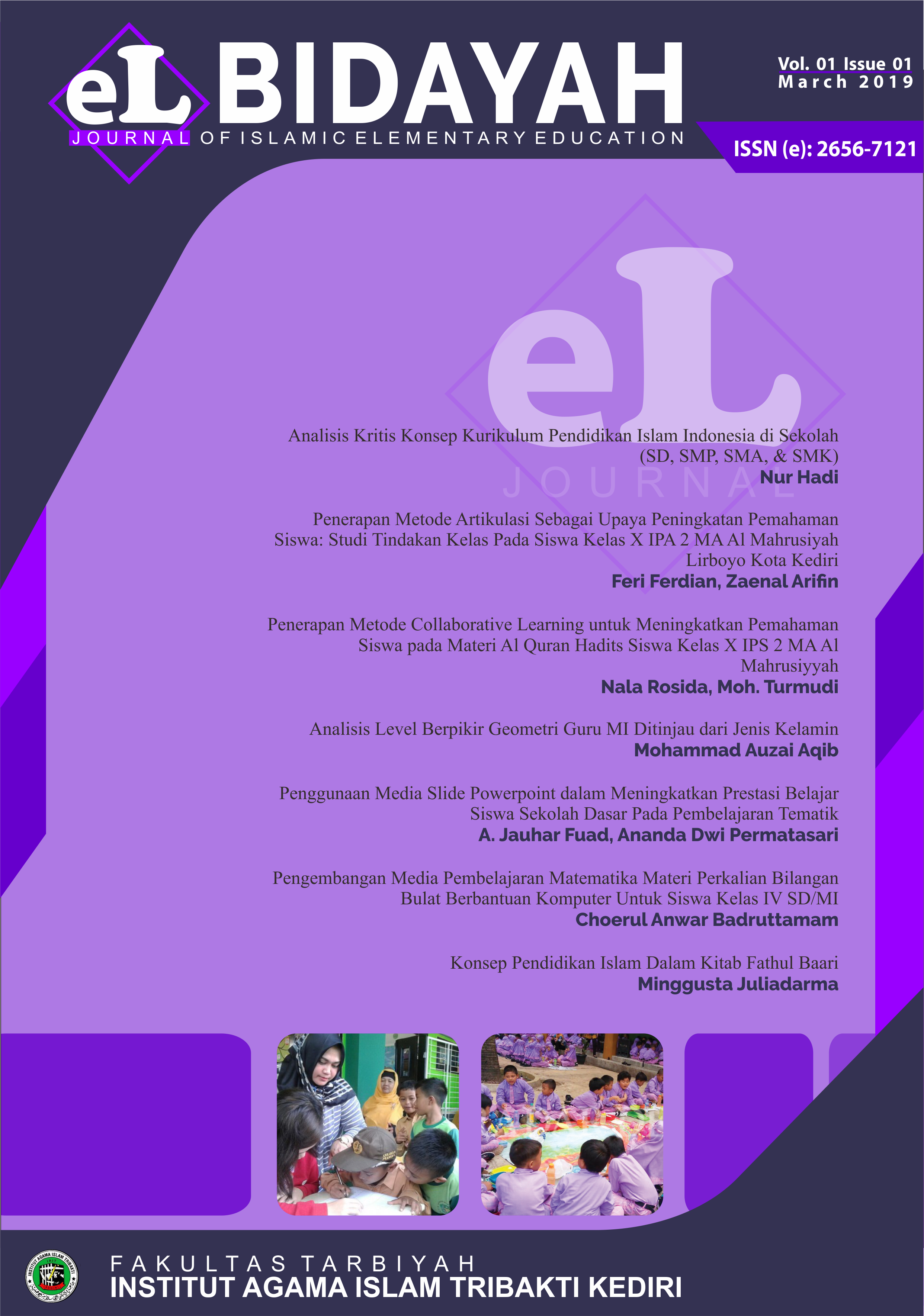
Konsep Pendidikan Islam Dalam Kitab Fathul Baari
DOI:
https://doi.org/10.33367/jiee.v1i1.741Keywords:
Concept of Islamic Education, Book Fathul Baari, Ibnu Hajar al-AsqalaniAbstract
The concept of Islamic education is absolutely necessary in forming Muslims who are pious, noble and have good cognitive abilities. For this reason, many Islamic thinkers try to formulate the concept of Islamic education as a whole which can be used as a reference in fostering the younger generation of Islam. Islamic thinkers include: Ibn Hazm, al-Ghazali, an-Nahlawi, Naguib al-Attas and others. In this paper, the author tries to present other nuances from a different perspective, the author tries to uncover the concept of Islamic education According to the hadith scholars, namely Ibn Hajar al-Asqalani in the book Fathul Baari. The research in this paper aims to: (1) To know the concept of Islamic education in the book Fathul Baari, and (2) To find out the differences in the concept of Islamic education in the book Fathul Baari with the concept of other Islamic education. the concept of Islamic education in the book contains the definition of education, the position of science in Islamic education, educators and their duties, and methods of education.
References
Al-Attas, Naquib. 1984. Konsep Pendidikan Islam. Bandung: Mizan.Arifin,
Muhammad. 2008. Ilmu Pendidikan Islam. Jakarta: Bumi Aksara.
Daradjat, Zakiah. 2000. Ilmu Pendidikan Islam. Jakarta: Bumi Aksara.
Desmita. (2009). Psikologi Perkembangan Peserta Didik. Bandung: Remaja Rosdakarya.
Fakultas Tarbiyah IAIN Walisongo. 2001. Paradigma Pendidikan Islam. Yogyakarta: Pustaka Pelajar.
Hajar, Ibnu. 2003. Fathul Baari. Beirut: Darul Kutub Ilmiyah.
Hasan, Fathiyah.1990. Konsep Pendidikan Al-Ghazali. Jakarta: P3M.Putra.
Ary Antony. 2017. “Konsep Pendidikan Agama Islam Perspektif ImamAl-Ghazali”. Al-Thariqah: Jurnal Pendidikan Agama Islam, 1(1).
Saleh, Abdurrahman. 1990. Teori-teori Pendidikan Berdasarkan Al-Qur’an. Jakarta: Rineka Cipta.
Sholeh, Sholeh. (2016). “Konsep Pendidikan Islam yang Ideal: Upaya Pembentukan Kepribadian Muslim”. Al-Hikmah:Jurnal Agama dan Ilmu Pengetahuan. 13(1).
Uhbiyati, Nur. 1998. Ilmu Pendidikan Islam. Bandung Pustaka Setia.
 Abstract
Views:
273,
Abstract
Views:
273,  PDF downloads: 674
Published
Issue
Section
License
License and Copyright Agreement
In submitting the manuscript to the journal, the authors certify that:
- They are authorized by their co-authors to enter into these arrangements.
- The work described has not been formally published before, except in the form of an abstract or as part of a published lecture, review, thesis, or overlay journal.
- That it is not under consideration for publication elsewhere,
- That its publication has been approved by all the author(s) and by the responsible authorities – tacitly or explicitly – of the institutes where the work has been carried out.
- They secure the right to reproduce any material that has already been published or copyrighted elsewhere.
- They agree to the following license and copyright agreement.
Copyright
Authors who publish with El Bidayah:Journal of Islamic Elementary Education agree to the following terms:
- Authors retain copyright and grant the journal the right of first publication with the work simultaneously licensed under a Creative Commons Attribution License (CC BY-SA 4.0) that allows others to share the work with an acknowledgement of the work's authorship and initial publication in this journal.
- Authors are able to enter into separate, additional contractual arrangements for the non-exclusive distribution of the journal's published version of the work (e.g., post it to an institutional repository or publish it in a book), with an acknowledgment of its initial publication in this journal.
- Authors are permitted and encouraged to post their work online (e.g., in institutional repositories or on their website) before and during the submission process, as it can lead to productive exchanges, as well as earlier and greater citation of published work.
Licensing for Data Publication
El Bidayah: Journal of Islamic Elementary Education uses a variety of waivers and licenses, that are specifically designed for and appropriate for the treatment of data:
- Open Data Commons Attribution License, http://www.opendatacommons.org/licenses/by/1.0/ (default)
- Creative Commons CC-Zero Waiver, http://creativecommons.org/publicdomain/zero/1.0/
- Open Data Commons Public Domain Dedication and Licence, http://www.opendatacommons.org/licenses/pddl/1-0/
Other data publishing licenses may be allowed as exceptions (subject to approval by the editor on a case-by-case basis) and should be justified with a written statement from the author, which will be published with the article.
Open Data and Software Publishing and Sharing
The journal strives to maximize the replicability of the research published in it. Authors are thus required to share all data, code, or protocols underlying the research reported in their articles. Exceptions are permitted but have to be justified in a written public statement accompanying the article.
Datasets and software should be deposited and permanently archived in appropriate, trusted, general, or domain-specific repositories (please consult http://service.re3data.org and/or software repositories such as GitHub, GitLab, Bioinformatics.org, or equivalent). The associated persistent identifiers (e.g. DOI, or others) of the dataset(s) must be included in the data or software resources section of the article. Reference(s) to datasets and software should also be included in the reference list of the article with DOIs (where available). Where no domain-specific data repository exists, authors should deposit their datasets in a general repository such as ZENODO, Dryad, Dataverse, or others.
Small data may also be published as data files or packages supplementary to a research article, however, the authors should prefer in all cases a deposition in data repositories.

This work is licensed under a Creative Commons Attribution-ShareAlike 4.0 International License.