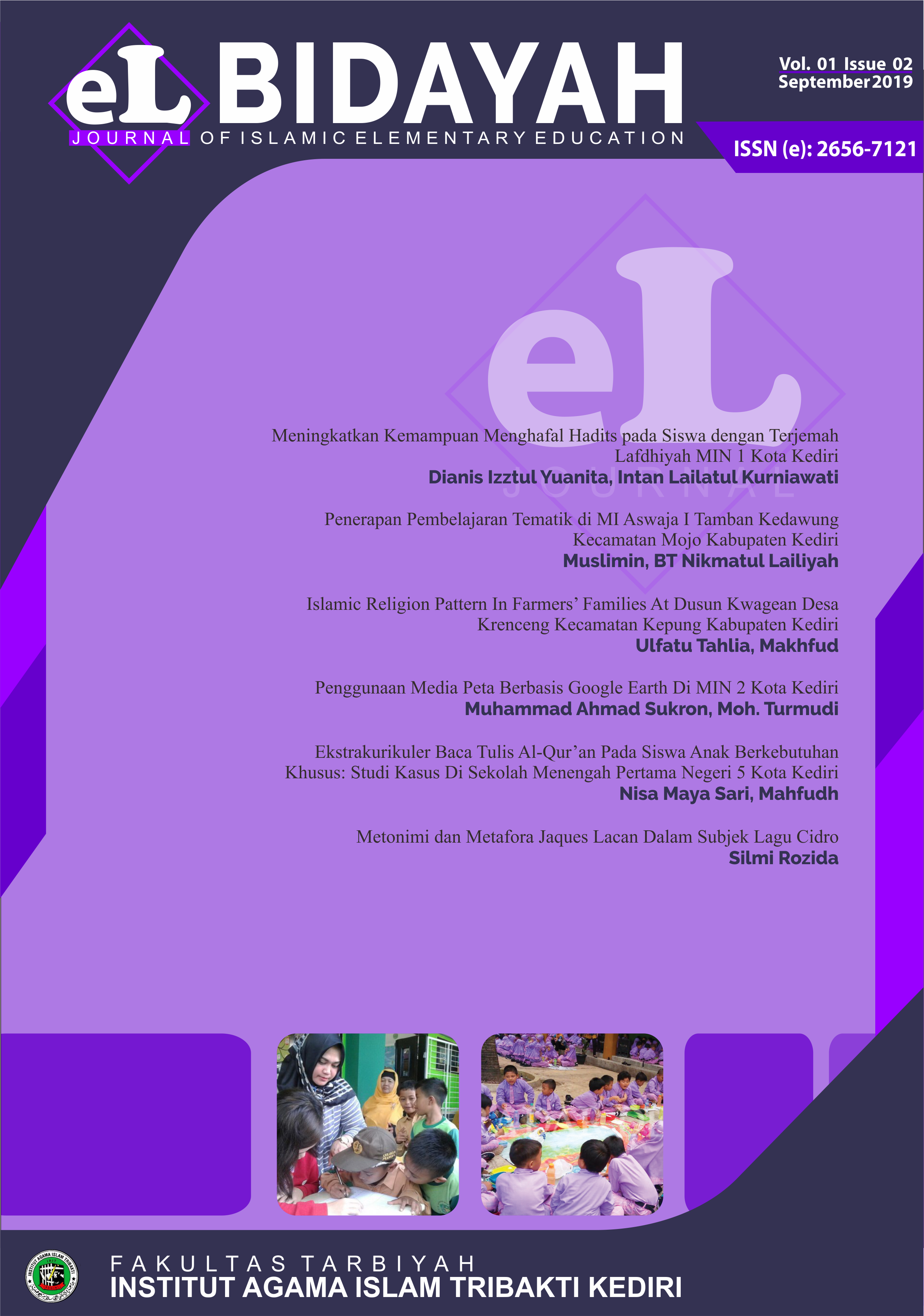
Islamic Religion Pattern In Farmers' Families At Dusun Kwagean Desa Krenceng Kecamatan Kepung Kabupaten Kediri
DOI:
https://doi.org/10.33367/jiee.v1i2.892Keywords:
Pattern of Islamic Education, Farmer Family, Islamic Religion PatternAbstract
Parents are fully responsible for providing Islamic religious education to children. This attitude can be seen from including the way parents give treatment to children, how to give gifts and punishments, how parents give attention and respond to desires child. With the right pattern of Islamic education there is a possibility that Islamic religious education will succeed in the family so that it can give birth to the expected generation. The researcher takes a focus on the problem, namel The Pattern of Islamic Education for Children in Farmers' Families in the Kwagean Hamlet of Krenceng Village, Kepung District, Kediri Regency. This research is type kualitatif research. Besides that ini collect author data use method observation, interview and documentation. The results of this study are Farmers' families in Krenceng Village in educating their children use several methods, namely training / habituation methods, exemplary methods and advice / ibrah and maudloh methods. The pattern of Islamic religious education used by the farmer's family in educating their children consists namely; Authoritative education patterns, Authoritarian education patterns, and Permissive education patterns.
References
AH. Choiron, Psikologi Perkembangan, Kudus: Nora Media Interprise, 2010.
Ahmadi, Abu. Ilmu Sosial Dasar, Jakarta: PT Rineka Cipta, 1991.
Ahmadi, Abu dan Nur Uhbiyati, Ilmu Pendidikan, Jakarta: Rinneka Cipta, 1991.
Amini, Ibrahim. Agar tidak Salah Mendidik Anak, Jakarta: Al Huda, 2006.
Ardi Wiyani, Novan. Pendidikan Karakter Berbasis Iman dan Taqwa, Yogyakarta: Teras, 2012.
Arief, Armai, Pengantar Ilmu Dan Metodologi Pendidikan Islam, Jakarta: Ciputat Pers, 2002.
Arikunto, Suharsimi. Prosedur Penelitian Suatu Pendekatan Praktek, Yogyakarta: Rineka Cipta, 2002.
Betsi, Damiana. dkk., “Pola Asuh Anak pada Keluarga Petani Desa Mangat Baru Kecamatan Dedai Kabupaten Sintangâ€. jppendidikandd130049. https://www.e-jurnal.com/2014/02/pola-asuh-anak-pada-keluarga-petani.html.
Daradjat, Zakiah. Pendidikan Islam dalam Keluarga dan Sekolah, Bandung: CV Ruhama, 1995.
Departemen Agama RI, Al Qur’an Terjemah Depag, Bandung: J-Art, 2004.
Em Zul Fajri dan Ratu Aprilia Senja, Kamus Lengkap Bahasa Indonesia, Jakarta: Difa Publisher, 2008.
Harmayani, “Persepsi Keluarga Petani terhadap Pendidikan Formal Anak (Studi tentang Keluarga Anak Putus Sekolah di Desa Baturijal Hulu Kecamatan Peranap Kabupaten Indragiri Hulu)â€, JOM FISIP, Vol. 4 No. 1, (Februari 2017), https://media.neliti.com/media/publications/122896-ID-persepsi-keluarga-petani-terhadap-pendid.pdf.
Hasan, M.Iqbal. Pokok-Pokok Materi Methodologi Penelitian dan Aplikasinya, Jakarta: Gia Indonesia, 2002.
Iqbal, Muhammad, “Pola Pendidikan Islam Pada Periode Rasulullah Mekkah Dan Madinahâ€, JIPSA. VOL. 15. No. 17. November 2015.
Jamaludin. Dkk, Kapita Pendidikan Islam, Bandung: Pustaka setia, 1998.
J.Maleong, Lexy. Metodologi Penelitian Kualitatif, Bandung: PT Rosdakarya Remaja, 2000.
Kurniawan, Faidillah. Ekstra Kurikuler Sebagai Wahana Pembentukan Karakter Siswa di Lingkungan Pendidikan Sekolah, Yogyakarta: Universitas Negeri Yogyakarta, 2003.
Laa, Raspa. “Pola Asuh Anak dalam Keluarga Petani di Domloli Kabupaten Alorâ€, Al-Asasiyya: Journal Basic of Education, Vol.03, No.01, Juli-Desember 2018.
Lestari, Sri, Psikologi Keluarga, Jakarta: Kencana Prenada Media Group, 2012.
Majid, Abdul. Pendidikan Agama Islam (KBK 2004), Bandung: Remaja Rosda Karya, 2004.
M. Arifin, Ilmu Pendidikan Islam (Suatu Tinjauan Teoritis dan Praktis Berdasarkan Pendekatan Interdisipliner), Jakarta: Bumi Aksara, 1994.
M.I.Soelaeman, Pendidikan dalam Keluarga, Bandung: Alfabeta, 2001.
Mubasyaroh, Materi dan Pembelajaran Aqidah Akhlaq, Buku Daros, Dipa STAIN Kudus, 2008.
Mudiyaharjo, Redja. Pengantar Pendidikan: Sebuah Studi Awal Tentang Dasar-dasar Penddidikan pada Umumnya dan Pendididkan di Indonesia, Jakarta: Raja Grafindo Persada, 2002.
Purnasari, “Pola Pengasuhan Anak pada Keluarga Petani Melayu di Desa Pusaka Kecamatan Tebas Kabupaten Sambasâ€, Jurnal Pendidikan Sosiologi dan Humaniora, Vol. 4. No. 1. April 2013
Ramulyo, Mohd.Idris. Hukum Perkawinan Islam, Jakarta: Bumi Aksara, 1999.
R.Ibrahim, Ilmu dan Aplikasi Pendidikan Bagian IV: Pendidikan Lintas Bidang, Bandung: Imperial Bhakti Utama, 2007.
Rofi, Sofyan, “Pandangan Keluarga Petani terhadap Pendidikan Anak (Studi Kasus pada Orang Tua Siswa SMP Muhammadiyah 6 Wuluhan Jember)â€, TARLIM | Vol. 1, Nomor 1 (Maret 2018), http://jurnal.unmuhjember.ac.id/index.php/TARLIM/article/download/1192/944.
Roqib, Moh. Ilmu Pendidikan Islam: Pengembangan Pendidikan Integratif di Sekolah, Keluarga, dan Masyarakat, Yogyakarta: LKIS, 2009.
Rosidi, Imron. Ayo Senang Menulis Karya Tulis Ilmiah, Jakarta: Media Pustaka, 2005.
Sabri, HM. Alisuf. Pengantar Ilmu Pendidikan, Jakarta: UIN Jakarta Press, 2005.
Salma, Nurul, “Makna Pendidikan Anak bagi Masyarakat Petani di Desa Munggu Kecamatan Petanahan Kabupaten Kebumenâ€, Jurnal Kebijakan Pendidikan Edisi 5 Vol. V Tahun 2016, https://core.ac.uk/download/pdf/78033694.pdf.
Satiadarma, Monty P. dan Fidelis E. Waruwu, Mendidik Kecerdasan. Pedoman Bagi Orang Tua dan Guru Dalam Mendidik Anak Cerdas, Jakarta: Pustaka Populer Obor, 2003.
Sismiati, â€Pengaruh Pernikahan Dini Terhadap Pola Pembinaan Pendidikan Agama Islam (PAI) Anak di Desa Carangwulung, Kecamatan Wonosalam, Kabupaten Kediri†Laporan skripsi, Kediri: Unipdu 2012.
St. Rahmah, “Peran Keluarga dalam Pendidikan Akhlakâ€, Alhiwar Jurnal Ilmu dan Teknik Dakwah Vol. 04 No. 07 (Januari-Juni 2016), .https://www.researchgate.net/publication/317429625_Peran_Keluarga_Dalam_Pendidikan_Akhlak/download.
Sugiyono, Metode Penelitian Pendidikan, Bandung: Alfabeta, 2008.
Syaefudin, “Kesadaran Keluarga Petani Terhadap Pentingnya Pendidikan Formal (Studi Kasus di Desa Pogungrejo Bayan Purworejo Jawa Tengah)â€, Jurnal Psikologi Integratif, Vol. 6, Nomor 1, (2018), h. 62-80. http://eprints.unm.ac.id/10499/1/JURNAL%20ARNIANTI.pdf.
Syaodih Sukmadinata, Nana. Metode Penelitian Pendidikan, Bandung: Remaja Rosdakarya, 2005.
Ahmad Tafsir, Ilmu pendidikan Dalam Perspektif Islam, Bandung: Remaja Rosdakarya, 2005.
Uhbiyati, Nur, Dasar-dasar Ilmu Pendidikan Islam., Semarang: Pustaka Rizki Putra, 2013.
Umar, Bukhari, Ilmu Pendidikan Islam, Jakarta: Amzah, 2010.
Zuhairini, Filsafat Pendidikan Islam, Jakarta: Bumi Aksara, 1994.
 Abstract
Views:
100,
Abstract
Views:
100,  PDF downloads: 72
Published
Issue
Section
License
License and Copyright Agreement
In submitting the manuscript to the journal, the authors certify that:
- They are authorized by their co-authors to enter into these arrangements.
- The work described has not been formally published before, except in the form of an abstract or as part of a published lecture, review, thesis, or overlay journal.
- That it is not under consideration for publication elsewhere,
- That its publication has been approved by all the author(s) and by the responsible authorities – tacitly or explicitly – of the institutes where the work has been carried out.
- They secure the right to reproduce any material that has already been published or copyrighted elsewhere.
- They agree to the following license and copyright agreement.
Copyright
Authors who publish with El Bidayah:Journal of Islamic Elementary Education agree to the following terms:
- Authors retain copyright and grant the journal the right of first publication with the work simultaneously licensed under a Creative Commons Attribution License (CC BY-SA 4.0) that allows others to share the work with an acknowledgement of the work's authorship and initial publication in this journal.
- Authors are able to enter into separate, additional contractual arrangements for the non-exclusive distribution of the journal's published version of the work (e.g., post it to an institutional repository or publish it in a book), with an acknowledgment of its initial publication in this journal.
- Authors are permitted and encouraged to post their work online (e.g., in institutional repositories or on their website) before and during the submission process, as it can lead to productive exchanges, as well as earlier and greater citation of published work.
Licensing for Data Publication
El Bidayah: Journal of Islamic Elementary Education uses a variety of waivers and licenses, that are specifically designed for and appropriate for the treatment of data:
- Open Data Commons Attribution License, http://www.opendatacommons.org/licenses/by/1.0/ (default)
- Creative Commons CC-Zero Waiver, http://creativecommons.org/publicdomain/zero/1.0/
- Open Data Commons Public Domain Dedication and Licence, http://www.opendatacommons.org/licenses/pddl/1-0/
Other data publishing licenses may be allowed as exceptions (subject to approval by the editor on a case-by-case basis) and should be justified with a written statement from the author, which will be published with the article.
Open Data and Software Publishing and Sharing
The journal strives to maximize the replicability of the research published in it. Authors are thus required to share all data, code, or protocols underlying the research reported in their articles. Exceptions are permitted but have to be justified in a written public statement accompanying the article.
Datasets and software should be deposited and permanently archived in appropriate, trusted, general, or domain-specific repositories (please consult http://service.re3data.org and/or software repositories such as GitHub, GitLab, Bioinformatics.org, or equivalent). The associated persistent identifiers (e.g. DOI, or others) of the dataset(s) must be included in the data or software resources section of the article. Reference(s) to datasets and software should also be included in the reference list of the article with DOIs (where available). Where no domain-specific data repository exists, authors should deposit their datasets in a general repository such as ZENODO, Dryad, Dataverse, or others.
Small data may also be published as data files or packages supplementary to a research article, however, the authors should prefer in all cases a deposition in data repositories.

This work is licensed under a Creative Commons Attribution-ShareAlike 4.0 International License.