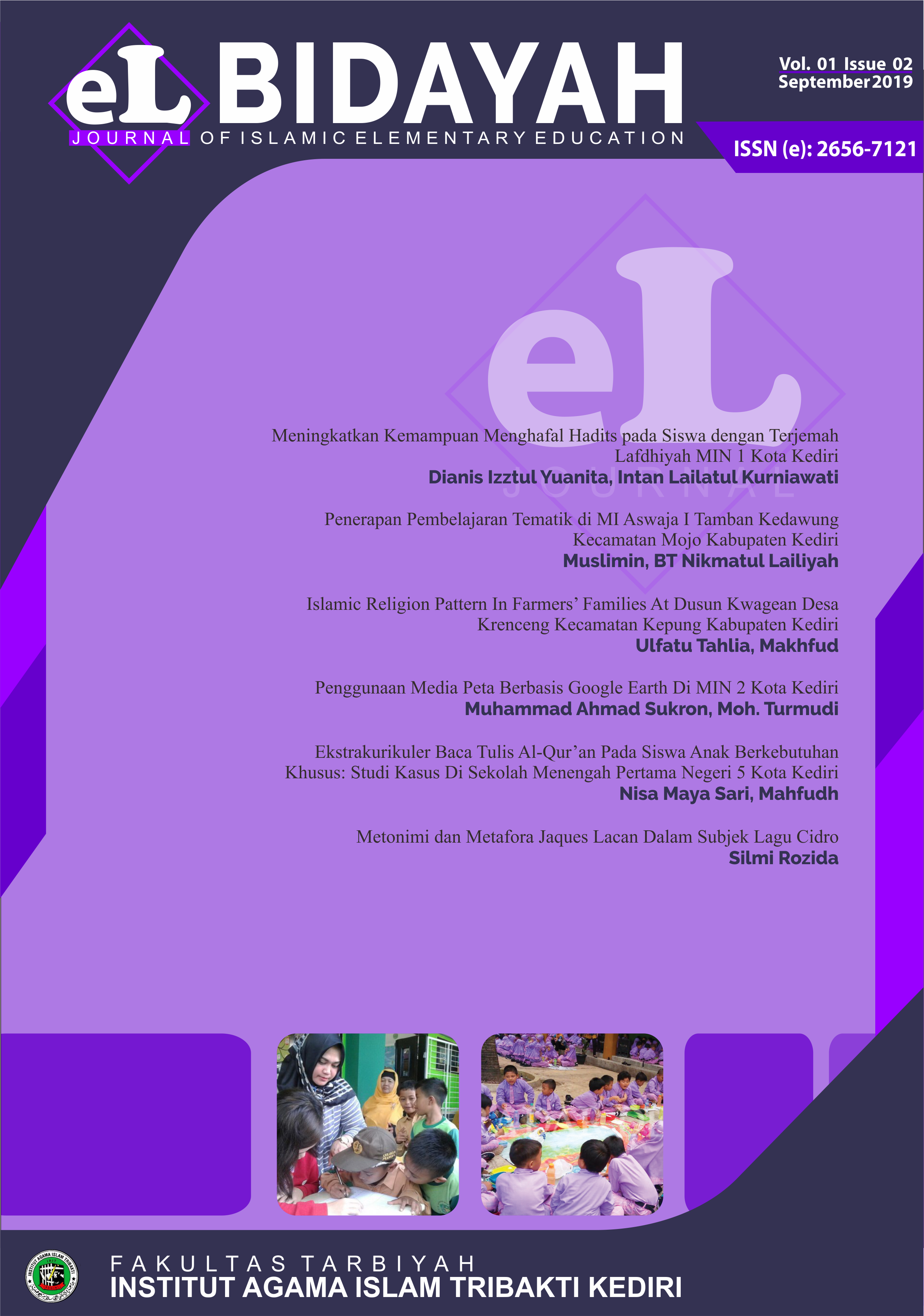
Ekstrakurikuler Baca Tulis Al-Qur'an Pada Siswa Anak Berkebutuhan Khusus
Studi Kasus Di Sekolah Menengah Pertama Negeri 5 Kota Kediri
DOI:
https://doi.org/10.33367/jiee.v1i2.949Keywords:
Reading and Writing Method, Al-Qur'an, Children with Special NeedsAbstract
An inclusive school is a school that combines children with special needs with other normal children in one class and this school was implemented in Kediri two years ago SMPN 05 Kediri. To make it easier for children with special needs to understand the teachings of Islam at school, the school organizes extracurricular writing the Qur'an every Thursday. This study uses qualitative research methods with a case study approach because researchers want to see and understand directly how the extracurricular process is carried out. For data collection techniques, researchers used interviews, observation, and documentation. With this extracurricular, children with special needs, little by little can already recognize the Hijaiyah letters and read the book Iqra.
References
Amelia, Wahyu, Karakteristik dan Jenis Kesulitan Belajar Anak Slow learner,d Jurnal Ilmu Kesehatan Aisyah, (2016), vol.1/2: 53-59.
Anggranti, Wiwik, Penerapan Metode Pembelajaran Baca-Tulis AL-Qur'an Jurnal Intelegensia, (2016) vol. 1/1: 101-119.
Arifin, Zainal, Evaluasi Pembelajaran Bandung: tp 2019.
Darka, Ahmad, Bagaimana Mengajar Iqra' dengan Benar, 01 ed. Jakarta: CV. Tunas Utama, 2009.
Filani Olyvia, Satu juta anak berkebutuhan khusus, http://m.Cnn Indonesia.com, read/2017/29/08/ Satu.juta.anak.berkebutuhan.khusus, 29 Agustus 2017, diakses tanggal 8 Januari 2019.
Hamsa, Mukhammadi, dan Setiyo Hartoto, Survey Minat Siswa Kelas VII dan VIII di SMPN 1 Bangil dalam Mengikuti Ekstrakurikuler Renang, Jurnal Pendidikan Olahraga dan Kesehatan, (2015), vol.3/3: 783-788.
Hasanah, Nur Hafidhotul, Efektifitas Pelaksanaan Program Ekstrakurikuler Baca Tulis Al-Qur'an Bagi Siswa Kelas VII Mts N Sumberagung Jetis Bantul†(2013) Vol.10/1:59-86.
Ma'mun, Muhammad Aman, Kajian Pembelajaran Baca Tulis Al-Qur'an, Annaba: Jurnal Pendidikan, (2018), vol. 4/1: 53-62.
Moleong, Lexy J. Metodologi Penelitian Kualitatif, Bandung: Remaja Rosdakarya, 2005.
Muhammad Hafidz, Imla' Aplikatif, Kompas Gramedia, 2017.
Nugroho, Kristiawan P. A, Dary, Risma Sijabat, Gaya Hidup yang Mempengaruhi Kesehatan Anak Brkebutuhan Khusus, Jurnal Keperawatan Muhammadiyah, (2017), vol. 2/1.
Sari, Maya, Implementasi Kurikulum 2013 pada Anak Berkebutuhan Khusus(ABK) Studi Kasus SD Muhammadiyah Sapen Yogyakarta, Journal of Disabilty Studies,(2016), vol. 3/1: 1-18.
Sulihandri, Hartanti, “Pembelajaran Pendidikan Agama Islam Berbasis Inklusif Bagi Anak Tuna Rungu di SMA Negeri 1 Sewon, Program Pascasarjana UIN Sunan Kalijaga, Yogyakarta, 2016.
Suprihatiningrum, Jamil, Persepsi Siswa Difabel Terhadap Praktik Pendidikan Inklusif Di Sma Inklusi Di Yogyakarta, INKLUSI: Journal of Disability Studies (2016). vol.3/2.
Yin, Robert K., Studi Kasus: Desain & Metode , Jakarta: Raja Grafindo Persada, 2002.
Zaini, Raudho, Implementasi Pembelajaran Pendidikan Agama Islam Pada Anak Berkebutuhan Khusus Di Sekolah Alam Medan, Program Pascasarjana Institut Agama Islam Negeri, Sumatera Utara, 2013.
 Abstract
Views:
265,
Abstract
Views:
265,  PDF downloads: 1324
Published
Issue
Section
License
License and Copyright Agreement
In submitting the manuscript to the journal, the authors certify that:
- They are authorized by their co-authors to enter into these arrangements.
- The work described has not been formally published before, except in the form of an abstract or as part of a published lecture, review, thesis, or overlay journal.
- That it is not under consideration for publication elsewhere,
- That its publication has been approved by all the author(s) and by the responsible authorities – tacitly or explicitly – of the institutes where the work has been carried out.
- They secure the right to reproduce any material that has already been published or copyrighted elsewhere.
- They agree to the following license and copyright agreement.
Copyright
Authors who publish with El Bidayah:Journal of Islamic Elementary Education agree to the following terms:
- Authors retain copyright and grant the journal the right of first publication with the work simultaneously licensed under a Creative Commons Attribution License (CC BY-SA 4.0) that allows others to share the work with an acknowledgement of the work's authorship and initial publication in this journal.
- Authors are able to enter into separate, additional contractual arrangements for the non-exclusive distribution of the journal's published version of the work (e.g., post it to an institutional repository or publish it in a book), with an acknowledgment of its initial publication in this journal.
- Authors are permitted and encouraged to post their work online (e.g., in institutional repositories or on their website) before and during the submission process, as it can lead to productive exchanges, as well as earlier and greater citation of published work.
Licensing for Data Publication
El Bidayah: Journal of Islamic Elementary Education uses a variety of waivers and licenses, that are specifically designed for and appropriate for the treatment of data:
- Open Data Commons Attribution License, http://www.opendatacommons.org/licenses/by/1.0/ (default)
- Creative Commons CC-Zero Waiver, http://creativecommons.org/publicdomain/zero/1.0/
- Open Data Commons Public Domain Dedication and Licence, http://www.opendatacommons.org/licenses/pddl/1-0/
Other data publishing licenses may be allowed as exceptions (subject to approval by the editor on a case-by-case basis) and should be justified with a written statement from the author, which will be published with the article.
Open Data and Software Publishing and Sharing
The journal strives to maximize the replicability of the research published in it. Authors are thus required to share all data, code, or protocols underlying the research reported in their articles. Exceptions are permitted but have to be justified in a written public statement accompanying the article.
Datasets and software should be deposited and permanently archived in appropriate, trusted, general, or domain-specific repositories (please consult http://service.re3data.org and/or software repositories such as GitHub, GitLab, Bioinformatics.org, or equivalent). The associated persistent identifiers (e.g. DOI, or others) of the dataset(s) must be included in the data or software resources section of the article. Reference(s) to datasets and software should also be included in the reference list of the article with DOIs (where available). Where no domain-specific data repository exists, authors should deposit their datasets in a general repository such as ZENODO, Dryad, Dataverse, or others.
Small data may also be published as data files or packages supplementary to a research article, however, the authors should prefer in all cases a deposition in data repositories.

This work is licensed under a Creative Commons Attribution-ShareAlike 4.0 International License.