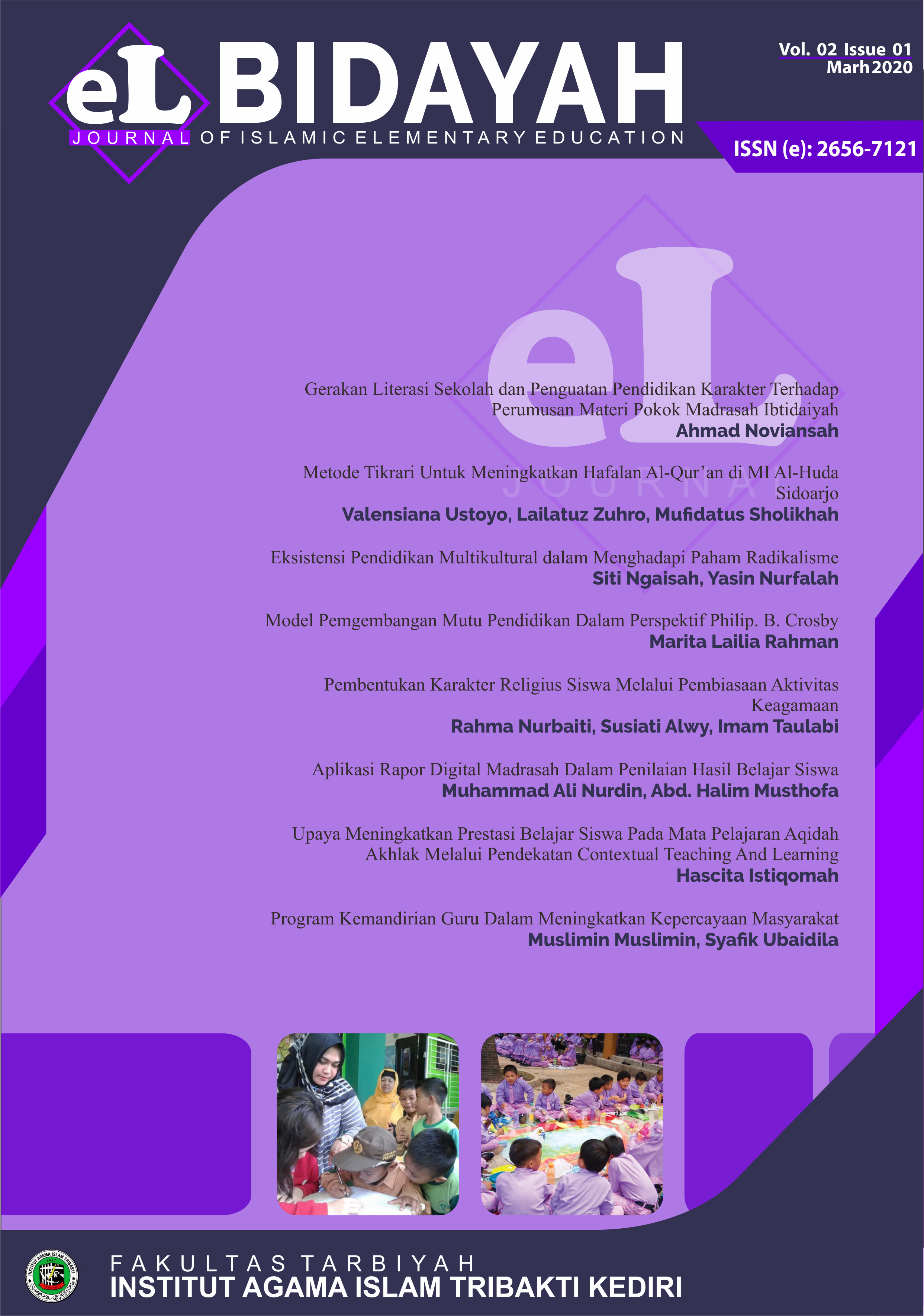
Pembentukan Karakter Religius Siswa Melalui Pembiasaan Aktivitas Keagamaan
DOI:
https://doi.org/10.33367/jiee.v2i1.995Keywords:
Religious Character Building, Habituation, Religious Activities.Abstract
This study aims to find out how the religious character of students developed in the Madrasah Ibtidaiyah Negeri 2 Bandar Kidul and how the formation of character through habituation of religious activities. The type and approach of research use descriptive qualitative. Data sources were obtained through interviews with the headmaster of the madrasa, curriculum waka, religious waka, class teachers, Islamic Religious Education teachers, several student guardians, and students. The results showed that the religious character of the students developed devotion, sincerity, honesty, politeness, help, help, love, grace, cleanliness, competition, and gratitude. Formation of religious character through the habituation of religious activities through joint prayer before and after learning, performing dhuha and dhuhur prayers, reading juz 'amma, asmaul husna, istighasah, infaq, habituation salam, salim, greeting, smiling, polite and polite, religious extracurricular activities such as tambourines, recite the Qur'an, the commemoration of Islamic holidays. Religious character is formed through the habituation of religious activities.
References
Arief, Armai. Pengantar ilmu dan metodologi pendidikan Islam. Jakarta: Ciputat Pers, 2002.
Gunawan, Heri. Pendidikan Karakter Konsep dan Implementasi. Bandung: Alfabeta, 2012.
Kesuma, Dharma. Pendidikan Karakter Kajian Teori dan Praktik di Sekolah. Bandung: PT. Remaja Rosdakarya, 2011.
Khoiruddin, M. Arif. Perkembangan Anak Ditinjau Dari Kemampuan Sosial Emosional. Jurnal Pemikiran Keislaman 29, no. 2 (24 Desember 2018): 425~438-425~438. https://doi.org/10.33367/tribakti.v29i2.624.
Khoiruddin, M. Arif, dan Dina Dahniary Sholekah. Implementasi Pendidikan Agama Islam Dalam Membentuk Karakter Religius Siswa. PEDAGOGIK : JURNAL PENDIDIKAN 6, no. 1 (1 Juli 2019): 12344.
Lickona, Thomas. Pendidikan Karakter. Jakarta: PT. Bumi Aksara, 2012.
Majid, Abdul, dan Dian Andayani. Pendidikan Karakter Perspektif Islam. Bandung: Remaja Rosdakarya, 2011.
Mulyasa, E. Manajemen Pendidikan Karakter. Jakarta: PT. Bumi Aksara, 2012.
Samani, Muchlas, dan Haryanto. Konsep dan Model Pendidikan Karakter. Bandung: PT. Rosdakarya, 2013.
 Abstract
Views:
3518,
Abstract
Views:
3518,  PDF downloads: 4795
Published
Issue
Section
License
License and Copyright Agreement
In submitting the manuscript to the journal, the authors certify that:
- They are authorized by their co-authors to enter into these arrangements.
- The work described has not been formally published before, except in the form of an abstract or as part of a published lecture, review, thesis, or overlay journal.
- That it is not under consideration for publication elsewhere,
- That its publication has been approved by all the author(s) and by the responsible authorities – tacitly or explicitly – of the institutes where the work has been carried out.
- They secure the right to reproduce any material that has already been published or copyrighted elsewhere.
- They agree to the following license and copyright agreement.
Copyright
Authors who publish with El Bidayah:Journal of Islamic Elementary Education agree to the following terms:
- Authors retain copyright and grant the journal the right of first publication with the work simultaneously licensed under a Creative Commons Attribution License (CC BY-SA 4.0) that allows others to share the work with an acknowledgement of the work's authorship and initial publication in this journal.
- Authors are able to enter into separate, additional contractual arrangements for the non-exclusive distribution of the journal's published version of the work (e.g., post it to an institutional repository or publish it in a book), with an acknowledgment of its initial publication in this journal.
- Authors are permitted and encouraged to post their work online (e.g., in institutional repositories or on their website) before and during the submission process, as it can lead to productive exchanges, as well as earlier and greater citation of published work.
Licensing for Data Publication
El Bidayah: Journal of Islamic Elementary Education uses a variety of waivers and licenses, that are specifically designed for and appropriate for the treatment of data:
- Open Data Commons Attribution License, http://www.opendatacommons.org/licenses/by/1.0/ (default)
- Creative Commons CC-Zero Waiver, http://creativecommons.org/publicdomain/zero/1.0/
- Open Data Commons Public Domain Dedication and Licence, http://www.opendatacommons.org/licenses/pddl/1-0/
Other data publishing licenses may be allowed as exceptions (subject to approval by the editor on a case-by-case basis) and should be justified with a written statement from the author, which will be published with the article.
Open Data and Software Publishing and Sharing
The journal strives to maximize the replicability of the research published in it. Authors are thus required to share all data, code, or protocols underlying the research reported in their articles. Exceptions are permitted but have to be justified in a written public statement accompanying the article.
Datasets and software should be deposited and permanently archived in appropriate, trusted, general, or domain-specific repositories (please consult http://service.re3data.org and/or software repositories such as GitHub, GitLab, Bioinformatics.org, or equivalent). The associated persistent identifiers (e.g. DOI, or others) of the dataset(s) must be included in the data or software resources section of the article. Reference(s) to datasets and software should also be included in the reference list of the article with DOIs (where available). Where no domain-specific data repository exists, authors should deposit their datasets in a general repository such as ZENODO, Dryad, Dataverse, or others.
Small data may also be published as data files or packages supplementary to a research article, however, the authors should prefer in all cases a deposition in data repositories.

This work is licensed under a Creative Commons Attribution-ShareAlike 4.0 International License.