
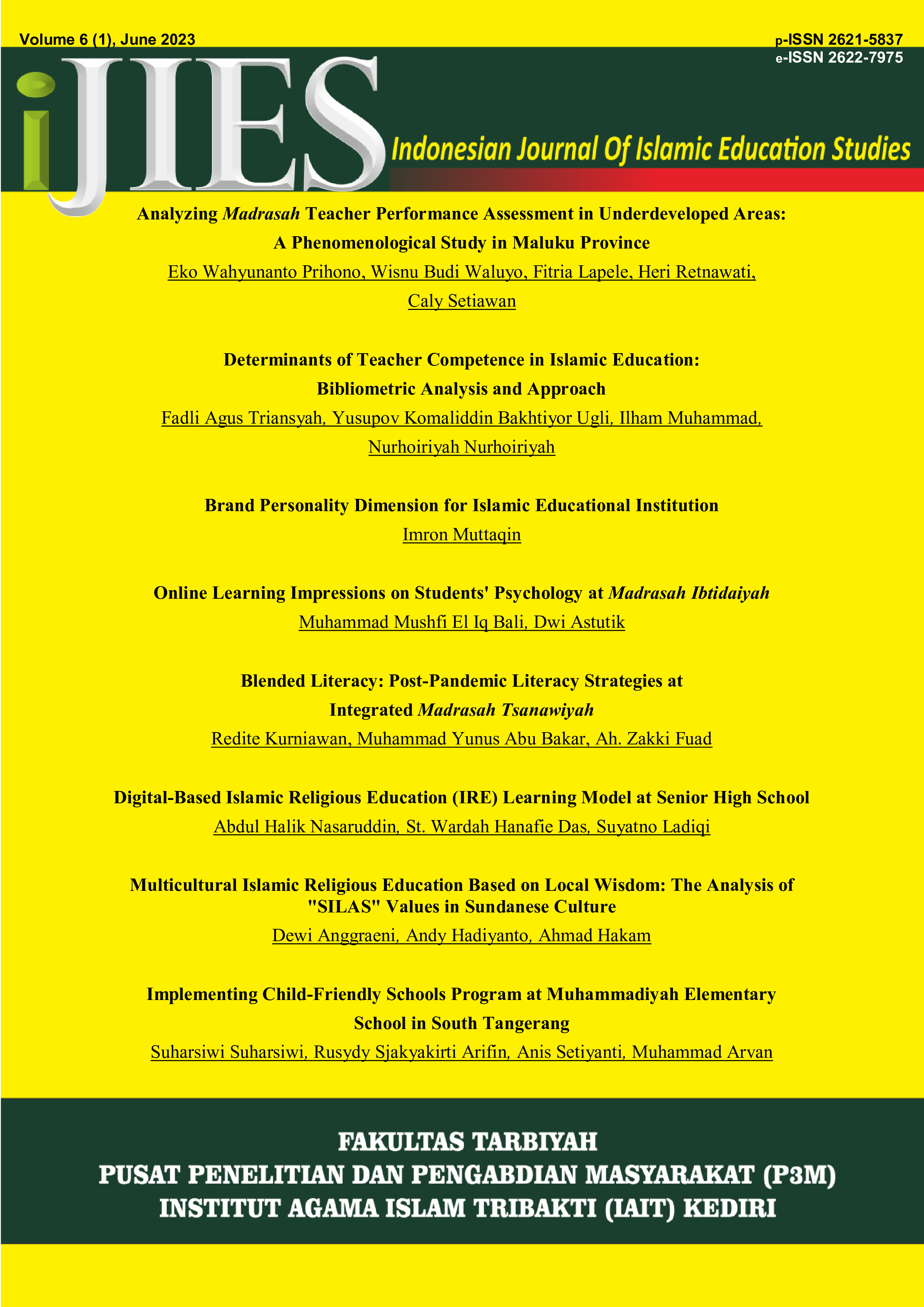
Implementing Child-Friendly Schools Program at Muhammadiyah Elementary School in South Tangerang
DOI:
https://doi.org/10.33367/ijies.v6i1.3619Keywords:
Child-friendly Learning Environment, Child-friendly Schools, Child Protection, Children's RightsAbstract
Child-Friendly Schools (CFS) are formal and non-formal education units that are safe, clean, healthy, and environmentally friendly. Schools guarantee, fulfill and respect children's rights and protect them from violence and discrimination. This child-friendly school model has proven effective in protecting children's rights, preventing discrimination, violence, and other unwanted actions, and developing students' potential. This study uses a qualitative descriptive approach to determine the implementation of the child-friendly school program at Muhammadiyah Elementary School in South Tangerang. Data collection in this study was conducted by conducting interviews with school principals and teachers, observing the teachers' and students' activities while at school, and studying school written documentation. To increase the trust, researchers conducted triangulation by examining field observation notes, written documents, and interview transcripts. Based on the study's findings and the discussion of the results, it was evident that Muhammadiyah Elementary School in South Tangerang has successfully implemented a child-friendly school program, despite needing to be officially designated. The school fulfills at least four of the six indicators required for implementing child-friendly schools, as outlined in PPPA Regulation 8 of 2014. These indicators include having a child-friendly school policy; incorporating child-friendly learning approaches; providing training for teachers and education administration staff on child rights; and ensuring child-friendly infrastructure and facilities are in place.
References
Afnibar, Afnibar. "Child-Friendly School in Regional Perspective and the Role of Counseling Services." JBKI (Jurnal Bimbingan Konseling Indonesia) 2, no. 2 (August 10, 2018): 26–30. https://doi.org/10.26737/jbki.v2i2.252.
Ambarsari, Luthfiana, and Harun Harun. "Child-Friendly School Environment to Ensure Children's Welfare." Journal of Education and Learning (EduLearn) 13, no. 1 (2019): 74–80. https://doi.org/10.11591/edulearn.v13i1.9523.
Çobanoğlu, Fatma, Zeynep Ayvaz-Tuncel, and Aydan Ordu. "Child-Friendly Schools: An Assessment of Secondary Schools." Universal Journal of Educational Research 6, no. 3 (March 2018): 466–77. https://doi.org/10.13189/ujer.2018.060313.
Çobanoğlu, Fatma, and Suadiye Sevim. "Child-Friendly Schools: An Assessment of Kindergartens." International Journal of Educational Methodology 5, no. 4 (November 15, 2019): 637–50. https://doi.org/10.12973/ijem.5.4.637.
Fitriani, Somariah, Istaryatiningtias Istaryatiningtias, and Lelly Qodariah. "A Child-Friendly School: How the School Implements the Model." International Journal of Evaluation and Research in Education (IJERE) 10, no. 1 (March 1, 2021): 273–84. https://doi.org/10.11591/ijere.v10i1.20765.
Hernik, Joanna, and Elżbieta Jaworska. "The Effect of Enjoyment on Learning." INTED2018 Proceedings, 2018, 508–14. https://doi.org/10.21125/inted.2018.1087.
Indonesia, State Secretariat of the Republic of. "Indonesia - Law No. 35 of 2014 Amending Law on Child Protection (No. 23/2002)." Ministry of State Secretariat of the Republic of Indonesia, 2014. https://www.ilo.org/dyn/natlex/natlex4.detail?p_lang=en&p_isn=98588.
Kahfi, Ashabul. “Implementasi Profil Pelajar Pancasila Dan Implikasinya Terhadap Karakter Siswa Di Sekolah.†Dirasah : Jurnal Pemikiran Dan Pendidikan Dasar Islam 5, no. 2 (September 1, 2022): 138–51. https://doi.org/10.51476/dirasah.v5i2.402.
King, Elizabeth. "Implications for the Child Friendly Schools Policy within Cambodia's Cultural and Primary School Context." Asia-Pacific Journal of Teacher Education 48, no. 4 (August 7, 2020): 375–88. https://doi.org/10.1080/1359866X.2019.1645811.
Kodelja, Zdenko. "Violence in Schools: Zero Tolerance Policies." Ethics and Education 14, no. 2 (April 3, 2019): 247–57. https://doi.org/10.1080/17449642.2019.1587682.
Listiowaty, Endang, and Margono Mitrohardjono. “Strategi Pengembangan Karakter Dalam Kegiatan Kepanduan Hizbul Wathan (HW): Studi Kasus Pada Sekolah Dasar Muhammadiyah 5 Kebayoran Baru.†Jurnal Tahdzibi : Manajemen Pendidikan Islam 4, no. 2 (November 30, 2019): 103–10. https://doi.org/10.24853/tahdzibi.4.2.103-110.
Miles, Matthew B., A. M. Huberman, and Johnny Saldaña. Qualitative Data Analysis: A Methods Sourcebook. Third edition. Thousand Oaks, California: SAGE Publications, Inc, 2014.
Nisa, Dinni Mufidatun, and Thomas Nugroho Aji. “Perkembangan Organisasi Tapak Suci Di Surabaya Tahun 1966-1991.†Avatara: E-Journal Pendidikan Sejarah 10, no. 2 (2021). https://ejournal.unesa.ac.id/index.php/avatara/article/view/38864.
Nurchaili, Nurchaili. “Membentuk Karakter Siswa Melalui Keteladanan Guru.†Jurnal Pendidikan dan Kebudayaan 16, no. 9 (October 10, 2010): 233–44. https://doi.org/10.24832/jpnk.v16i9.515.
Nygren, Thomas, Divina Frau-Meigs, Nicoleta Corbu, and Sonia Santoveña-Casal. "Teachers' Views on Disinformation and Media Literacy Supported by a Tool Designed for Professional Fact-Checkers: Perspectives from France, Romania, Spain and Sweden." SN Social Sciences 2, no. 4 (April 9, 2022): 40. https://doi.org/10.1007/s43545-022-00340-9.
Ofojebe, W. N., and Theodorah Chinelo Ezugoh. "Provision of Health Facilities for Promoting Healthy Child-Friendly School Environment in Primary Schools in Delta State, Nigeria." Unizik Journal Of Educational Management And Policy 3, no. 1 (July 30, 2020). https://ezenwaohaetorc.org/journals/index.php/UJOEMP/article/view/901.
Pixler, Paul W. "An Introduction to Philosophy In Education." Idealistic Studies 22, no. 3 (November 1, 1992): 277–78. https://doi.org/10.5840/idstudies199222365.
Sa’ban, L. M. Azhar, Anwar Sadat, and Asrul Nazar. “Meningkatkan Pengetahuan Masyarakat Dalam Perbaikan Sanitasi Lingkungan.†Dinamisia : Jurnal Pengabdian Kepada Masyarakat 5, no. 1 (2021): 10–16. https://doi.org/10.31849/dinamisia.v5i1.4365.
Saleem, Amna, Iqra Shaheen, and Humaira Zahid. "Assessment of Child-Friendly Environment in Public Schools." PalArch's Journal of Archaeology of Egypt / Egyptology 17, no. 9 (December 30, 2020): 9535–56. https://archives.palarch.nl/index.php/jae/article/view/5915.
Suharjuddin, Suharjuddin, and Markum Markum. "Child-Friendly School Policy with Children's Rights Approach in Bekasi City." Jurnal Studi Guru Dan Pembelajaran 4, no. 2 (August 5, 2021): 387–97. https://doi.org/10.30605/jsgp.4.2.2021.1270.
Sunandar, Asep, Mohammad Efendi, Ediyanto Ediyanto, Mohd Mokhtar Thahar, Nurnaningsih Herya Ulfah, Maulana Amirul Adha, Ni’matul Lailiyah, and Ade Dian Firdiana. “Healthy School Management Model of Child-Friendly Schools: Children Nutrition Status and Learning Atmosphere.†MOJEM: Malaysian Online Journal of Educational Management 10, no. 2 (April 4, 2022): 73–89. https://vmis.um.edu.my/index.php/MOJEM/article/view/35988. .
Susanto, Susanto. "Child-Friendly School Policy in the Perspective of Islamic Education Teachers in Indonesia." Al Qalam 39, no. 1 (June 17, 2022): 13–24. https://doi.org/10.32678/alqalam.v39i1.5732.
Sutarto, Sutarto, Dewi Purnama Sari, and Irwan Fathurrochman. "Teacher Strategies in Online Learning to Increase Students' Interest in Learning during COVID-19 Pandemic." Jurnal Konseling Dan Pendidikan 8, no. 3 (October 1, 2020): 129–37. https://doi.org/10.29210/147800.
Thomas, Shinto, K. Alphonsa Jose, and P. Aneesh Kumar. "Child Friendly Schools: Challenges and Issues in Creating a Positive and Protective School Environment." In Positive Schooling and Child Development, edited by Sibnath Deb, 233–48. Singapore: Springer Singapore, 2018. https://doi.org/10.1007/978-981-13-0077-6_12.
(UNICEF), United Nations Children's Fund. "Preventing and Responding to Violence Against Children and Adolescents: Theory of Change." UNICEF Child Protection Section Programme Division, New York 2017. https://www.unicef.org/documents/preventing-and-responding-violence-against-children-and-adolescents-theory-change.
Wulandari, Ni Luh Putu Titin, Ni Made Ratminingsih, and Dewa Putu Ramendra. "Strategies Implemented in Teaching English for Young Learners in Primary School." Journal of Education Research and Evaluation 4, no. 3 (July 6, 2020): 227–33. https://doi.org/10.23887/jere.v4i3.26228.
Yap, Jeffrey Boon Hui, Queennie Lip Tin Hew, and Martin Skitmore. "Student Learning Experiences in Higher Education: Investigating a Quantity Surveying Programme in Malaysia." Construction Economics and Building 22, no. 1 (March 6, 2022): 1–20. https://doi.org/10.5130/AJCEB.v22i1.7835.
 Abstract
Views:
351,
Abstract
Views:
351,  PDF downloads: 206


