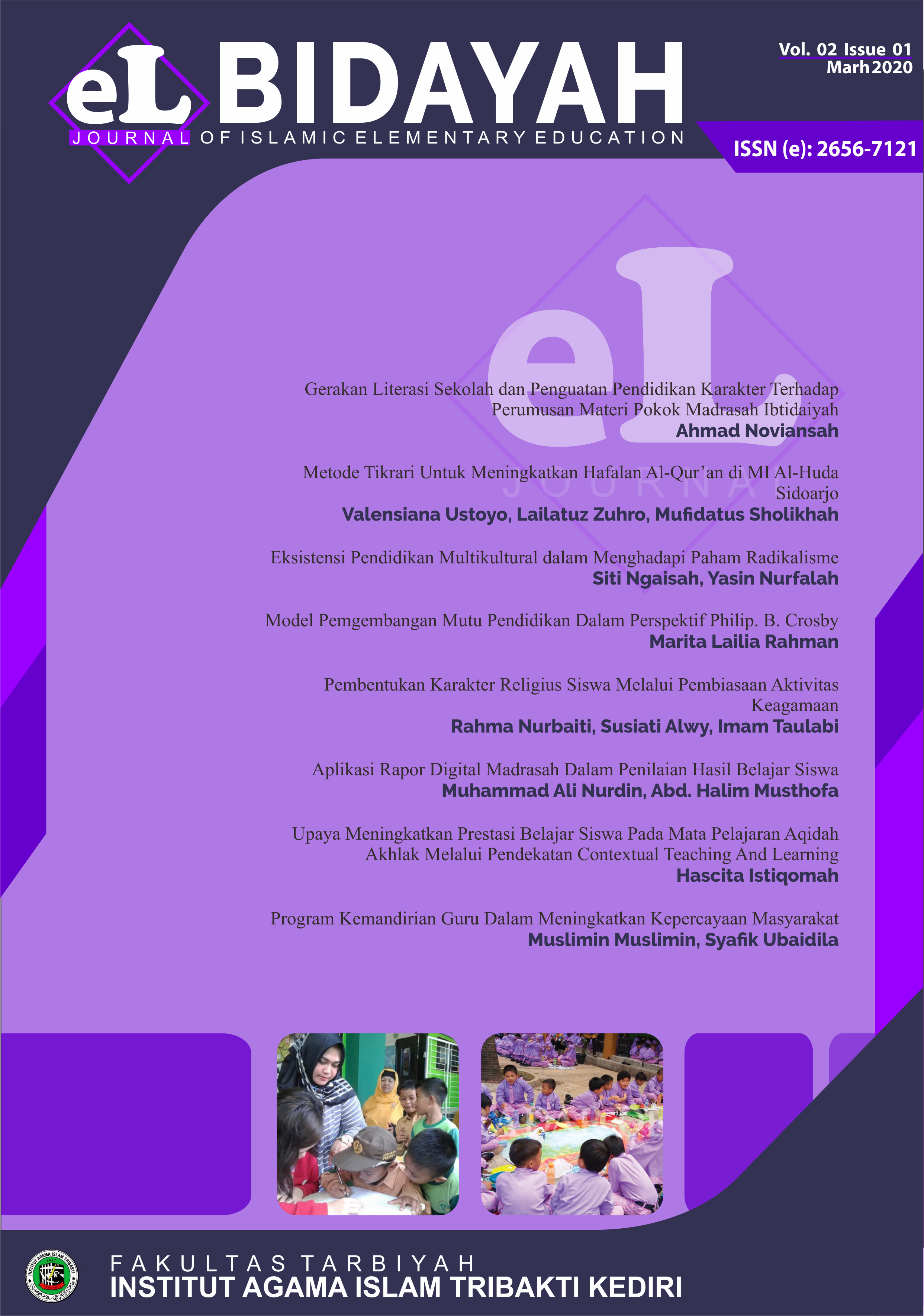
Eksistensi Pendidikan Multikultural dalam Menghadapi Paham Radikalisme
DOI:
https://doi.org/10.33367/jiee.v2i1.1077Keywords:
Existence, Multicultural Education, RadicalismAbstract
This research, was born from a small part of anxiety over the understanding of radicalism in educational institutions. Many researchers claim that the spread of radicalism in Indonesia has been very acute, the article has spread to elementary students. Nevertheless, many are optimistic that multiculturalism education is one of the antidotes to the understanding of radicalism. This encourages researchers to assess the existence of multiculturalist education in facing radicalism in the Wanengpaten State Elementary School, Gampengrejo District, Kediri. This study uses a descriptive qualitative approach. The method used is, interviews with stakeholders at the institution, observing activities in implementing multicultural education values and tracking documents related to the educational institution. As a result, the key to counteract radicalism is religious understanding and awareness of the dangers of radicalism. Without it, the de-radicalization program would not be possible.
References
Abdul Munip, Menangkal Radikalisme Agama di Sekolah , Jurnal Pendidikan Islam, vol 1. No. 2, (Desember, 2015)
Azra, Muhammad Najib, Yang Muda, Yang Radikal: Refleksi Sosiologis Terhadap Fenomena Radikalisme Kaum Muda Muslim di Indonesia Pasca Orde Baru, Jurnal Maarif, Vol.8 No.1 (Juli 2015).
Azca, Muhammad Najib. Yang Muda, Yang Radikal: Refleksi Sosiologis Terhadap Fenomena Radikalisme Kaum Muda Muslim di Indonesia Pasca Orde Baru Jurnal Maarif, Vol. 8, No. 1 (Juli 2013): 14-41. Diakses dari http://maarifinstitute.org/ images/xplod/jurnal/vol%20viii %20no%201%20juli %202014. pdf tanggal 18 April 2019.
Abdillah, https://www.merdeka.com/peristiwa/5-murid-sd-di-tarakan-dilarang -hormat-bendera.html, diakses 30 Januari 2019.
Ahmad Najib Burhani. Islam Dinamis (Menggugat Peran Agama Membongkar Doktrin yang Membatu) (Jakarta: PT. Kompas Media Nusantara. Cet.1, 2004).
Abdul Majid, dan Dian Andayani, Pendidikan Agama Islam Berbasis Kompetensi Konsep dan Implementasi Kurikulum, (Bandung: Remaja Rosdakarya, 2005).
BNPT: Hati-Hati Radikalisme di Kalangan Mahasiswa Capai Angka 20,3% (http://diktis.kemenag.go.id/index.php?berita=detil&jd=162) diakses pada 30 Januari 2019).
Cavatorta, Francesco,. The War on Terrorisme Perspectives from Radical Islamic Groups. Journal of Irish Studies in International Affairs, Vol. 16 (2005). Diakses dari http://doras.dcu.ie/488/1/isia_ 05_1_2019.
Departemen Pendidikan dan Kebudayaan,. Kamus Besar Bahasa Indonesia, (Jakarta: Balai Pustaka 1995, Edisi II)
Mukhibat, Memutus Mata Rantai Radikalisme dan Terorisme Berbasis Studi Etnopedagogi di PTNU Dalam Membentuk Keberagamaan Inklusif dan Pluralis, Islamica:Jurnal Studi Keislaman, vol. 10, No. 1, (September, 2015).
Mulyadi Mudis Taruna, Perbedaan Kompetensi Guru Pendidikan Agama Islam , Jurnal Analisa, Vol.2, No 1 (Palu: IAIN, 2014).
Suparlan, Parsudi, Menuju Masyarakat Indonesia yang Multikultural dalam Artikel CMDD, (Jakarta, CMDD Online), p. 1. http:// www. scripps.ohiou.edu/news/cmdd/ artikel_ps.htm.
Turmudi, Endang dan Riza Sihbudi, Islam dan Radikalisme di Indonesia. Cet.I; (Jakarta: LIPI Press. Cet.1.2005)
Parsudi Suparlan, Menuju Masyarakat Indonesia yang Multikultural, Makalah. Disampaikan pada Simposium Internasional Bali ke-3, Jurnal Antropologi Indonesia, (Denpasar Bali, 16-21 Juli 2012).
Zubadki, Zora A, Kaum Muda dan Radikalisme Jurnal Maarif, Vol. 8, No. 1 (Juli 2013): 14-41. Diakses dari http://maarifinstitute.org/ images/xplod/jurnal/vol%20viii %20no%201%20juli %202013.pdf tanggal 30 Januari 2019.
 Abstract
Views:
278,
Abstract
Views:
278,  PDF downloads: 342
Published
Issue
Section
License
License and Copyright Agreement
In submitting the manuscript to the journal, the authors certify that:
- They are authorized by their co-authors to enter into these arrangements.
- The work described has not been formally published before, except in the form of an abstract or as part of a published lecture, review, thesis, or overlay journal.
- That it is not under consideration for publication elsewhere,
- That its publication has been approved by all the author(s) and by the responsible authorities – tacitly or explicitly – of the institutes where the work has been carried out.
- They secure the right to reproduce any material that has already been published or copyrighted elsewhere.
- They agree to the following license and copyright agreement.
Copyright
Authors who publish with El Bidayah:Journal of Islamic Elementary Education agree to the following terms:
- Authors retain copyright and grant the journal the right of first publication with the work simultaneously licensed under a Creative Commons Attribution License (CC BY-SA 4.0) that allows others to share the work with an acknowledgement of the work's authorship and initial publication in this journal.
- Authors are able to enter into separate, additional contractual arrangements for the non-exclusive distribution of the journal's published version of the work (e.g., post it to an institutional repository or publish it in a book), with an acknowledgment of its initial publication in this journal.
- Authors are permitted and encouraged to post their work online (e.g., in institutional repositories or on their website) before and during the submission process, as it can lead to productive exchanges, as well as earlier and greater citation of published work.
Licensing for Data Publication
El Bidayah: Journal of Islamic Elementary Education uses a variety of waivers and licenses, that are specifically designed for and appropriate for the treatment of data:
- Open Data Commons Attribution License, http://www.opendatacommons.org/licenses/by/1.0/ (default)
- Creative Commons CC-Zero Waiver, http://creativecommons.org/publicdomain/zero/1.0/
- Open Data Commons Public Domain Dedication and Licence, http://www.opendatacommons.org/licenses/pddl/1-0/
Other data publishing licenses may be allowed as exceptions (subject to approval by the editor on a case-by-case basis) and should be justified with a written statement from the author, which will be published with the article.
Open Data and Software Publishing and Sharing
The journal strives to maximize the replicability of the research published in it. Authors are thus required to share all data, code, or protocols underlying the research reported in their articles. Exceptions are permitted but have to be justified in a written public statement accompanying the article.
Datasets and software should be deposited and permanently archived in appropriate, trusted, general, or domain-specific repositories (please consult http://service.re3data.org and/or software repositories such as GitHub, GitLab, Bioinformatics.org, or equivalent). The associated persistent identifiers (e.g. DOI, or others) of the dataset(s) must be included in the data or software resources section of the article. Reference(s) to datasets and software should also be included in the reference list of the article with DOIs (where available). Where no domain-specific data repository exists, authors should deposit their datasets in a general repository such as ZENODO, Dryad, Dataverse, or others.
Small data may also be published as data files or packages supplementary to a research article, however, the authors should prefer in all cases a deposition in data repositories.

This work is licensed under a Creative Commons Attribution-ShareAlike 4.0 International License.