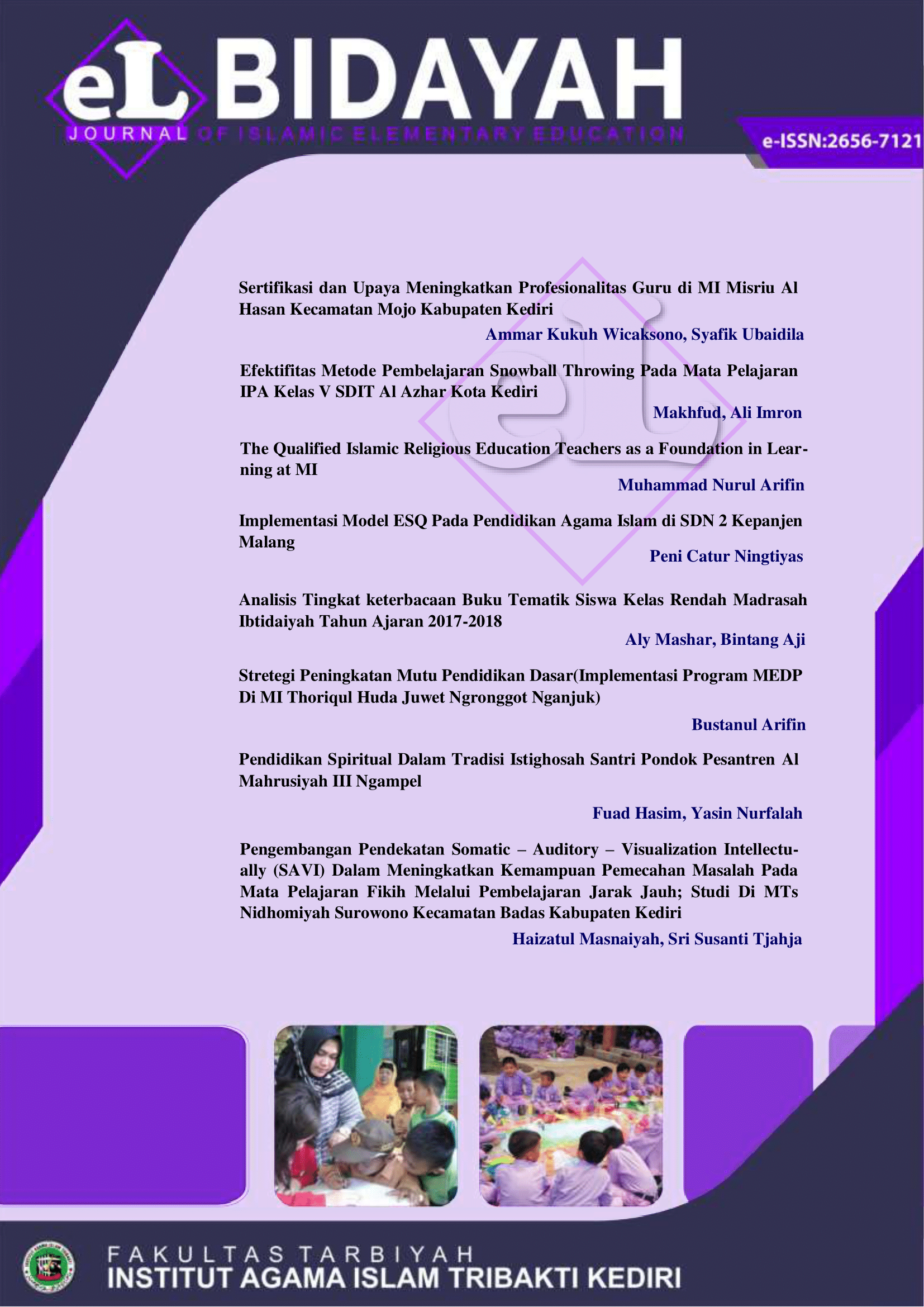
Pendidikan Spiritual Dalam Tradisi Istighosah Santri Pondok Pesantren Al Mahrusiyah III Ngampel
DOI:
https://doi.org/10.33367/jiee.v2i2.1304Keywords:
Spiritual, Tradition, IstighotsahAbstract
This research was conducted to determine how spiritual education is in the istighotsah tradition of HM Al-Mahrusiyah III Ngampel Islamic boarding schools. Spiritual education is education that instills a sense of love for Allah in a person's heart which makes him expect Allah's blessing, in every word, deed, attitude and behavior. Itighotsah is an expectation of help from Allah because Allah is the most helper of everything and only Allah grants all kinds of human needs that become their wants and needs. In this study, the authors used a descriptive qualitative approach which moved from two questions, namely; 1) How is the process of Istighotsah activity 2) How is the spiritual change felt after attending Istighotsah? With the questions that formulated the problem, the researcher obtained the following results: 1) The pre-istighotsah stage, carried out for operation. The istighotsah stage, there are three parts in it, the first is Muqodimah, namely the Tasbih, Witir and Hajat circumcision prayers. Second Contents, namely tawashul, tahlil and reciting dhikr. Third Closing, read Hisbus Salamah, Hisbun Nasar and prayer istighotsah. Post istighotsah stage. Carry out the subuh prayer in congregation. 2) calms the soul, because in it there are things that bring calm, such as circumcision prayer, dzikrullah in reciting tahlil, tahmit, tasbih, takbir and sholawat.
References
Abd al-HalÄ«m MahmÅ«d Ali, Al-TarbÄ«yah al-RÅ«hÄ«yah. QÄhirah: DÄr al-Tauzī’ wa al-Nasyr al-IslÄmiyah, 1995.
Afrizal, Wawancara. Kelas Pondok Pesantren HM Al-Mahrusiyah III Ngampel. 12 Juli 2020.
Akmansyah, Muhamad. “Eksistensi Guru (Mursyid) Dalam Pendidikan Spiritual Perspektif Abu Hamid al-Ghozali.†IAIN Raden Lintang, 2015.
Al-Ghazali. Ihya’ ‘Ulumuddin. Kairo: Dar al-Kutub al-Arabiyah, 1988.
Arikunto, Suharsini. Prosedur Penelitian Suatu Pendekatan Praktek, Jakarta: Raneka Cipta, 2002.
Asif Muhamad, dan Fadli Zamzami, Wawancara, Pengurus Jami’iyah Pondok Pesantren HM Al-Mahrusiyah, 5 Juli 2020.
Asrul, Anam. “Nilai-nilai Pendidikan Islam Dalam Konsep Emotional Spiritual Qoutent.†Universitas Yudharta, 2018.
Ayyam, Sayidul. Wawancara, Kantor Pondok Pesantren HM Al-Mahrusiyah III Ngampel, 15 Juli 2020.
Buzan, Toni. Kekuatan ESQ: 10 Langkah Meningkatkan Kecerdasan Emosional Spiritual, Indonesia: PT Pustaka Delapratosa, 2003.
Dali, Zulkarnain, “Menejemen Mutu Pondok Pesantranâ€, At-Ta’lim, Vol. 12, No. 1.
Daud, Ali Muhamad. Pendidikan Agama Islam, Jakarta: PT. Raja Grafindo, 2002.
Dewey. Demokracy and Education, New York: The Free Pers, 2005.
Djumaransjah Muhamad dan abdul Malik Karim Amrulloh. Pendidikan Islam , Menggali Tradisi, Meneguhkan eksistensi, Malang: UIN Malang Perss, 2007.
Dzaky, Wawancara. Santri Pondok Pesantren Lirboyo HM. Al-Mahrusiyah, 10 Juni 2020.
Fauzi, Fuad. “Pendidikan Spiritual Dalam Mengembangkan Karakter Perspektif Imam Al-Gozali.†Universitas Islam Negeri Sunan Kalijaga, 2015.
Firman. Wawancara. Santri Pondok Pesantren Lirboyo HM. Al-Mahrusiyah, 10 Juni 2020.
Firza, Wawancara. Kantor Pondok Pesantren HM Al-Mahrusiyah III Ngampel, 25 Juli 2020.
Fuad, A. Jauhar. “Tlatah Dan Tradisi Keagamaan Islam Mataraman,†Jurnal Pemikiran Keislaman 30, no. 1 Hal. 1–27, https://doi.org/10.33367/tribakti.v30i1.659 (2019).
Hafs. Kholid. Wawancara, Kamar Anak Ndalem, Pondok Pesantren Lirboyo HM. Al-Mahrusiyah, 10 Juli 2020.
Hawwa. Said. Pendidikan Spiritual.Yogyakarta: Mitra Pustaka, 2006.
Moleong. Lexy J. Metodologi Penelitian Kualitatif, Bandung: Remaja Rosda Karya, 2002.
Jadid, Nurul. Tujuan Santri, www.NurulJadid.net, diakses tanggal 20 Desember 2019.
Jejak Pendidikan. “Pengertian Pendidikan Spiritual,†Desember 2016. http://www.jejakpendidikan.com/2016/12/pengertian-pendidikan-spiritual.html.
Khalidiyah, Tuhfatul. “Istighotsah Gus Ali Mustofa Asady Dalam Membangun Emosional Spiritual Qoutient Pada Siswa Dalam Menghadapi Ujian Nasional di Singosari Kabupaten Malangâ€, Skripsi: UIN Malang, 2019.
Khoerudin, Arif. Wawancara, Kantor Pondok Pesantren HM Al-Mahrusiyah III Ngampel, 15 Juli 2020.
Khoerul, Anam Muhamad. Wawancara, Kamar Timur Pondok Pesantren Al-Mahrusiyah III Ngampel, 15 Juli 2020.
Kholid, Afandi Muhamad, Pedoman ke-NU-an Kurikulum Madrasah Hidayatul Mubtadi-in Lirboyo, Kediri: Lembaga Bahtsul Masa-il, 2014.
Lubis Khoerudin. “Pembinaan Mental Spiritual Santri di Pesantren Modern Unggulan Terpadu Darul Mursyid Kabupaten Tapanuli Selatan.†Analitica Islamica 7, 2018.
Ma’sum, Ishomudin. Sejarah dan Keutamaan Istighotsa., Surabaya: PWLTN NU Jawa Timur/LTN Pustaka, 2018.
Mahzumi, M. Al-Qodhi Abi Saidil, and A. Jauhar Fuad. “Spiritual Education Through Ziarah Tradition In Syaikh Syamsuddin Al-Wasil Town Kediri City.†EL HARAKAH Jurnal Budaya Islam 21, no. 2 Hal. 237–54. https://doi.org/10.18860/el.v21i2.7030 (2019).
Mangestuti, Retno. “Pengembangan Spiritulitas Remaja: Mengapa Remaja Laki-Laki Lebih Memerlukan Dukungan Keluarga Dalam Pengembangan Spiritualitas.†Jurnal Psikoislamika 14 Hal. 32. (2017).
Max, Manroe. “Pengetian Pendidikan.†Maxmanroe.com (blog), 14 Februari 2018.
Mohana, Wawancara, Mustahiq di Pondok Pesantren Al-Mahrusiyah III Ngampel, 4 Juli 2020.
Muhamad “Pendidikan Spiritual Santri Dalam Membaca al-Qur’an Pondok Pesantren Haji Mahrus (PPHM) Lirboyo Kediri.â€. Skripsi: IAIT Kediri, 2017.
Muhamad, Akhmansyah. “Eksistensi Guru Dalam Pendidikan Spiritual Perspektif Abu Hamid Al-Ghozali.†Al-Tazkiyyah: Jurnal Pendidikan Islam 6 (2015).
Mulyana, Dedy. Metodologi Penelitian Kualitatifâ€. Bandung: PT. Remaja Rosdakarya, 2010.
Nafiul, Karim Muhamad. “Pendidikan Spiritual Santri Dalam Membaca Al-Qur’an di Pondok Pesantren Haji Mahrus Lirboyo Kota Kediri.†IAI Tribakti, 2017.
Najmudin, Ahmad. Wawancara, Kantor Pondok Pesantren HM Al-Mahrusiyah III Ngampel, 15 Juli 2020.
Nur, Falah Yasin. “Pengaruh Kecerdasan Intelektual Dengan Kecerdasan Emosional.†Jurnal Tribakti 26 (2016).
Nur, Said Ahmad. “Pengaruh Kecerdasan Spiritual Intelektual Dan Kecerdasan Spiritual Terhadap Sikap Etis Mahasiswa.†Journal of Universitas Negri Yogyakarta 7 (2018).
Quthub, Muhamad. Manhaj al-TarbÄ«yah al-IslÄmÄ«yah, Kairo: DÄr al-Syuruq, 2004.
Rafli. Wawancara, Santri Pondok Pesantren Lirboyo HM. Al-Mahrusiyah, 10 Juni 2020.
Republika.com. “Pendidikan Spiritual,†27 Maret 2013. https://www.republika.co.id/berita/dunia-islam/hikmah/13/03/27/mkb6ak-pendidikan-spiritual.
Rustam, Ibrahim. “Pesantren dan Pengabdian Masyarakat.†Jurnal At-Tahrir 16 (2016).
Satiadarma, Montay P dan Fidelis E. Waruwu, Mendidik Kecerasan. Jakarta: Pustaka Populer Obor, 2003.
Sayaodih, Nana Sukmadinata. “Metode Penelitian Pendidikanâ€. Bandung: Remaja Rosdakarya, 2005.
Suhailah Zain Al- Abidin Ahmad, Mas’uliyah al-Usrah Tahin al-Syababmin al-Irhab, (Lajnah al-Ilmiyahal-Mu’tamar al-Alami’an Mauqif al-Islam min al-Irhab, 2004).
Sumadi. Metodologi Penelitian. Jakarta: Raja Grafindo Persada, 1998.
Suryaningrat Erwin. “Menanamkan Kecerdasan Spiritual Pada Anak.†At-Ta’lim 12 (2013).
Susanto Happy. “Perubahan Perilaku Santri.†Journal of Universitas Muhammadiyah Ponorogo 2 (2016).
Susilo, Suko. Metode Penelitian Kualitatif. Surabaya: Jenggala Pustaka Utama, 2013.
Tasmara, Toto. Kecerdasan Ruhaniyah. Depok: Gema Insani Press, 2001.
Umi Nur Arifah Aninda. “Hubungan Antara Kecerdasan Spiritual Dengan Prilaku Prososional Pada Remaja.†Universitas Muhammadiyah Surakarta, 2018.
W. Santrok Jhon, Adollocence. Dalas: Texsas Univercity, 2007.
Wahab Abd dan Umiarso, Kepemimpinan Pendidikan dan Kecerdasan Spiritual Jogjakarta: Ar-Ruzz Media, 2011.
Wikipedia, “Santriâ€, https://id.wikipedia.org/wiki/Santri. diakses tanggal 21 Desember 2019.
Yuliyatun.‘Mengembangkan Kecerdasan Spiritual Anak Melalui Pendidikan Agama’, jurnal dakwah STAIN Kudus, Vol.1, No. 1 (Desember, 2013), h. 155.†Jurnal Dakwah STAIN Kudus 1 Hlm. 155 (2013).
 Abstract
Views:
703,
Abstract
Views:
703,  PDF downloads: 972
Published
Issue
Section
License
License and Copyright Agreement
In submitting the manuscript to the journal, the authors certify that:
- They are authorized by their co-authors to enter into these arrangements.
- The work described has not been formally published before, except in the form of an abstract or as part of a published lecture, review, thesis, or overlay journal.
- That it is not under consideration for publication elsewhere,
- That its publication has been approved by all the author(s) and by the responsible authorities – tacitly or explicitly – of the institutes where the work has been carried out.
- They secure the right to reproduce any material that has already been published or copyrighted elsewhere.
- They agree to the following license and copyright agreement.
Copyright
Authors who publish with El Bidayah:Journal of Islamic Elementary Education agree to the following terms:
- Authors retain copyright and grant the journal the right of first publication with the work simultaneously licensed under a Creative Commons Attribution License (CC BY-SA 4.0) that allows others to share the work with an acknowledgement of the work's authorship and initial publication in this journal.
- Authors are able to enter into separate, additional contractual arrangements for the non-exclusive distribution of the journal's published version of the work (e.g., post it to an institutional repository or publish it in a book), with an acknowledgment of its initial publication in this journal.
- Authors are permitted and encouraged to post their work online (e.g., in institutional repositories or on their website) before and during the submission process, as it can lead to productive exchanges, as well as earlier and greater citation of published work.
Licensing for Data Publication
El Bidayah: Journal of Islamic Elementary Education uses a variety of waivers and licenses, that are specifically designed for and appropriate for the treatment of data:
- Open Data Commons Attribution License, http://www.opendatacommons.org/licenses/by/1.0/ (default)
- Creative Commons CC-Zero Waiver, http://creativecommons.org/publicdomain/zero/1.0/
- Open Data Commons Public Domain Dedication and Licence, http://www.opendatacommons.org/licenses/pddl/1-0/
Other data publishing licenses may be allowed as exceptions (subject to approval by the editor on a case-by-case basis) and should be justified with a written statement from the author, which will be published with the article.
Open Data and Software Publishing and Sharing
The journal strives to maximize the replicability of the research published in it. Authors are thus required to share all data, code, or protocols underlying the research reported in their articles. Exceptions are permitted but have to be justified in a written public statement accompanying the article.
Datasets and software should be deposited and permanently archived in appropriate, trusted, general, or domain-specific repositories (please consult http://service.re3data.org and/or software repositories such as GitHub, GitLab, Bioinformatics.org, or equivalent). The associated persistent identifiers (e.g. DOI, or others) of the dataset(s) must be included in the data or software resources section of the article. Reference(s) to datasets and software should also be included in the reference list of the article with DOIs (where available). Where no domain-specific data repository exists, authors should deposit their datasets in a general repository such as ZENODO, Dryad, Dataverse, or others.
Small data may also be published as data files or packages supplementary to a research article, however, the authors should prefer in all cases a deposition in data repositories.

This work is licensed under a Creative Commons Attribution-ShareAlike 4.0 International License.