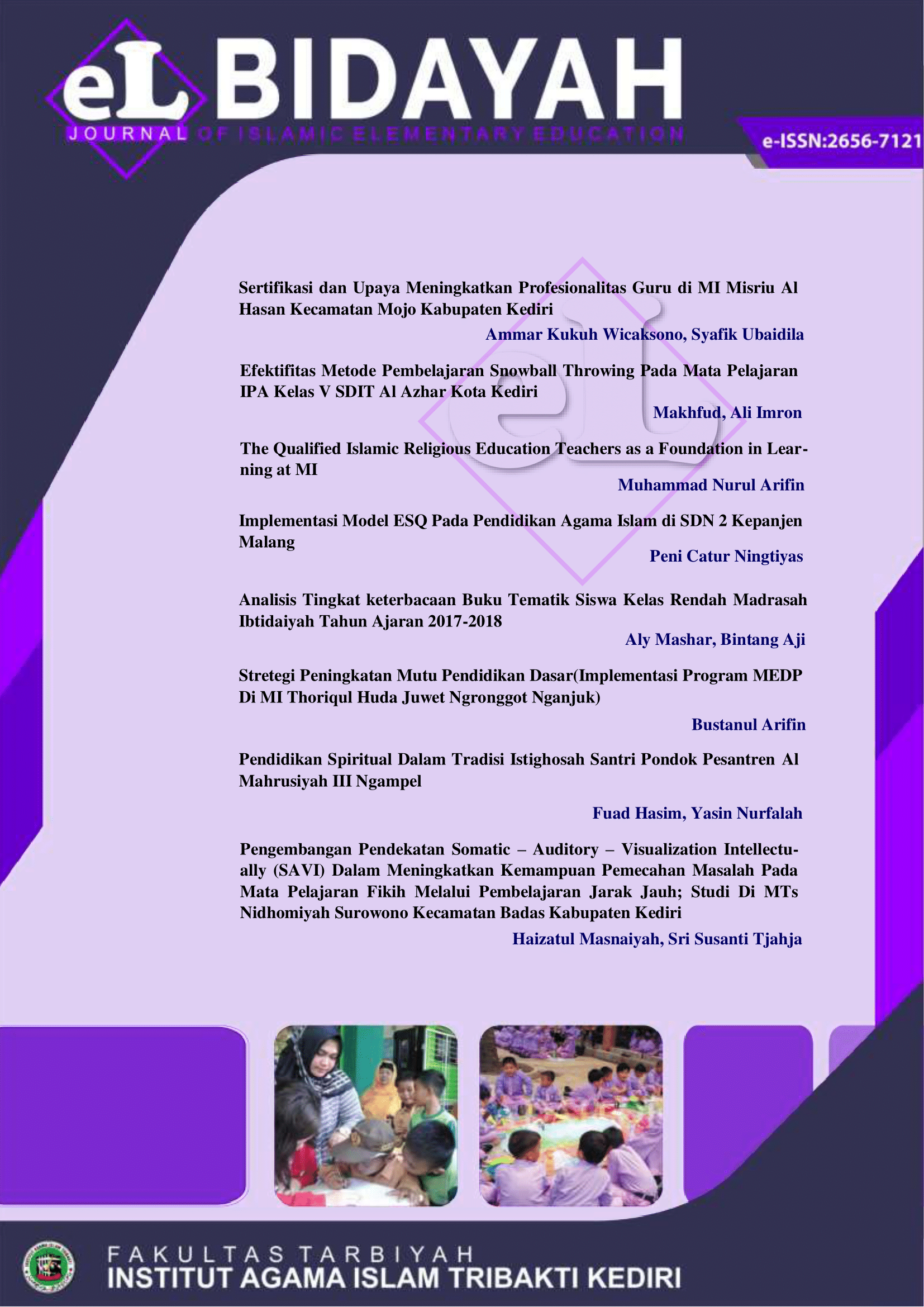
Sertifikasi dan Upaya Meningkatkan Profesionalitas Guru di MI Misriu Al Hasan Kecamatan Mojo Kabupaten Kediri
DOI:
https://doi.org/10.33367/jiee.v2i2.1300Keywords:
Teachers, Certification, ProfessionalityAbstract
Professional teachers are teachers who are competent in their fields. With certification, teacher competence will be further improved to better quality education. To be able to take part in the certification program, of course several conditions must be fulfilled by certification participants. Fulfilling the requirements will make it easier to get an educator certificate. After obtaining a certificate, teacher educators must continue to strive to improve performance and professionalism as a form of responsibility as a professional teacher. This research is qualitative. Words and actions obtained from interviews are the main data sources in this study, while additional data is in the form of documents. The results of this study are, 1. The terms and patterns that are passed by the teachers at MI Misriu Al Hasan are under the applicable regulations, three patterns are followed, namely Portfolio, PLPG, and PPG, 2. Efforts that have been made by certification teachers in MI Misriu Al Hasan Kraton Mojo Kediri in improving professionalism, including by increasing discipline, using appropriate and effective teaching methods, preparing themselves and materials that have been planned before carrying out learning, providing problem-solving to students with problems intensively and participating in activities of professional organizations such as PGIN and KKG and NU community organizations. Other supporting activities include training and seminars.
References
Al-Qur’an dan Tejemahnya. Bandung: CV Diponegoro, 2011.
Anwar, Muhamad. Menjadi Guru Profesional. Prenada Media, 2018.
BUKU 2 | Petunjuk Teknis Pelaksanaan Sertifikasi Guru di Rayon LPTK. Jakarta: Direktorat Jenderal Pendidikan Tinggi kementerian Pendidikan Dan Kebudayaan, 2012.
Jejen Musfah. Peningkatan Kompetensi Guru: Melalui Pelatihan dan Sumber Belajar Teori dan Praktik. Kencana, 2012.
Maulidia, Rahmah. Kontribusi Pesantren pada MDGs: penguatan edukasi isu krusial kesehatan reproduksi dan safe motherhood. IMTIYAZ, 2015.
“Permendikbud Nomor 37 Tahun 2017 Tentang Sertifikasi Bagi Guru Dalam Jabatan Yang Diangkat Sampai Dengan Akhir Tahun 2015 - Pendidikan Kewarganegaraan.†Diakses 14 Juni 2020. https://ainamulyana.blogspot.com/2017/12/permendikbud-nomor-no-37-tahun-2017.html.
Ristekdikti. Pedoman Penyelenggaraan Program Pendidikan Profesi Guru. 1 ed. Jakarta: Direktorat Jenderal Pembelajaran dan Kemahasiswaan Kementerian Riset, Teknologi, dan Pendidikan Tinggi, 2018.
Setiawan, Johan, dan Albi Anggito. Metodologi penelitian kualitatif. CV Jejak Publisher, 2018.
Sukmadinata, Nana Syaodih. Metode penelitian pendidikan. Bandung: Program Pascasarjana Universitas Pendidikan Indonesia dengan PT Remaja Rosdakarya, 2005.
Undang-undang Nomor 20 Tahun 2003 tentang Sistem Pendidikan Nasional & Undang-undang No.14 th 2005 tentang Guru & dosen. VisiMedia, t.t.
Wardan, Khusnul. Guru Sebagai Profesi. Deepublish, 2019.
 Abstract
Views:
145,
Abstract
Views:
145,  PDF downloads: 165
Published
Issue
Section
License
License and Copyright Agreement
In submitting the manuscript to the journal, the authors certify that:
- They are authorized by their co-authors to enter into these arrangements.
- The work described has not been formally published before, except in the form of an abstract or as part of a published lecture, review, thesis, or overlay journal.
- That it is not under consideration for publication elsewhere,
- That its publication has been approved by all the author(s) and by the responsible authorities – tacitly or explicitly – of the institutes where the work has been carried out.
- They secure the right to reproduce any material that has already been published or copyrighted elsewhere.
- They agree to the following license and copyright agreement.
Copyright
Authors who publish with El Bidayah:Journal of Islamic Elementary Education agree to the following terms:
- Authors retain copyright and grant the journal the right of first publication with the work simultaneously licensed under a Creative Commons Attribution License (CC BY-SA 4.0) that allows others to share the work with an acknowledgement of the work's authorship and initial publication in this journal.
- Authors are able to enter into separate, additional contractual arrangements for the non-exclusive distribution of the journal's published version of the work (e.g., post it to an institutional repository or publish it in a book), with an acknowledgment of its initial publication in this journal.
- Authors are permitted and encouraged to post their work online (e.g., in institutional repositories or on their website) before and during the submission process, as it can lead to productive exchanges, as well as earlier and greater citation of published work.
Licensing for Data Publication
El Bidayah: Journal of Islamic Elementary Education uses a variety of waivers and licenses, that are specifically designed for and appropriate for the treatment of data:
- Open Data Commons Attribution License, http://www.opendatacommons.org/licenses/by/1.0/ (default)
- Creative Commons CC-Zero Waiver, http://creativecommons.org/publicdomain/zero/1.0/
- Open Data Commons Public Domain Dedication and Licence, http://www.opendatacommons.org/licenses/pddl/1-0/
Other data publishing licenses may be allowed as exceptions (subject to approval by the editor on a case-by-case basis) and should be justified with a written statement from the author, which will be published with the article.
Open Data and Software Publishing and Sharing
The journal strives to maximize the replicability of the research published in it. Authors are thus required to share all data, code, or protocols underlying the research reported in their articles. Exceptions are permitted but have to be justified in a written public statement accompanying the article.
Datasets and software should be deposited and permanently archived in appropriate, trusted, general, or domain-specific repositories (please consult http://service.re3data.org and/or software repositories such as GitHub, GitLab, Bioinformatics.org, or equivalent). The associated persistent identifiers (e.g. DOI, or others) of the dataset(s) must be included in the data or software resources section of the article. Reference(s) to datasets and software should also be included in the reference list of the article with DOIs (where available). Where no domain-specific data repository exists, authors should deposit their datasets in a general repository such as ZENODO, Dryad, Dataverse, or others.
Small data may also be published as data files or packages supplementary to a research article, however, the authors should prefer in all cases a deposition in data repositories.

This work is licensed under a Creative Commons Attribution-ShareAlike 4.0 International License.