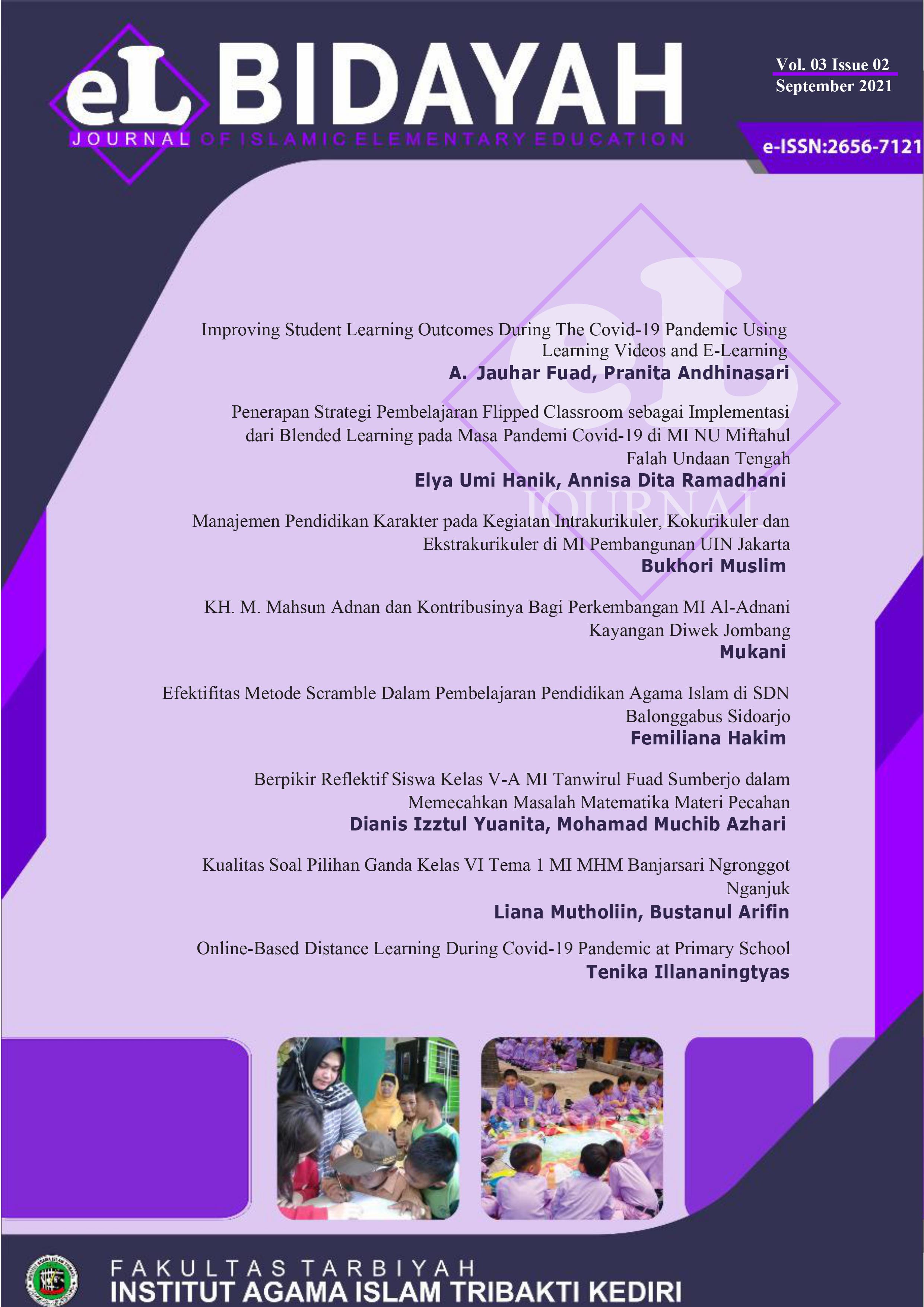
Berpikir Reflektif Siswa Kelas V-A MI Tanwirul Fuad Sumberjo dalam Memecahkan Masalah Matematika Materi Pecahan
DOI:
https://doi.org/10.33367/jiee.v3i2.1938Keywords:
Reflective Thinking, Problem Solving, FractionAbstract
So far, the tendency of mathematics teachers to not optimize students' mathematical thinking skills in learning, especially higher-order thinking skills. One of the higher-order thinking skills is reflective thinking. Reflective thinking is a directed and precise process in which individuals analyze, evaluate, motivate, and gain deep meaning, using appropriate learning strategies. The reflective thinking ability according to Surbeck, Han, and Moyer has 3 phases/levels, namely reacting, comparing, and contemplating. The purpose of this study was to describe students' reflective thinking skills in solving math problems with fractions in class V-A MI Tanwirul Fuad Sumberjo. As a source of data taken 6 students from 27 students. In this study data collection techniques were used, namely tests, interviews, and documentation. The data analysis technique used is qualitative data analysis with data reduction steps, data presentation, and conclusion. Data analysis was carried out by 1) presenting the data, 2) comparing the test result data with interviews conducted with students, and 3) concluding the data.
References
Arifin, Zainal. 2011. Penelitian Pendidikan Metode dan Paradigma Baru. Bandung: Remaja Rosdakarya.
Fadhilah, Millatul. 2015. Analisis Berpikir Reflektif Siswa dalam Memecahkan Masalah Matematika Materi Garis Singgung Lingkaran Kelas VIII A
Masykur Ag , Moch & Fathani, Abdul Halim . 2008. Mathematical Intelligence Cara Cerdas Melatih Otak Kanan dan Menanggulangi Kesulitan Belajar. Jogjakarta: Ar-Ruzz Media.
Moleong, Lexy J. 2011. Metode Penelitian Kualitatif. Bandung: Remaja Rosdakarya.
Mulyana, Deddy. 2008. Metodologi Penelitian Kualitatif. Bandung: Remaja Rosdakarya.
Nisak, Lailatun. 2013. Analisis Kemampuan Berpikir Reflektif Siswa dalam Memecahkan Masalah Berbentuk Semantik, Figural dan Simbolik pada Pokok Bahasan Fungsi Kelas XI IPA di MAN Nglawak Kertosono Nganjuk. Skripsi Jurusan Pendidikan Matematika IAIN Sunan Ampel.
Noer, Sri Hastuti. 2008. Problem-Based Learning dan Kemampuan Berpikir Reflektif dalam Pembelajaran Matematika. Semnas Matematika dan Pendidikan Matematika.
Purwanto, Ngalim. 2013. Psikologi Pendidikan. Bandung: Remaja Rosdakarya.
Suharna, Hery, dkk. 2013. Berpikir Reflektif Mahasiswa. KNPM V, Himpunan Matematika Indonesia.
Suharna, Hery. 2012. Berpikir Reflektif (Reflective Thinking) Siswa SD Berkemampuan Matematika Tinggi dalam Pemahaman Masalah Pecahan. Ternate: Seminar Nasional Matematika dan Pendidikan Matematika FMIPA UNY Yogyakarta.
Tanzeh, Ahmad. 2009. Pengantar Metode Penelitian. Yogyakarta: Teras.
Widiawati, Restu. 2016. Kemampuan Berpikir Reflektif Siswa dalam Memecahkan Masalah Matematika pada Materi Sistem Persamaan Linier Dua Variabel (SPLDV) Berdasarkan Gender Kelas VIII Di MTs Negeri Tanjunganom. Kediri: Artikel Skripsi FKIP Universitas Nusantara PGRI Kediri.
 Abstract
Views:
189,
Abstract
Views:
189,  PDF downloads: 138
Published
Issue
Section
License
License and Copyright Agreement
In submitting the manuscript to the journal, the authors certify that:
- They are authorized by their co-authors to enter into these arrangements.
- The work described has not been formally published before, except in the form of an abstract or as part of a published lecture, review, thesis, or overlay journal.
- That it is not under consideration for publication elsewhere,
- That its publication has been approved by all the author(s) and by the responsible authorities – tacitly or explicitly – of the institutes where the work has been carried out.
- They secure the right to reproduce any material that has already been published or copyrighted elsewhere.
- They agree to the following license and copyright agreement.
Copyright
Authors who publish with El Bidayah:Journal of Islamic Elementary Education agree to the following terms:
- Authors retain copyright and grant the journal the right of first publication with the work simultaneously licensed under a Creative Commons Attribution License (CC BY-SA 4.0) that allows others to share the work with an acknowledgement of the work's authorship and initial publication in this journal.
- Authors are able to enter into separate, additional contractual arrangements for the non-exclusive distribution of the journal's published version of the work (e.g., post it to an institutional repository or publish it in a book), with an acknowledgment of its initial publication in this journal.
- Authors are permitted and encouraged to post their work online (e.g., in institutional repositories or on their website) before and during the submission process, as it can lead to productive exchanges, as well as earlier and greater citation of published work.
Licensing for Data Publication
El Bidayah: Journal of Islamic Elementary Education uses a variety of waivers and licenses, that are specifically designed for and appropriate for the treatment of data:
- Open Data Commons Attribution License, http://www.opendatacommons.org/licenses/by/1.0/ (default)
- Creative Commons CC-Zero Waiver, http://creativecommons.org/publicdomain/zero/1.0/
- Open Data Commons Public Domain Dedication and Licence, http://www.opendatacommons.org/licenses/pddl/1-0/
Other data publishing licenses may be allowed as exceptions (subject to approval by the editor on a case-by-case basis) and should be justified with a written statement from the author, which will be published with the article.
Open Data and Software Publishing and Sharing
The journal strives to maximize the replicability of the research published in it. Authors are thus required to share all data, code, or protocols underlying the research reported in their articles. Exceptions are permitted but have to be justified in a written public statement accompanying the article.
Datasets and software should be deposited and permanently archived in appropriate, trusted, general, or domain-specific repositories (please consult http://service.re3data.org and/or software repositories such as GitHub, GitLab, Bioinformatics.org, or equivalent). The associated persistent identifiers (e.g. DOI, or others) of the dataset(s) must be included in the data or software resources section of the article. Reference(s) to datasets and software should also be included in the reference list of the article with DOIs (where available). Where no domain-specific data repository exists, authors should deposit their datasets in a general repository such as ZENODO, Dryad, Dataverse, or others.
Small data may also be published as data files or packages supplementary to a research article, however, the authors should prefer in all cases a deposition in data repositories.

This work is licensed under a Creative Commons Attribution-ShareAlike 4.0 International License.