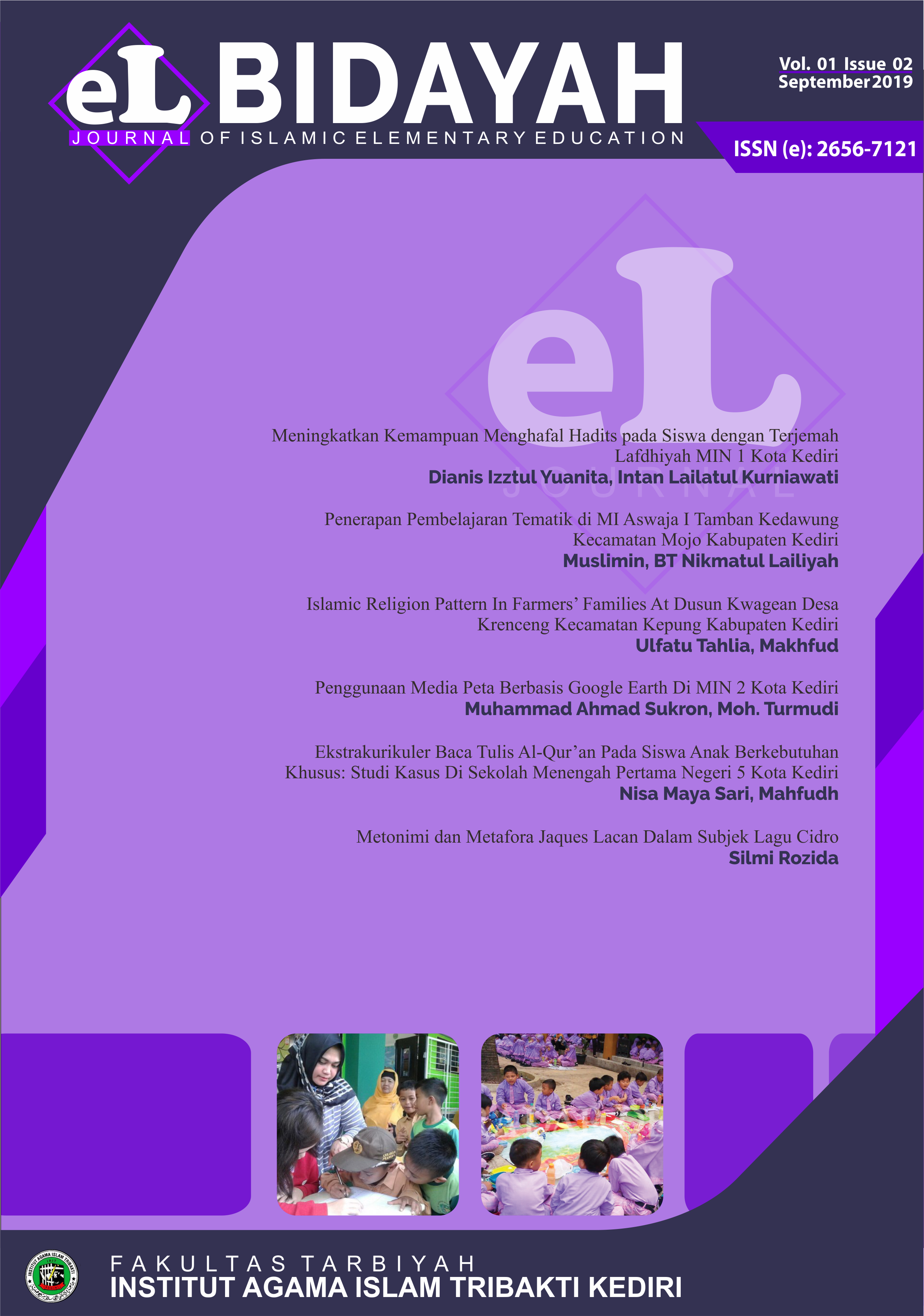
Meningkatkan Kemampuan Menghafal Hadits pada Siswa dengan Terjemah Lafdhiyah MIN 1 Kota Kediri
DOI:
https://doi.org/10.33367/jiee.v1i2.721Keywords:
Memorization Ability, Al-Hadith, Lafdziyah Translation MethodeAbstract
This paper aims to find out the learning using the lafdhiyah translation and the increase in the ability to memorize the hadith of students in the Islamic Elementary Public School 1 of Kediri City subject to the Qur'an Hadith. The type of research used is classroom action research (CAR) which consists of Cycle I and Cycle II. The application of the lafdhiyah translation method can improve the ability to memorize the hadith in students. This is evidenced by the increasing results of the first-semester class V student learning tests on memorizing hadith material about loving orphans. Research findings: (1) the existence of the technique of translating lafadh (lafdhiyah translation) by using sticky paper media and student identity numbers; (2) there is an increase in the ability to memorize the hadith in students with the lafdhiyah translation from Cycle I to Cycle II.
References
Akmaliyah. Teori dan Praktik Terjemah Indonesia – Arab. Depok: Kencana. 2017.
Anwar, Desy. Kamus Lengkap Bahasa Indonesia. Surabaya: Amelia. 2003.
Arikunto, Suharsimi, dkk. Penelitian Tindakan Kelas. Jakarta: PT Bumi Aksara. 2010.
Bukhari, Imam Al. Shahih al-Bukhari. t.tp. Dar al-Fikr. 1981.
Dahlan, Abdul Azis. Ensiklopedi Hukum Islam. Jakarta: Ichtiar Baru van Hoeve. 1997.
Idri. Studi Hadith. Jakarta: Kencana. 2010.
Iskandar, Dadang dan Narsim. Penelitian Tindakan Kelas dan Publikasinya Untuk Kenaikan Pangkat dan
Golongan Guru & Pedoman Penulisan PTK bagi Mahasiswa. Cilacap:Ihya Media. 2015.
Izzan, Ahmad. Ulumul Qur’an, Telaah Tekstualitas dan Kontekstualitas al-Qur’an. Bandung: Humaniora. 2011.
Khon, Abdul Majid. Ulumul Hadits. Jakarta: Amzah. 2013.
Khudlarî, Syaikh Muhammad al. Ushûl al-Fiqh. Beirut: Dâr al-Fikr. 1988.
Kunandar. Langkah Mudah Penelitian Tindakan Kelas sebagai Pengembang Profesi Guru. Jakarta : PT.Raja Grafindo persada. 2011.
Mariati, Siti dan Amaliya Iranty Ningsih, “Upaya Meningkatkan Menghafal Hadits dengan Metode SAVI pada Mata Pelajaran Al-Qur?an Hadits Kelas III di MI Darun Najah Tulungan Sidoarjo”, Jurnal Penelitian Tindakan Kelas Pendidikan Agama Islam. Vol. VII, 1 . Juni 2016.
Muqsid, Abdul. Metode Penelitian al-Qur’an dan Tafsir. Yogyakarta: Idea Press. 2015.
Proceeding Book ICGC?17. Islamic State Institute of Pontianak. Pontianak: Pontianak Islamic State Ins. 2017.
Purwati, Eni, dkk. Penelitian Tindakan Kelas Peket V. Surabaya: Lapis PGMI. 2009.
Qaththan, Syaikh Manna Al. Pengantar Studi Hadits. Jakarta: Pustaka Al-Kautsar. 2005.
Rusman, Model-model Pembelajaran Mengembangkan Profesionalitas Guru. Jakarta: Rajawali Persada. 2013.
Subagyo, P. Joko. Metode Penelitian. Jakarta: PT. Rineka Cipta. 2006.
Thahir, Ahmad. Fikih Sunnah untuk Anak. Surakarta: Ziyad Visi Media. 2014.
Wahid, Abdul dan Muhammad Zaini. Pengantar Ulumul Qur’an dan Ulumul Hadits. Banda Aceh: Yayasan Pena Banda Aceh. 2016.
Yunus, Mahmud. Kamus Arab-Indonesia, Cet II. Jakarta: PT. Mahmud Yunus. 1990.
Zahrah, Abû. Ushûl al-Fiqh. t.tp.: Dâr al Fikr, t.th.
Zuhaylî, Wahbah al. Ushûl al-Fiqh. Damaskus: Dâr al-Fikr, 1986.
 Abstract
Views:
453,
Abstract
Views:
453,  PDF downloads: 475
Published
Issue
Section
License
License and Copyright Agreement
In submitting the manuscript to the journal, the authors certify that:
- They are authorized by their co-authors to enter into these arrangements.
- The work described has not been formally published before, except in the form of an abstract or as part of a published lecture, review, thesis, or overlay journal.
- That it is not under consideration for publication elsewhere,
- That its publication has been approved by all the author(s) and by the responsible authorities – tacitly or explicitly – of the institutes where the work has been carried out.
- They secure the right to reproduce any material that has already been published or copyrighted elsewhere.
- They agree to the following license and copyright agreement.
Copyright
Authors who publish with El Bidayah:Journal of Islamic Elementary Education agree to the following terms:
- Authors retain copyright and grant the journal the right of first publication with the work simultaneously licensed under a Creative Commons Attribution License (CC BY-SA 4.0) that allows others to share the work with an acknowledgement of the work's authorship and initial publication in this journal.
- Authors are able to enter into separate, additional contractual arrangements for the non-exclusive distribution of the journal's published version of the work (e.g., post it to an institutional repository or publish it in a book), with an acknowledgment of its initial publication in this journal.
- Authors are permitted and encouraged to post their work online (e.g., in institutional repositories or on their website) before and during the submission process, as it can lead to productive exchanges, as well as earlier and greater citation of published work.
Licensing for Data Publication
El Bidayah: Journal of Islamic Elementary Education uses a variety of waivers and licenses, that are specifically designed for and appropriate for the treatment of data:
- Open Data Commons Attribution License, http://www.opendatacommons.org/licenses/by/1.0/ (default)
- Creative Commons CC-Zero Waiver, http://creativecommons.org/publicdomain/zero/1.0/
- Open Data Commons Public Domain Dedication and Licence, http://www.opendatacommons.org/licenses/pddl/1-0/
Other data publishing licenses may be allowed as exceptions (subject to approval by the editor on a case-by-case basis) and should be justified with a written statement from the author, which will be published with the article.
Open Data and Software Publishing and Sharing
The journal strives to maximize the replicability of the research published in it. Authors are thus required to share all data, code, or protocols underlying the research reported in their articles. Exceptions are permitted but have to be justified in a written public statement accompanying the article.
Datasets and software should be deposited and permanently archived in appropriate, trusted, general, or domain-specific repositories (please consult http://service.re3data.org and/or software repositories such as GitHub, GitLab, Bioinformatics.org, or equivalent). The associated persistent identifiers (e.g. DOI, or others) of the dataset(s) must be included in the data or software resources section of the article. Reference(s) to datasets and software should also be included in the reference list of the article with DOIs (where available). Where no domain-specific data repository exists, authors should deposit their datasets in a general repository such as ZENODO, Dryad, Dataverse, or others.
Small data may also be published as data files or packages supplementary to a research article, however, the authors should prefer in all cases a deposition in data repositories.

This work is licensed under a Creative Commons Attribution-ShareAlike 4.0 International License.