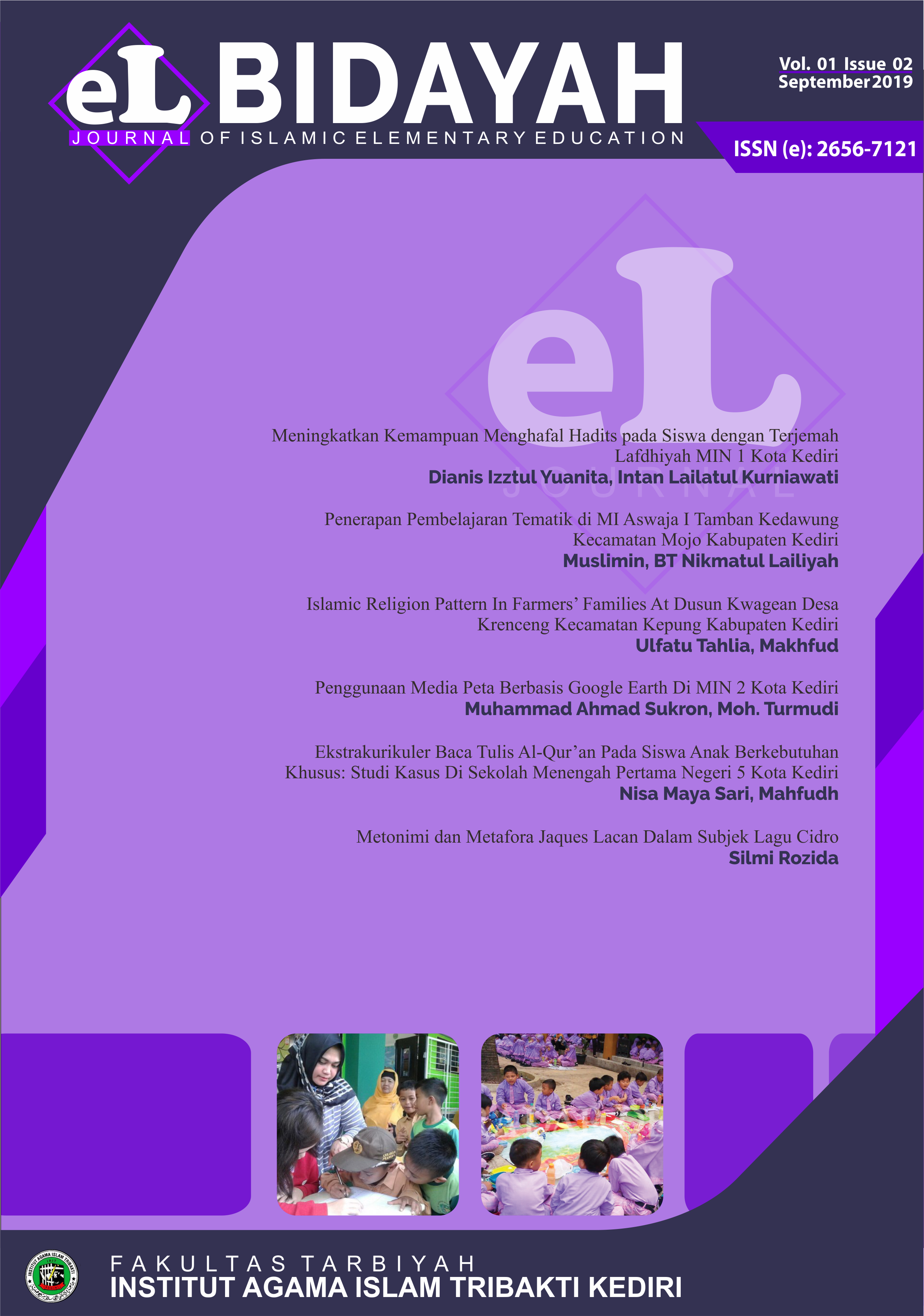
Penerapan Pembelajaran Tematik di MI Aswaja I Tamban Kedawung Kecamatan Mojo Kabupaten Kediri
DOI:
https://doi.org/10.33367/jiee.v1i2.889Keywords:
Thematic Learning, Primary Islamic School, Learning OutcomesAbstract
Regulation of the Minister of Education and Culture (Permendikbud) No. 64 of 2013 concerning the Content Standards for Primary and Middle Education Units covers the scope of the minimum competency stipulates that the approach in learning in Primary and Secondary Schools is the thematic learning or curriculum 2013. This basis is used as researchers to conduct research on: the application of thematic learning and its results in Primary Islamic School (MI) Tamban Kedawung Mojo, Kediri. This study uses qualitative research with a phenomenological approach that illustrates the experience of each teacher in applying thematic learning in Primary Islamic School (MI) Tamban Kedawung Mojo, Kediri. The data source in this study is the Head of Madrasah, MI Aswaja I Tamban Kedawung teacher taken by observation, interview and documentation techniques. The research instruments used in this study include, observation guidelines and interview guidelines. Data analysis techniques are carried out through three stages, namely: reduction, display and verification/ conclusion. The results showed that: (1) Teachers in planning have not made competency mapping and theme webs. (2) In the implementation, learning has been thematically and the boundaries between the materials are not visible, the methods used at the time of learning also vary. In addition, teachers also use media in the learning process. The types of assessments used by teachers are tests and non-tests. (3) Student learning outcomes are satisfying in each class even though there are some children whose grades are the same as KKM in the class.
References
Barnawi dan Mohammad Arifin, Kinerja Guru Profesional (Instrumen Pembinaan, Peningkatan & Penilaian) Jogjakarta: AM Ar-ruzzmedia, 2012.
Daryanto, Pembelajaran Tematik Terpadu, Terintegrasi ( Kurikulum 2013) Yogyakarta: Grava Media, Cet.1; 2014.
Mohammad, Ali dan Asrori Mohammad, Psikologi Remaja: Perkembangan Peserta Didik, Jakarta: Bumi Aksara, Cet. VIII; 2012.
Permendikbud Nomor 103 Tahun 2014 tentang Pembelajaran Pada Pendidikan Dasar dan Pendidikan Menengah, 2014.
Permendikbud Nomor 104 Tahun 2014 tentang Penilaian Hasil Belajar oleh Pendidik pada Pendidikan Dasar dan Pendidikan Menengah, 2014.
Permendikbud Nomor 57 Tahun 2014 tentang Pedoman Pembelajaran Tematik Terpadu 2014.
Prastowo, Andi. Pengembangan Bahan Ajar Tematik: Tinjauan Teoritis dan Praktik, Jakarta: Kencana Prenada Group, 2014.
Rusman, Model- model Pembelajaran: Mengembangkan Profesionalisme Guru Jakarta: Rajawali Pers, 2012.
Sanjaya, Wina. Perencanaan dan Desain Sistem Pembelajaran ( Jakarta: Kencana Prenada Media Grup, 2012.
Sugiyono. Metode Penelitian Pendidikan: Pendekatan Kuantitatif, Kualitatif dan R&D. Bandung: Alfabeta, Cet. 21, 2015.
Sukmadinata, Nana Syaodih. Landasan Psikologi Proses Pendidikan, Bandung: PT Remaja Rosdakarya, Cet. IV; 2012.
Trianto, Desain Pengembangan Pembelajaran Tematik: Bagi Anak Usia Dini TK/RA & Anak Usia Kelas Awal SD/ MI, Jakarta: Kencana, Cet I; 2011.
Trianto, Model Pembelajaran Terpadu; Konsep, Strategi dan Implementasinya dalam Kurikulum Tingkat Satuan Pendidikan Bumi Aksara, Agustus Cet. II; 2010.
 Abstract
Views:
146,
Abstract
Views:
146,  PDF downloads: 357
Published
Issue
Section
License
License and Copyright Agreement
In submitting the manuscript to the journal, the authors certify that:
- They are authorized by their co-authors to enter into these arrangements.
- The work described has not been formally published before, except in the form of an abstract or as part of a published lecture, review, thesis, or overlay journal.
- That it is not under consideration for publication elsewhere,
- That its publication has been approved by all the author(s) and by the responsible authorities – tacitly or explicitly – of the institutes where the work has been carried out.
- They secure the right to reproduce any material that has already been published or copyrighted elsewhere.
- They agree to the following license and copyright agreement.
Copyright
Authors who publish with El Bidayah:Journal of Islamic Elementary Education agree to the following terms:
- Authors retain copyright and grant the journal the right of first publication with the work simultaneously licensed under a Creative Commons Attribution License (CC BY-SA 4.0) that allows others to share the work with an acknowledgement of the work's authorship and initial publication in this journal.
- Authors are able to enter into separate, additional contractual arrangements for the non-exclusive distribution of the journal's published version of the work (e.g., post it to an institutional repository or publish it in a book), with an acknowledgment of its initial publication in this journal.
- Authors are permitted and encouraged to post their work online (e.g., in institutional repositories or on their website) before and during the submission process, as it can lead to productive exchanges, as well as earlier and greater citation of published work.
Licensing for Data Publication
El Bidayah: Journal of Islamic Elementary Education uses a variety of waivers and licenses, that are specifically designed for and appropriate for the treatment of data:
- Open Data Commons Attribution License, http://www.opendatacommons.org/licenses/by/1.0/ (default)
- Creative Commons CC-Zero Waiver, http://creativecommons.org/publicdomain/zero/1.0/
- Open Data Commons Public Domain Dedication and Licence, http://www.opendatacommons.org/licenses/pddl/1-0/
Other data publishing licenses may be allowed as exceptions (subject to approval by the editor on a case-by-case basis) and should be justified with a written statement from the author, which will be published with the article.
Open Data and Software Publishing and Sharing
The journal strives to maximize the replicability of the research published in it. Authors are thus required to share all data, code, or protocols underlying the research reported in their articles. Exceptions are permitted but have to be justified in a written public statement accompanying the article.
Datasets and software should be deposited and permanently archived in appropriate, trusted, general, or domain-specific repositories (please consult http://service.re3data.org and/or software repositories such as GitHub, GitLab, Bioinformatics.org, or equivalent). The associated persistent identifiers (e.g. DOI, or others) of the dataset(s) must be included in the data or software resources section of the article. Reference(s) to datasets and software should also be included in the reference list of the article with DOIs (where available). Where no domain-specific data repository exists, authors should deposit their datasets in a general repository such as ZENODO, Dryad, Dataverse, or others.
Small data may also be published as data files or packages supplementary to a research article, however, the authors should prefer in all cases a deposition in data repositories.

This work is licensed under a Creative Commons Attribution-ShareAlike 4.0 International License.