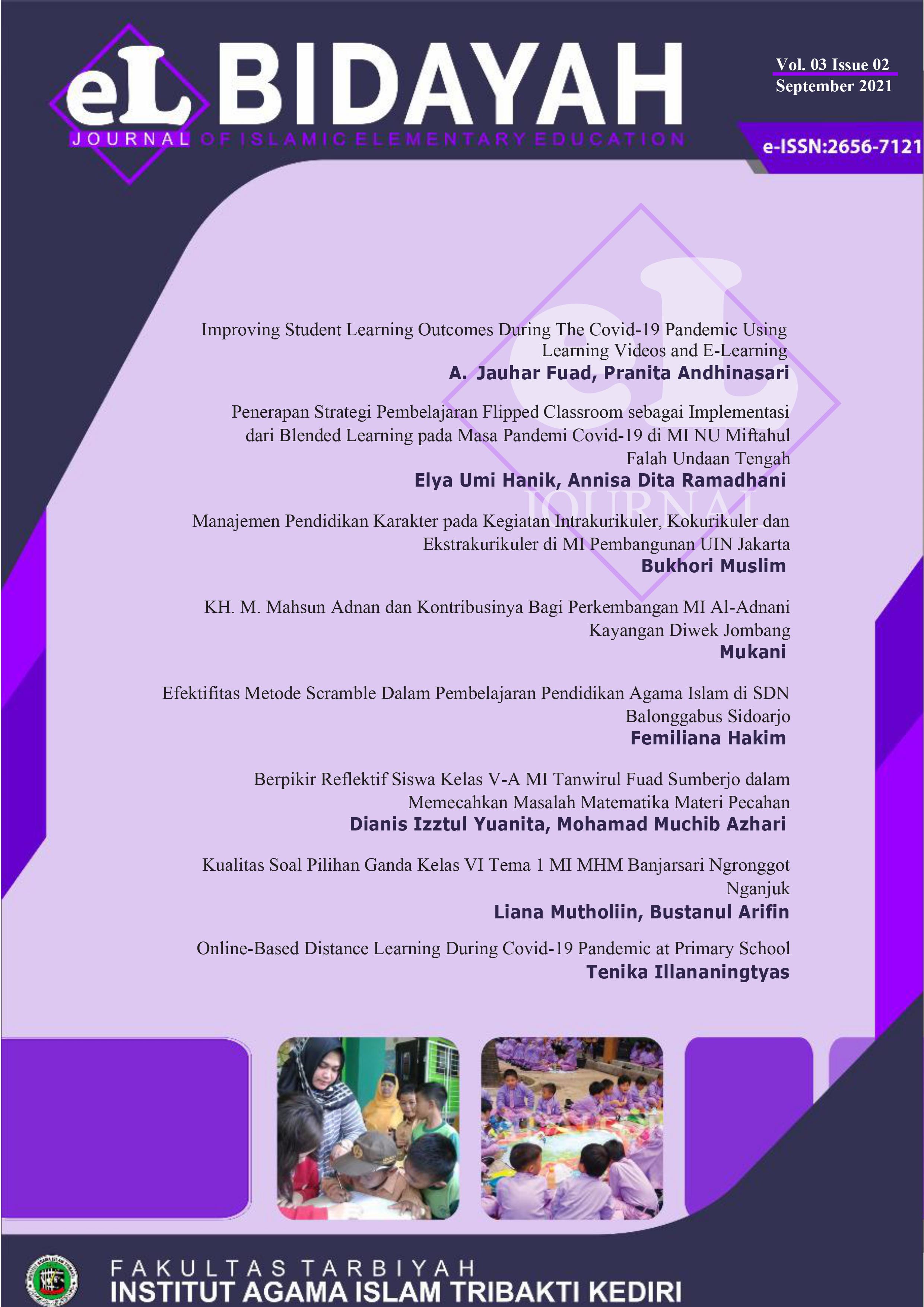
Improving Student Learning Outcomes During The Covid-19 Pandemic Using Learning Videos and E-Learning
DOI:
https://doi.org/10.33367/jiee.v3i2.1876Keywords:
Learning Outcomes, Covid 19 Pandemic, Learning Videos and E-LearningAbstract
The problem that arises in learning in the Covid-19 era is unilateral learning centered on teacher activities, by giving assignments. Students only work on assignments and then the work is photographed and sent via WhatsApp, causing students to lack understanding of the material and be reluctant to do assignments. The solution to the problems above is the use of video for learning and e-learning. This research phase begins with action planning, action implementation, observation, and reflection. This stage is repeated until the expected increase in learning outcomes is achieved, and does not require further improvement. The final result analysis showed that in the pre-learning cycle, the percentage of classical completeness was 27.28%. In the first cycle, there was an increase in classical completeness reaching 54.5%. In the second cycle, there was an increase in classical completeness reaching 91%. Thus, it can be concluded that the use of video for learning and e-learning during the COVID-19 pandemic is able to improve student learning outcomes.
References
Abidin, Zainul. “Penerapan Pemilihan Media Pembelajaran.†Edcomtech Jurnal Kajian Teknologi Pendidi-kan 1, no. 1 (November 8, 2017): 9–20.
Andrianto, Andrianto. “The Role Of Audio Visual Media In Increasing Interst In Learning Islamic Religious Education In Sdn Teloko.†Abdau: Jurnal Pendidikan Madrasah Ibtidaiyah 4, no. 1 (July 1, 2021): 71–91. https://doi.org/10.36768/abdau.v4i1.177
Apriyanti, Eka. “Peningkatan Motivasi Belajar Siswa Dalam Pembe-lajaran Pkn Menggunakan Media Audiovisual Kelas IV.†Jurnal Pendidikan Dan Pembelajaran Khatulistiwa 6, no. 3 (March 21, 2017) https://jurnal.untan.ac.id/index.php/jpdpb/article/view/19182.
Baharuddin, Ilham. “Pembelajaran Bermakna Berbasis Daring Di Tengah Pandemi COVID-19.†Kelola: Journal of Islamic Education Management 5, no. 2 (November 16, 2020): 79–88. https://doi.org/10.24256/kelola.v5i2.1377.
Damayanti, Putri Oktavia. “Efektivitas Media Video Berbasis Powerpoint Dalam Pembelajaran Daring Ter-hadap Hasil Belajar Tema 7 Sub-tema 3 Di Kelas IV B MINU Ngingas Waru Sidoarjo.†Undergraduate, UIN Sunan Ampel Surabaya, 2021. http://digilib.uinsby.ac.id/48170/
Fuad, A. Jauhar. “Domain Pemanfatan Teknologi Pembelajaran Di Masa Pandemik Covid-19 Pada Pendidikan Agama Islam.†Prosiding Muktamar Pemikiran Dosen PMII 1, no. 1 (July 27, 2021): 763–76.
Fuad, A. Jauhar, and Sandi Susilo. “Analisis Penggunaan Media Online Dalam Pembelajaran Di Masa Pandemi Covid-19 Di MAN 1 Kota Kediri.†Seminar Nasional Teknologi Pembelajaran 1, no. 1 (August 5, 2021): 58–70.
Gusty, Sri, Nurmiati Nurmiati, Muliana Muliana, Oris Krianto Sulaiman, Ni Luh Wiwik Sri Rahayu Ginantra, Melda Agnes Manuhutu, Andri-asan Sudarso, et al. Belajar Mandiri: Pembelajaran Daring di Tengah Pandemi Covid-19. Yayasan Kita Menulis, 2020.
Ibrahim, Doni Septumarsa, and Siti Partini Suardiman. “Pengaruh Penggunaan E-Learning Terhadap Motivasi Dan Prestasi Belajar Matematika Siswa Sd Negeri Tahunan Yogyakarta.†Jurnal Prima Edukasia 2, no. 1 (January 1, 2014): 66–79. https://doi.org/10.21831/jpe.v2i1.2645.
Muhammad Rusli, Dadang Hermawan, and Ni Nyoman Supuwiningsih. Memahami E-learning: Konsep, Teknologi, dan Arah Perkembangan. Penerbit Andi, 2020.
Novisya, Dira, and Festiyed Festiyed. “Meta Analisis Video Pembe-lajaran Dalam Menghadapi Tantangan Pendidikan Di Era Revolusi Industri 4.0.†Jurnal Penelitian Pembelajaran Fisika 5, no. 1 (December 21, 2019). https://doi.org/10.24036/jppf.v5i1.107421.
Nugraha, Sobron Adi, Titik Sudiatmi, and Meidawati Suswandari. “Studi Pengaruh Daring Learning Terhadap Hasil Belajar Mate-matika Kelas IV.†Jurnal Inovasi Penelitian 1, no. 3 (July 24, 2020): 265–76. https://doi.org/10.47492/jip.v1i3.74.
Nugroho, Dimas, and Yudha Nurdian. “Pemicuan Pendidikan Kecakapan Hidup Anak Era Pandemi di Sumbersari Jember.†GERVASI: Jurnal Pengabdian kepada Masyarakat 5, no. 1 (May 2, 2021): 13–24. https://doi.org/10.31571/gervasi.v5i1.1955.
Pohan, Albert Efendi. Konsep Pembe-lajaran Daring Berbasis Pendekatan Ilmiah. Riau: Penerbit CV. Sarmu Untung, 2020.
Raniah, Atalah, Jefiska Roman Prantista, Dwi Pangestuti Alfiana, Sangga Firman Aghisni, and Eva Luthfi Fakhru Ahsani. “Dampak Pandemi Terhadap Pemanfaatan E-Learning Pada Sekolah Dasar Di Den Haag.†Islamic Review: Jurnal Riset Dan Kajian Keislaman 10, no. 1 (April 26, 2021): 111–24. https://doi.org/10.35878/islamicreview.v10i1.251.
Rigianti, Henry Aditia. “Kendala Pembelajaran Daring Guru Sekolah Dasar Di Banjarnegara.†Elementary School: Jurnal Pendidikan Dan Pembelajaran Ke-SD-An 7, no. 2 (July 1, 2020). https://doi.org/10.31316/esjurnal.v7i2.768.
Setyorini, In. “Pandemi COVID-19 Dan Online Learning: Apakah Berpengaruh Terhadap Proses Pembelajaran Pada Kurikulum 13?†Journal of Industrial Engineering & Management Research 1, no. 1 (July 5, 2020): 95–102. https://doi.org/10.7777/jiemar.v1i1.31.
Sihombing, Susi, Hizkia Ronaldus Silalahi, Jonas Ramza Sitinjak, and Hardi Tambunan. “Analisis Minat Dan Motivasi Belajar, Pemahaman Konsep Dan Kreativitas Siswa Terhadap Hasil Belajar Selama Pembelajaran Dalam Jaringan.†Jurnal Pendidikan Matematika:Judika Education 4, no. 1 (June 27, 2021): 41–55. https://doi.org/10.31539/judika.v4i1.2061.
Sukanto, Didik. “Pembelajaran Jarak Jauh dengan Media E-learning sebagai Solusi Pembelajaran pada Masa Pandemi Coronavirus Disease 2019 (Covid-19).†Syntax Idea 2, no. 11 (November 20, 2020): 834–50. https://doi.org/10.36418/syntax-idea.v2i11.679.
Sukmadewi, Ni Putu Rika. “Problem-Based Learning (Konsep Ideal Model Pembelajaran dalam Peningkatan Mutu Prestasi Belajar dan Motivasi Berprestasi Masa Pandemi Covid 19).†PINTU: Jurnal Penjaminan Mutu 1, no. 1 (June 22, 2021). http://jurnal.stahnmpukuturan.ac.id/index.php/jurnalmutu/article/view/1326.
Susmiati, Eri. “Meningkatkan Motivasi Belajar Bahasa Indonesia Melalui Penerapan Model Discovery Learning Dan Media Video Dalam Kondisi Pandemi Covid-19 Bagi Siswa SMPN 2 Gangga.†Jurnal Paedagogy 7, no. 3 (August 13, 2020): 210–15. https://doi.org/10.33394/jp.v7i3.2732.
 Abstract
Views:
371,
Abstract
Views:
371,  PDF downloads: 249
Published
Issue
Section
License
License and Copyright Agreement
In submitting the manuscript to the journal, the authors certify that:
- They are authorized by their co-authors to enter into these arrangements.
- The work described has not been formally published before, except in the form of an abstract or as part of a published lecture, review, thesis, or overlay journal.
- That it is not under consideration for publication elsewhere,
- That its publication has been approved by all the author(s) and by the responsible authorities – tacitly or explicitly – of the institutes where the work has been carried out.
- They secure the right to reproduce any material that has already been published or copyrighted elsewhere.
- They agree to the following license and copyright agreement.
Copyright
Authors who publish with El Bidayah:Journal of Islamic Elementary Education agree to the following terms:
- Authors retain copyright and grant the journal the right of first publication with the work simultaneously licensed under a Creative Commons Attribution License (CC BY-SA 4.0) that allows others to share the work with an acknowledgement of the work's authorship and initial publication in this journal.
- Authors are able to enter into separate, additional contractual arrangements for the non-exclusive distribution of the journal's published version of the work (e.g., post it to an institutional repository or publish it in a book), with an acknowledgment of its initial publication in this journal.
- Authors are permitted and encouraged to post their work online (e.g., in institutional repositories or on their website) before and during the submission process, as it can lead to productive exchanges, as well as earlier and greater citation of published work.
Licensing for Data Publication
El Bidayah: Journal of Islamic Elementary Education uses a variety of waivers and licenses, that are specifically designed for and appropriate for the treatment of data:
- Open Data Commons Attribution License, http://www.opendatacommons.org/licenses/by/1.0/ (default)
- Creative Commons CC-Zero Waiver, http://creativecommons.org/publicdomain/zero/1.0/
- Open Data Commons Public Domain Dedication and Licence, http://www.opendatacommons.org/licenses/pddl/1-0/
Other data publishing licenses may be allowed as exceptions (subject to approval by the editor on a case-by-case basis) and should be justified with a written statement from the author, which will be published with the article.
Open Data and Software Publishing and Sharing
The journal strives to maximize the replicability of the research published in it. Authors are thus required to share all data, code, or protocols underlying the research reported in their articles. Exceptions are permitted but have to be justified in a written public statement accompanying the article.
Datasets and software should be deposited and permanently archived in appropriate, trusted, general, or domain-specific repositories (please consult http://service.re3data.org and/or software repositories such as GitHub, GitLab, Bioinformatics.org, or equivalent). The associated persistent identifiers (e.g. DOI, or others) of the dataset(s) must be included in the data or software resources section of the article. Reference(s) to datasets and software should also be included in the reference list of the article with DOIs (where available). Where no domain-specific data repository exists, authors should deposit their datasets in a general repository such as ZENODO, Dryad, Dataverse, or others.
Small data may also be published as data files or packages supplementary to a research article, however, the authors should prefer in all cases a deposition in data repositories.

This work is licensed under a Creative Commons Attribution-ShareAlike 4.0 International License.