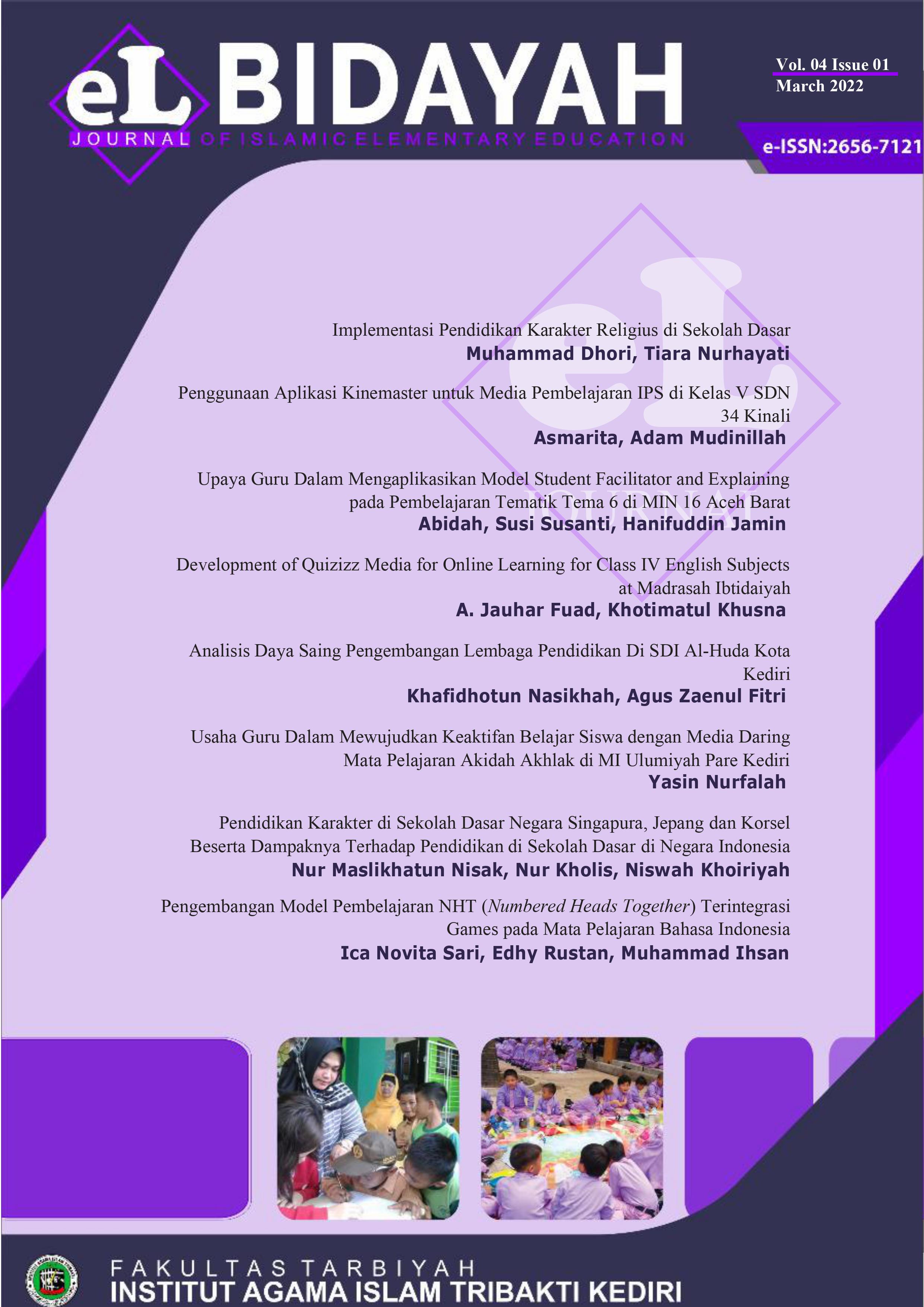
Development of Quizizz Media for Online Learning for Class IV English Subjects at Madrasah Ibtidaiyah
DOI:
https://doi.org/10.33367/jiee.v4i1.2371Keywords:
Learning Media Development, Quizizz, English Online LearningAbstract
This study aims to determine the feasibility of the media based on the responses of material experts and media experts, as well as to determine student responses to the use of Quizizz media in online learning of English subjects at MI Darul Huda Deyeng. The research method used is a type of Research and Development (R&D) by adapting the Dick and Carrey development model. The test subjects in this study were fourth-grade students of MI Darul Huda Deyeng. The data collection instrument used is a questionnaire (questionnaire). The technique used in data collection is a questionnaire with a Likert scale. Analysis of the data used is descriptive analysis. The results of the research conducted, show that the Quizizz media in online learning of class IV English subjects at MI Darul Huda Deyeng which has been developed based on the assessment responses from material experts has obtained a feasibility percentage of 80% and is included in the appropriate category, based on the assessment responses by media experts, it is obtained The percentage of eligibility is 82.66% which is included in the very feasible category, while student responses to the Quizizz media developed get a percentage of 82.82% included in the very feasible category.
References
Agustien, Relis, Nurul Umamah, dan S. Sumarno. “Pengembangan Media Pembelajaran Video Animasi Dua Dimensi Situs Pekauman Di Bondowoso Dengan Model Addie Mata Pelajaran Sejarah Kelas X IPS.†Jurnal Edukasi 5, no. 1 (9 Juli 2018): 19–23. https://doi.org/10.19184/jukasi.v5i1.8010.
Aini, Yulia Isratul. “Pemanfaatan Media Pembelajaran Quizizz Untuk Pembelajaran Jenjang Pendidikan Dasar Dan Menengah Di Bengkulu.†Kependidikan 2, no. 25 (2019). http://jurnal.umb.ac.id/index.php/kependidikan/article/view/567.
Arif, Jira Rastal, Aiman Faiz, dan Lidiya Septiani. “Penggunaan Media Quiziz Sebagai Sarana Pengembangan Berpikir Kritis Siswa.†EDUKATIF : JURNAL ILMU PENDIDIKAN 4, no. 1 (2022): 201–10. https://doi.org/10.31004/edukatif.v4i1.1804.
Biesta, Gert. Educational Research: An Unorthodox Introduction. Bloomsbury Publishing, 2020.
Dick, Walter, Lou Carey, dan James O. Carey. The Systematic Design of Instruction. Pearson, 2014.
Fitriyah, Fitriyah. “Peningkatan Kualitas Pembelajaran Daring Pada Masa Pandemik Melalui Penggunaan Aplikasi Google Classroom Di SDN Sudimoro Kecamatan Tulangan Sidoarjo.†Educatif Journal of Education Research 3, no. 2 (10 Maret 2021): 97–101. https://doi.org/10.36653/educatif.v3i2.71.
Fuad, A. Jauhar, dan Pranita Andhinasari. “Improving Student Learning Outcomes During The Covid-19 Pandemic Using Learning Videos and E-Learning.†EL Bidayah: Journal of Islamic Elementary Education 3, no. 2 (30 September 2021): 102–14. https://doi.org/10.33367/jiee.v3i2.1876.
Fuad, A. Jauhar, dan Sandi Susilo. “Analisis Penggunaan Media Online Dalam Pembelajaran Di Masa Pandemi Covid-19 Di MAN 1 Kota Kediri.†Seminar Nasional Teknologi Pembelajaran 1, no. 1 (5 Agustus 2021): 58–70.
Haddar, Gamar Al, dan Maulana Adam Juliano. “Analisis Media Pembelajaran Quizizz Dalam Pembelajaran Daring Pada Siswa Tingkat Sekolah Dasar.†EDUKATIF : JURNAL ILMU PENDIDIKAN 3, no. 6 (18 Oktober 2021): 4794–4801. https://doi.org/10.31004/edukatif.v3i6.1512.
Heriawan, I. Gede Teguh, dan Putu Ida Arsani Dewi. “Efektivitas Pembelajaran Daring Dalam Meningkatkan Keaktifan Siswa Melalui Media Pembelajaran Quizizz Di Kaum Pelajar Masa Kini.†PINTU: Jurnal Penjaminan Mutu 2, no. 2 (27 Oktober 2021). http://jurnal.stahnmpukuturan.ac.id/index.php/jurnalmutu/article/view/1685.
Hidayati, Issrina Dwika, dan Aslam Aslam. “Efektivitas Media Pembelajaran Aplikasi Quizizz Secara Daring Terhadap Perkembangan Kognitif Siswa.†Jurnal Pedagogi Dan Pembelajaran 4, no. 2 (17 Agustus 2021): 251–57. https://doi.org/10.23887/jp2.v4i2.37038.
Imani, M. Naqqi, Rizka Oktaviyanti, dan Vicky Akhlan Romdhoni. “Inovasi Media Pembelajaran Linktree Dan Evaluasi Quizizz Pada Materi Sistem Peredaran Darah Manusia Kelas VIII SMP.†PISCES : Proceeding of Integrative Science Education Seminar 1, no. 1 (22 Desember 2021): 222–31.
Juliyanti, Nuria Ulfa Eka, Chindy Hanggara Rosa Indah, dan Munawwir Hadiwijaya. “Pengembangan Media Pembelajaran Menggunakan Aplikasi Quizizz Pada Implementasi Ulangan Harian Siswa XI-A SMAN 1 Waru-Pamekasan.†Prosiding Seminar Nasional Sastra, Lingua, Dan Pembelajarannya (Salinga) 1, no. 1 (26 Oktober 2021): 145–51.
Kristanto, Bagas Prima, dan Tri Nova Hasti Yunianta. “Development of Media Evaluation of Mathematics Learning Based Applications Quizizz with Problems PISA Content Quantity.†Edumatica : Jurnal Pendidikan Matematika 11, no. 02 (30 Agustus 2021): 64–72. https://doi.org/10.22437/edumatica.v11i02.12449.
Kurnia, Lani Dwi, Sri Haryati, dan Roza Linda. “Pengembangan Instrumen Evaluasi Higher Order Thinking Skills Menggunakan Quizizz Pada Materi Termokimia untuk Meningkatkan Kemampuan Berpikir Tingkat Tinggi Peserta Didik.†Jurnal Pendidikan Sains Indonesia 10, no. 1 (19 Januari 2022): 176–90. https://doi.org/10.24815/jpsi.v10i1.21727.
Magdalena, Ina, Azza Salsabila, Diah Ajeng Krianasari, dan Shabira Fairuza Apsarini. “Implementasi Model Pembelajaran Daring Pada Masa Pandemi Covid-19 Di Kelas III SDN Sindangsari III.†PANDAWA 3, no. 1 (31 Januari 2021): 119–28. https://doi.org/10.36088/pandawa.v3i1.1005.
Muzakki, Hawwin, Restu Yulia Hidayatul Umah, dan Khoirul Mudawinun Nisa’. “Teori Belajar Konstruktivisme Maria Montessori Dan Penerapannya Di Masa Pandemi Covid-19.†Ibriez : Jurnal Kependidikan Dasar Islam Berbasis Sains 6, no. 2 (16 Desember 2021): 241–62. https://doi.org/10.21154/ibriez.v6i2.164.
Nurfadhillah, Septy, Annisa Rachmadani, Cintana Shafa Salsabila, Dea Oktaviani Yoranda, Destri Savira, dan Siti Nurani Oktaviani. “Pengembangan Media Pembelajaran Interaktif Berbasis Android Melalui Aplikasi Quiziz Pada Pelajaran Matematika VI SDN Karang Tengah 06.†PENSA 3, no. 2 (30 Agustus 2021): 280–96. https://doi.org/10.36088/pensa.v3i2.1359.
Purba, Leony Sanga Lamsari. “Peningkatan Konsentrasi Belajar Mahasiswa Melalui Pemanfaatan Evaluasi Pembelajaran Quizizz Pada Mata Kuliah Kimia Fisika I.†Jurnal Dinamika Pendidikan 12, no. 1 (2019): 29–39.
Rohmah, Nafilatur. “Media Pembelajaran Masa Kini: Aplikasi Pembuatan Dan Kegunaannya.†Awwaliyah: Jurnal Pendidikan Guru Madrasah Ibtidaiyah 4, no. 2 (17 Desember 2021): 127–32.
Siska, Jumiati, dan Muhammad Kristiawan. “Pengembangan Modul Pembelajaran Terhadap Hasil Belajar Mata Pelajaran Aqidah Di Sekolah Dasar.†Jurnal Basicedu 5, no. 6 (14 Oktober 2021): 5035–42. https://doi.org/10.31004/basicedu.v5i6.1570.
Swarniti, Ni Wayan. “Efektivitas Penggunaan Aplikasi Quizizz Dalam Proses Pembelajaran Bahasa Inggris Bagi Mahasiswa.†Seminar Nasional Teknologi Pembelajaran 1, no. 1 (7 Agustus 2021): 133–44.
Widiyanti, Ifa Seftia Rakhma, dan Saeful Mizan. “Validasi Buku Penilaian Berbasis Literasi Sains (Bupena Berisi) Untuk Calon Guru Sekolah Dasar.†Autentik : Jurnal Pengembangan Pendidikan Dasar 5, no. 1 (2 Februari 2021): 21–32. https://doi.org/10.36379/autentik.v5i1.100.
Yusuf, A. Muri. Metode Penelitian Kuantitatif, Kualitatif & Penelitian Gabungan. Prenada Media, 2016.
 Abstract
Views:
269,
Abstract
Views:
269,  PDF downloads: 159
Published
Issue
Section
License
License and Copyright Agreement
In submitting the manuscript to the journal, the authors certify that:
- They are authorized by their co-authors to enter into these arrangements.
- The work described has not been formally published before, except in the form of an abstract or as part of a published lecture, review, thesis, or overlay journal.
- That it is not under consideration for publication elsewhere,
- That its publication has been approved by all the author(s) and by the responsible authorities – tacitly or explicitly – of the institutes where the work has been carried out.
- They secure the right to reproduce any material that has already been published or copyrighted elsewhere.
- They agree to the following license and copyright agreement.
Copyright
Authors who publish with El Bidayah:Journal of Islamic Elementary Education agree to the following terms:
- Authors retain copyright and grant the journal the right of first publication with the work simultaneously licensed under a Creative Commons Attribution License (CC BY-SA 4.0) that allows others to share the work with an acknowledgement of the work's authorship and initial publication in this journal.
- Authors are able to enter into separate, additional contractual arrangements for the non-exclusive distribution of the journal's published version of the work (e.g., post it to an institutional repository or publish it in a book), with an acknowledgment of its initial publication in this journal.
- Authors are permitted and encouraged to post their work online (e.g., in institutional repositories or on their website) before and during the submission process, as it can lead to productive exchanges, as well as earlier and greater citation of published work.
Licensing for Data Publication
El Bidayah: Journal of Islamic Elementary Education uses a variety of waivers and licenses, that are specifically designed for and appropriate for the treatment of data:
- Open Data Commons Attribution License, http://www.opendatacommons.org/licenses/by/1.0/ (default)
- Creative Commons CC-Zero Waiver, http://creativecommons.org/publicdomain/zero/1.0/
- Open Data Commons Public Domain Dedication and Licence, http://www.opendatacommons.org/licenses/pddl/1-0/
Other data publishing licenses may be allowed as exceptions (subject to approval by the editor on a case-by-case basis) and should be justified with a written statement from the author, which will be published with the article.
Open Data and Software Publishing and Sharing
The journal strives to maximize the replicability of the research published in it. Authors are thus required to share all data, code, or protocols underlying the research reported in their articles. Exceptions are permitted but have to be justified in a written public statement accompanying the article.
Datasets and software should be deposited and permanently archived in appropriate, trusted, general, or domain-specific repositories (please consult http://service.re3data.org and/or software repositories such as GitHub, GitLab, Bioinformatics.org, or equivalent). The associated persistent identifiers (e.g. DOI, or others) of the dataset(s) must be included in the data or software resources section of the article. Reference(s) to datasets and software should also be included in the reference list of the article with DOIs (where available). Where no domain-specific data repository exists, authors should deposit their datasets in a general repository such as ZENODO, Dryad, Dataverse, or others.
Small data may also be published as data files or packages supplementary to a research article, however, the authors should prefer in all cases a deposition in data repositories.

This work is licensed under a Creative Commons Attribution-ShareAlike 4.0 International License.