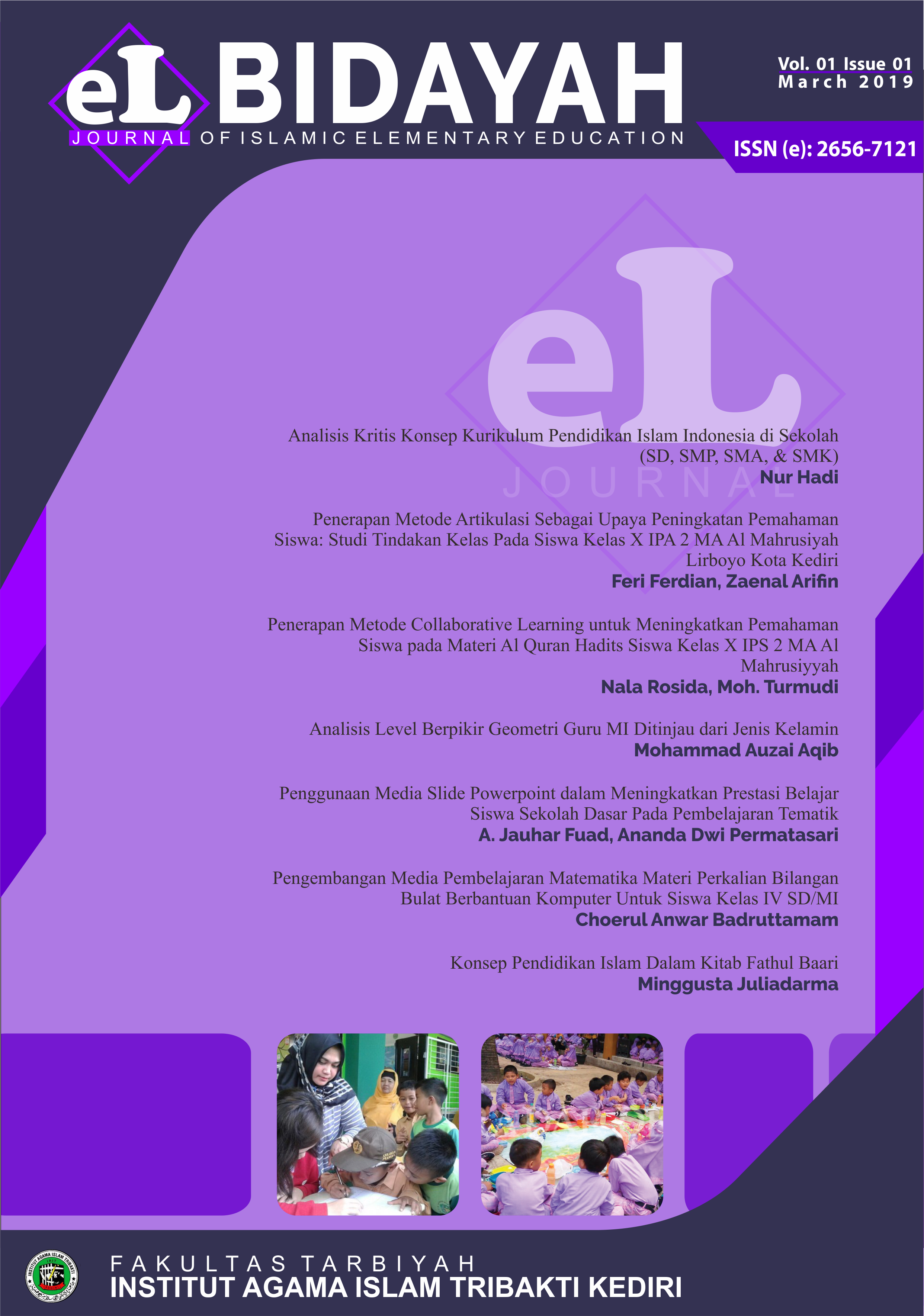
Penggunaan Media Slide Powerpoint dalam Meningkatkan Prestasi Belajar Siswa Sekolah Dasar Pada Pembelajaran Tematik
DOI:
https://doi.org/10.33367/jiee.v1i1.683Keywords:
Thematic Learning, Power Point Media, Learning AchievementAbstract
The purpose of this study was to improve the quality of learning and learning achievement of grade IV students in my Heroes' Theme using PowerPoint slide media. This research was conducted in two cycles. Where in each cycle has stages that start from doing planning, action, observation and reflection. The results of the study: (1) through the application of PowerPoint slide media can improve the quality of learning; (2) the use of PowerPoint slide media can improve learning achievement 'pahlawanku' Theme in grade IV of SDN Sanan 1. The average value of the class before being subjected to action is 62, in cycle 1 it increases to 71 and in cycle II to 80. The number of students completing study at pre-action as many as 5 students or equal to 35.7%, in the first cycle increased to 9 students or equal to 64.3%, and in the second cycle to 12 students or by 85.7%. The advice given is that the teacher should use innovative models and varied media in learning.
References
Apperson, Jennifer M., Eric L. Laws, and James A. Scepansky. “An Assessment of Student Preferences for PowerPoint Presentation Structure in Undergraduate Courses.” Computers & Education50, no. 1 (January 1, 2008): 148–53. https://doi.org/10.1016/j.compedu.2006.04.003.
Arsyad, Azhar. Media Pembelajaran. Jakarta: PT. Raja Grafindo Persada, 2003.
Badri, Nur, and Berliana Kusuma Riasti. “Pembuatan Media Pembelajaran Interaktif Pada SMK Negeri Tiga Jepara Dengan Materi Power Point 2007.” Speed -Sentra Penelitian Engineering Dan Edukasi4, no. 1 (July 14, 2011). http://portal.ejurnal.net/index.php/speed/article/view/849.
Bartsch, Robert A, and Kristi M Cobern. “Effectiveness of PowerPoint Presentations in Lectures.” Computers & Education41, no. 1 (August 1, 2003): 77–86. https://doi.org/10.1016/S0360-1315(03)00027-7.
Burton, Kelley J. “Interactive Powerpoints: Is There Any Point in Giving Power to Students?” ELaw Journal11 (December 2004). https://eprints.qut.edu.au/12052/.
Carmichael, Stephen W., and Wojciech Pawlina. “Animated PowerPoint as a Tool to Teach Anatomy.” The Anatomical Record261, no. 2 (April 15, 2000): 83–88. https://doi.org/10.1002/(SICI)1097-0185(20000415)261:2<83::AID-AR8>3.0.CO;2-D.
Djamarah, Syaiful Bahri. Psikologi Belajar. Jakarta: Rineka Cipta, 2002.
Elpira, Nira, and Anik Ghufron. “Pengaruh Penggunaan Media Powerpoint Terhadap Minat Dan Hasil Belajar IPA Siswa Kelas IV SD.” Jurnal Inovasi Teknologi Pendidikan2, no. 1 (April 30, 2015): 94–104. https://doi.org/10.21831/tp.v2i1.5207.
Endarmoko, Eko. Tesaurus bahasa Indonesia. Jakarta: Gramedia Pustaka Utama, 2007.
Fuad, A. Jauhar. Media Dan Teknologi Pembelajaran. Kediri: IAIT, 2010.
Fuad, A. Jauhar, and Hamam. Teori Dan Praktik Penelitian Tindakan Kelas (PTK). Tulungagung: STAIN Tulungagung, 2012.
Fuad, A. Jauhar, and Manu Winarsih. “Peningkatan Prestasi Belajar Dengan Metode Bermain Peran Pada Tema Kegiatan Jual Beli.” Ed-Humanistics : Jurnal Ilmu Pendidikan3, no. 1 (April 25, 2018). http://ejournal.unhasy.ac.id/index.php/ed-humanistics/article/view/251.
Holzl, J. “Twelve Tips for Effective PowerPoint Presentations for the Technologically Challenged.” Medical Teacher19, no. 3 (January 1, 1997): 175–79. https://doi.org/10.3109/01421599709019377.
Kristiantari, Mg Rini. “Analisis Kesiapan Guru Sekolah Dasar Dalam Mengimplementasikan Pembelajaran Tematik Integratif Menyongsong Kurikulum 2013.” JPI (Jurnal Pendidikan Indonesia)3, no. 2 (January 5, 2015). https://doi.org/10.23887/jpi-undiksha.v3i2.4462.
Lai, Yen-Shou, Hung-Hsu Tsai, and Pao-Ta Yu. “Integrating Annotations into a Dual-Slide PowerPoint Presentation for Classroom Learning.” Journal of Educational Technology & Society14, no. 2 (2011): 43–57.
Levasseur, David G., and J. Kanan Sawyer. “Pedagogy Meets PowerPoint: A Research Review of the Effects of Computer-Generated Slides in the Classroom.” The Review of Communication, August 19, 2006. https://doi.org/10.1080/15358590600763383.
Mulyani, Dessy. “Hubungan Kesiapan Belajar Siswa Dengan Prestasi Belajar.” Konselor2, no. 1 (January 1, 2013). https://doi.org/10.24036/0201321729-0-00.
Murtikusuma, Randi Pratama. “Pengembangan Perangkat Pembelajaran Matematika Model Problem-Based Learning Berbantuan Media Powerpoint Untuk Siswa Kelas XI SMK Materi Barisan Dan Deret.” Saintifika17, no. 2 (2015). https://jurnal.unej.ac.id/index.php/STF/article/view/2733.
Nurhidayat, Oki. “Perbandingan Media Power Point Dengan Flip Chart Dalam Meningkatkan Pengetahuankesehatan Gigi Dan Mulut.” Unnes Journal of Public Health1, no. 1 (2012). https://doi.org/10.15294/ujph.v1i1.179.
Nurlatifah, Anissyafa’at. “Pengembangan Media Pembelajaran Ipa Berbasis Microsoft Office Power Point Interaktif Pada Siswa Kelas IV SD Negeri Ngrukeman Kasihan Bantul.” Jurnal PGSD Indonesia1, no. 2 (January 8, 2015). http://ojs.upy.ac.id/ojs/index.php/JPGSDI/article/view/299.
Penciner, Rick. “Does PowerPoint Enhance Learning?” Canadian Journal of Emergency Medicine15, no. 2 (March 2013): 109–12.https://doi.org/10.2310/8000.2013.130756.
Prastowo, Andi. Menyusun Rencana Pelaksanaan Pembelajaran (RPP) Tematik Terpadu. Jakarta: Kencana, 2017. https://books.google.com/books/about/Menyusun_Rencana_Pelaksanaan_Pembelajara.html?id=_JBBDwAAQBAJ.
Siagian, Roida Eva Flora. “Pengaruh Minat Dan Kebiasaan Belajar Siswa Terrhadap Prestasi Belajar Matematika.” Formatif: Jurnal Ilmiah Pendidikan MIPA2, no. 2 (August 5, 2015). https://doi.org/10.30998/formatif.v2i2.93.
Slameto. Belajar Dan Faktor-Faktor Yang Mempengaruhinya. Jakarta: Rineka Cipta, 2003.
Stein, Karen. “The Dos and Don’ts of PowerPoint Presentations.” Journal of the American Dietetic Association106, no. 11 (November 1, 2006): 1745–48. https://doi.org/10.1016/j.jada.2006.09.029.
Sudjana, Nana, and Ahmad Rivai. Media Pengajaran. Bandung: Sinar Baru Algensindo, 2009.
Sukarsa, I. Wayan, Nyoman Dantes, and Ni Wayan Arini. “Penerapan Model Pembelajaran Kuantum Berbantuan Media Microsoft Powerpoint Untuk Meningkatkan Aktivitas Dan Hasil Belajar IpaSiswa Kelas IV Semester 1 SD Negeri 6 Menanga.” MIMBAR PGSD Undiksha2, no. 1 (March 3, 2014). https://ejournal.undiksha.ac.id/index.php/JJPGSD/article/view/2555.
Sungkono, Sungkono. “Pembelajaran Tematik Dan Implementasinya Di Sekolah Dasar.” Majalah Ilmiah Pembelajaran2, no. 1 (May 10, 2006). https://journal.uny.ac.id/index.php/mip/article/view/7113.
Suryanto, Mardian. Penggunaan Power Point Untuk Meningkatkan Aktivitas Dan Hasil Belajar Pada Pembelajaran IPS. Lampung: Fakultas Keguruan dan Ilmu Pendidikan, 2013.
Utari, Unga, I. Nyoman Sudana Degeng, and Sa’dun Akbar. “Pembelajaran Tematik Berbasis Kearifan Lokal Di Sekolah Dasar Dalam Menghadapi Masyarakat Ekonomi Asean (MEA).” Jurnal Teori Dan Praksis Pembelajaran IPS1, no. 1 (April 30, 2016): 39–44. https://doi.org/10.17977/jtp2ips.v1i1.5861.
Wangid, Muhammad Nur, Ali Mustadi, Vera Yuli Erviana, and Slamet Arifin. “Kesiapan Guru SD dalam Pelaksanaan Pembelajaran Tematik-Integratif Pada Kurikulum 2013 di DIY.” Jurnal Prima Edukasia2, no. 2 (July 1, 2014): 175–82. https://doi.org/10.21831/jpe.v2i2.2717.
 Abstract
Views:
1070,
Abstract
Views:
1070,  PDF downloads: 944
Published
Issue
Section
License
License and Copyright Agreement
In submitting the manuscript to the journal, the authors certify that:
- They are authorized by their co-authors to enter into these arrangements.
- The work described has not been formally published before, except in the form of an abstract or as part of a published lecture, review, thesis, or overlay journal.
- That it is not under consideration for publication elsewhere,
- That its publication has been approved by all the author(s) and by the responsible authorities – tacitly or explicitly – of the institutes where the work has been carried out.
- They secure the right to reproduce any material that has already been published or copyrighted elsewhere.
- They agree to the following license and copyright agreement.
Copyright
Authors who publish with El Bidayah:Journal of Islamic Elementary Education agree to the following terms:
- Authors retain copyright and grant the journal the right of first publication with the work simultaneously licensed under a Creative Commons Attribution License (CC BY-SA 4.0) that allows others to share the work with an acknowledgement of the work's authorship and initial publication in this journal.
- Authors are able to enter into separate, additional contractual arrangements for the non-exclusive distribution of the journal's published version of the work (e.g., post it to an institutional repository or publish it in a book), with an acknowledgment of its initial publication in this journal.
- Authors are permitted and encouraged to post their work online (e.g., in institutional repositories or on their website) before and during the submission process, as it can lead to productive exchanges, as well as earlier and greater citation of published work.
Licensing for Data Publication
El Bidayah: Journal of Islamic Elementary Education uses a variety of waivers and licenses, that are specifically designed for and appropriate for the treatment of data:
- Open Data Commons Attribution License, http://www.opendatacommons.org/licenses/by/1.0/ (default)
- Creative Commons CC-Zero Waiver, http://creativecommons.org/publicdomain/zero/1.0/
- Open Data Commons Public Domain Dedication and Licence, http://www.opendatacommons.org/licenses/pddl/1-0/
Other data publishing licenses may be allowed as exceptions (subject to approval by the editor on a case-by-case basis) and should be justified with a written statement from the author, which will be published with the article.
Open Data and Software Publishing and Sharing
The journal strives to maximize the replicability of the research published in it. Authors are thus required to share all data, code, or protocols underlying the research reported in their articles. Exceptions are permitted but have to be justified in a written public statement accompanying the article.
Datasets and software should be deposited and permanently archived in appropriate, trusted, general, or domain-specific repositories (please consult http://service.re3data.org and/or software repositories such as GitHub, GitLab, Bioinformatics.org, or equivalent). The associated persistent identifiers (e.g. DOI, or others) of the dataset(s) must be included in the data or software resources section of the article. Reference(s) to datasets and software should also be included in the reference list of the article with DOIs (where available). Where no domain-specific data repository exists, authors should deposit their datasets in a general repository such as ZENODO, Dryad, Dataverse, or others.
Small data may also be published as data files or packages supplementary to a research article, however, the authors should prefer in all cases a deposition in data repositories.

This work is licensed under a Creative Commons Attribution-ShareAlike 4.0 International License.