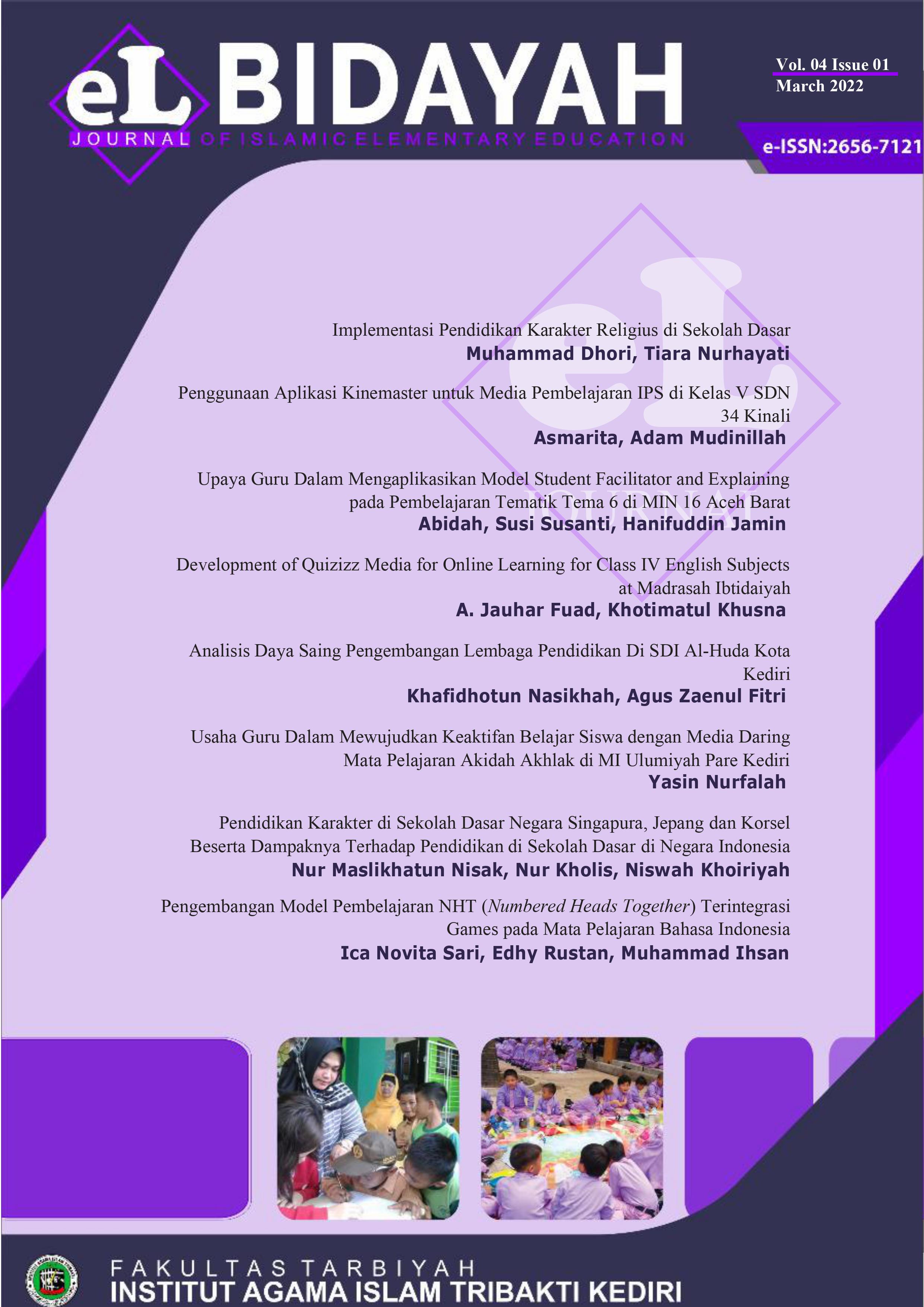
Usaha Guru Dalam Mewujudkan Keaktifan Belajar Siswa dengan Media Daring Mata Pelajaran Akidah Akhlak di MI Ulumiyah Pare Kediri
DOI:
https://doi.org/10.33367/jiee.v4i1.2406Keywords:
Teacher's Effort, Active Learning, PAKEM MethodAbstract
The COVID-19 pandemic has brought major changes to the teaching and learning process, including activating Madrasah Ibtidaiyah (MI) students in Akidah Akhlak subjects through bold media. So the researcher aims to analyze the efforts made by the teacher in realizing student learning activities in the Akidah Akhlak subject through the PAKEM method at MI Ulumiyah Tertek Pare Kediri, the application of the PAKEM method in learning Akidah Akhlak to realize student learning activities at MI Ulumiyah Semanding Tertek Pare Kediri, and The background that supports and hinders the efforts made by the teacher in realizing student learning activities in the Akidah Akhlak subject through the PAKEM method at MI Ulumiyah Semanding Tertek Pare Kediri. This type of research is qualitative, the data collection method uses observation, interviews/interviews, and documentation. The results of the study show that the teacher's efforts in realizing student learning activity in the moral aqidah subjects by applying PAKEM learning, namely, the intrinsic effort that is different and depends on each individual, while the extrinsic effort is to activate students in learning and create long-term memories in students. The application of PAKEM in learning includes differences in tools and media used because the learning process is carried out through courage, so students practice at home according to the general equipment in their respective homes. The background is a strong commitment, the creative attitude of the teacher, and a reliable managerial head of the madrasa.
References
Abadi, Hasan. Mencari sosok Guru Agama Islam Yang Ideal. Surabaya: Usaha Nasional, 2002.
Ali, Mohamad. Penelitian Kependidikan Prosedur & Strategi. Bandung: Angkasa, 1987.
Daryanto. Panduan Proses Pembelajaran Kreatif dan Inovatif. Jakarta: AV Publisher, 2009.
Djamarah, Syaiful Bahri, dan Aswan Zain. Strategi Belajar Mengajar. Jakarta: Rineka Cipta, 2010.
Hisyam, Zaini, Bermawy Munthe, dan Sekar Ayu. Strategi Pembelajaran Aktif. Yogyakarta: CTSD Sunan Kalijaga, 2007.
Jogiyanto. Filosofi, Pendekatan dan Penerapan Pembelajaran Metode Kasus. Yogyakarta: Andi Offset, 2007.
Meleong, Lexy J. “Metodologi Penelitian Kualitatif. Bandung: PT Remaja Rosdakarya, 2008, t.t.
Mulyasa, E. Manajemen Pendidikan Formal. Bandung: PT. Remaja Rosydakarya, 2003.
Panitia Sertifikasi Guru LPTK Rayon 206 IAIN Walisongo. Modul: Pendidikan dan Latihan Profesi Guru (PLPG) Kelompok Guru MI. Semarang: Kementrian Agama, 2012.
Rusman. Model-Model Pembelajaran. Jakarta: Raja Grafindo Persada, 2011.
Saminanto. Mengembangkan RPP Pembelajaran Aktif Inovatif Kreatif dan Menyenangkan (PAIKEM), EEK & Berkarakter. Semarang: RaSAIL Media Group, 2012.
Silberman, Mel. Active Learning 101 Strategi Pembelajaran Aktif. Yogyakarta: Yappendis, 2002.
Tim MKDK IKIP. MKDK IKIP. IKIP: Surabaya, 1995.
 Abstract
Views:
156,
Abstract
Views:
156,  PDF downloads: 148
Published
Issue
Section
License
License and Copyright Agreement
In submitting the manuscript to the journal, the authors certify that:
- They are authorized by their co-authors to enter into these arrangements.
- The work described has not been formally published before, except in the form of an abstract or as part of a published lecture, review, thesis, or overlay journal.
- That it is not under consideration for publication elsewhere,
- That its publication has been approved by all the author(s) and by the responsible authorities – tacitly or explicitly – of the institutes where the work has been carried out.
- They secure the right to reproduce any material that has already been published or copyrighted elsewhere.
- They agree to the following license and copyright agreement.
Copyright
Authors who publish with El Bidayah:Journal of Islamic Elementary Education agree to the following terms:
- Authors retain copyright and grant the journal the right of first publication with the work simultaneously licensed under a Creative Commons Attribution License (CC BY-SA 4.0) that allows others to share the work with an acknowledgement of the work's authorship and initial publication in this journal.
- Authors are able to enter into separate, additional contractual arrangements for the non-exclusive distribution of the journal's published version of the work (e.g., post it to an institutional repository or publish it in a book), with an acknowledgment of its initial publication in this journal.
- Authors are permitted and encouraged to post their work online (e.g., in institutional repositories or on their website) before and during the submission process, as it can lead to productive exchanges, as well as earlier and greater citation of published work.
Licensing for Data Publication
El Bidayah: Journal of Islamic Elementary Education uses a variety of waivers and licenses, that are specifically designed for and appropriate for the treatment of data:
- Open Data Commons Attribution License, http://www.opendatacommons.org/licenses/by/1.0/ (default)
- Creative Commons CC-Zero Waiver, http://creativecommons.org/publicdomain/zero/1.0/
- Open Data Commons Public Domain Dedication and Licence, http://www.opendatacommons.org/licenses/pddl/1-0/
Other data publishing licenses may be allowed as exceptions (subject to approval by the editor on a case-by-case basis) and should be justified with a written statement from the author, which will be published with the article.
Open Data and Software Publishing and Sharing
The journal strives to maximize the replicability of the research published in it. Authors are thus required to share all data, code, or protocols underlying the research reported in their articles. Exceptions are permitted but have to be justified in a written public statement accompanying the article.
Datasets and software should be deposited and permanently archived in appropriate, trusted, general, or domain-specific repositories (please consult http://service.re3data.org and/or software repositories such as GitHub, GitLab, Bioinformatics.org, or equivalent). The associated persistent identifiers (e.g. DOI, or others) of the dataset(s) must be included in the data or software resources section of the article. Reference(s) to datasets and software should also be included in the reference list of the article with DOIs (where available). Where no domain-specific data repository exists, authors should deposit their datasets in a general repository such as ZENODO, Dryad, Dataverse, or others.
Small data may also be published as data files or packages supplementary to a research article, however, the authors should prefer in all cases a deposition in data repositories.

This work is licensed under a Creative Commons Attribution-ShareAlike 4.0 International License.